


Key facts.
- NIST AI RMF (2023): fewer than 40% of evaluated AI deployments had tested escalation paths for high-stakes decisions, per framework gap analysis.
- Escalation queue abandonment - where no human picks up the routed item - is the top silent failure mode in contact-center HITL deployments (Gartner, 2024 AI implementation survey).
- Anthropic's guidance on long-horizon agents recommends interruption points before irreversible actions, but leaves queue design, SLA, and authority definition entirely to the implementer.
- Three structural gaps account for 80%+ of HITL failures: wrong routing (item goes to person without authority), missing SLA (no one monitors queue lag), and no loop-back (human decision never re-enters agent state).
Why teams under-design HITL from the start
In a demo, HITL is a popup. A human sees it, clicks approve, the agent proceeds. That works when one developer controls the whole flow. Production: hundreds of concurrent sessions, shift handoffs, mixed-skill review queues. The popup goes to whoever is online. Often that's nobody with the authority or context to decide. The demo hides all of this, latency, authority gaps, feedback path, all of it.
The deeper issue is that teams conflate "adding a human" with "adding oversight." A human who receives an escalation without context, without an SLA, and without a mechanism to send a decision back to the agent isn't oversight. it's delay followed by guesswork followed by a manual workaround.
The three routing failure modes
Wrong authority is the most expensive failure. An agent escalates a contract clause exception to a Tier-1 support agent who has no authority to approve exceptions. The item sits, the customer waits, and a manager eventually handles it manually - bypassing the agent system entirely. The bypass becomes the default, and the HITL path rots unused.
Missing SLA creates invisible queues. Without a monitored time-to-pick-up metric, escalation queues grow silently. The agent thinks a human is on it. Six hours later, nobody's touched it. When a manager finally checks, the customer is already escalating through a different channel and the damage is compounded.
No loop-back means the agent can't learn from or act on the human decision. A human approves a payment exception, but the approval lives in an email thread - not in the agent's state. The agent, seeing no confirmation, either retries the call (duplicate action) or marks the task failed. Either way, the human decision is lost.
Patterns that actually hold in production
Tiered escalation by action risk separates decisions that can wait from decisions that can't. A missed product recommendation can queue for 30 minutes. A pending wire transfer can't. Explicit risk tiers with defined latency budgets - not a single queue for everything - are the architectural foundation.
Authority-matched routing sends each escalation to the specific role with the specific authority to decide it. This requires a routing table maintained by operations, not a developer assumption about who's available. Version-control the routing table. Test it on every personnel change.
State-carrying handoffs: the agent's context, the trigger condition, and the valid decision set travel together. The human sees what the agent saw. They pick from a bounded set. The decision flows back into agent state as a structured event, not a free-text note buried in a ticket.
# Escalation event structure (pseudocode)
escalation = {
 "session_id": "txn-8821",
 "trigger": "wire_amount_exceeds_threshold",
 "threshold": 50000,
 "requested_amount": 72000,
 "context_snapshot": { ... },
 "valid_decisions": ["approve", "deny", "defer_24h"],
 "sla_deadline": "2026-03-03T15:00:00Z",
 "routing_tier": "finance-L2"
}
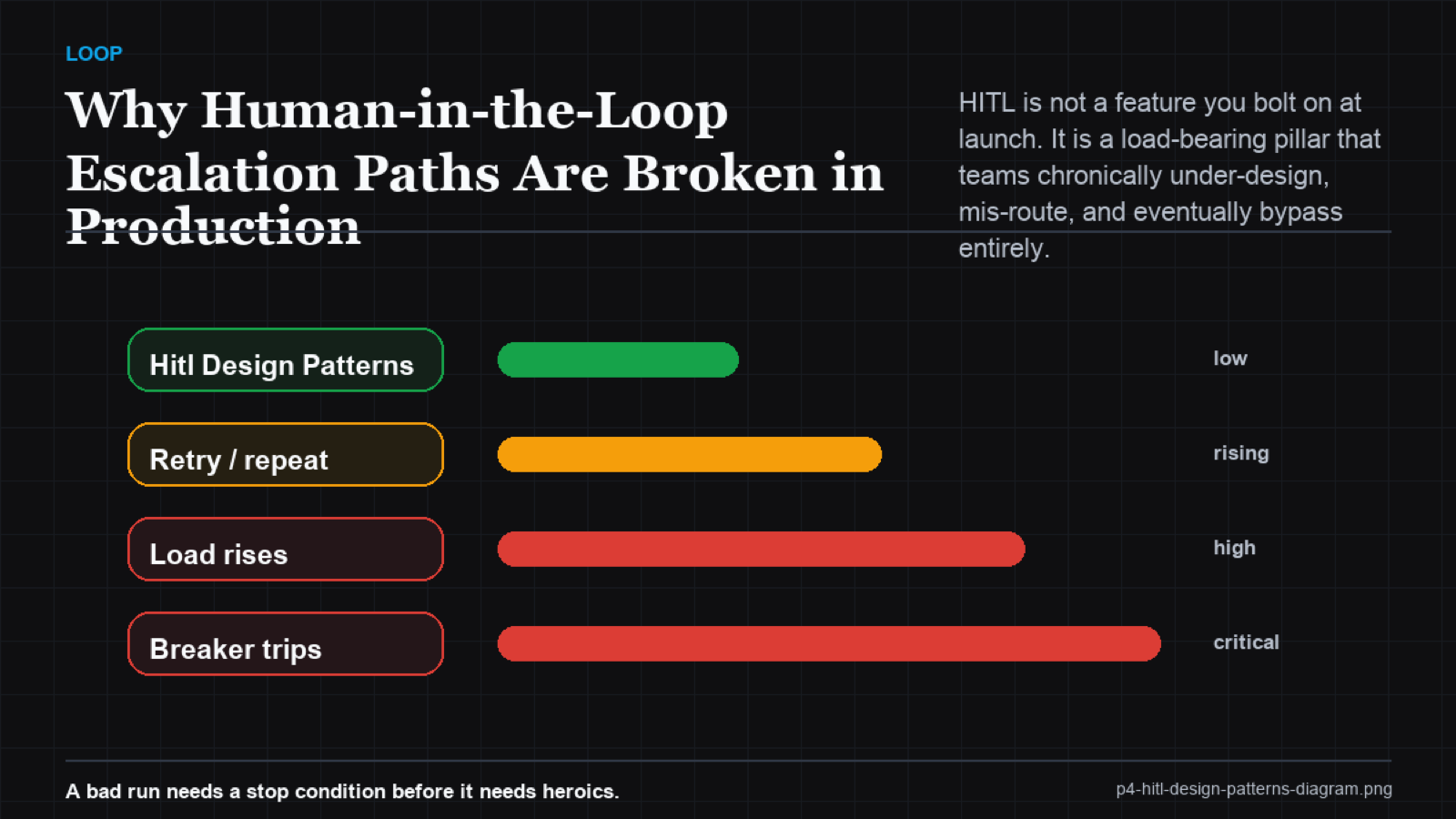
Escalation path comparison
| Design | Routing | SLA | Loop-back | Production outcome |
|---|---|---|---|---|
| Single queue, any agent | Unmatched authority | None | Email thread | Queue abandonment, manual bypass |
| Tiered queue, role-matched | Authority-matched | Per tier | Structured state event | Decisions reach agent, SLA monitored |
| Automatic fallback only | No human involved | N/A | Agent retries | Silent failure on edge cases |
NIST AI RMF found under 40% had tested escalation paths; a better model routes risky actions nowhere just as fast.
The Pattern Intelligence Layer builds escalation routing into the pattern definition itself. Each pattern carries its risk tier, its authority mapping, and its loop-back contract. When an agent matches a pattern that requires HITL, the routing, SLA, and state-carrying handoff are already specified - not left to the developer to wire up per-deployment.