


Key facts.
- METR's "Measuring AI Ability to Complete Long Software Tasks" defines a 50%-task-completion time horizon and reports frontier models like Claude 3.7 Sonnet at roughly a 50-minute horizon, with frontier horizons doubling about every seven months. source
- "The Illusion of Diminishing Returns" shows why this happens: per-step execution accuracy degrades as tasks get longer, so reliability falls with task length even when single-step accuracy looks high. source
- OpenAI's GDPval, evaluating models on real economically-valuable tasks across 44 occupations, shows frontier models can do well on short professional tasks, which is exactly the regime where human review is cheapest to remove and longest tasks are where it is most needed. source
Why is escalation an economic decision, not a maturity flaw?
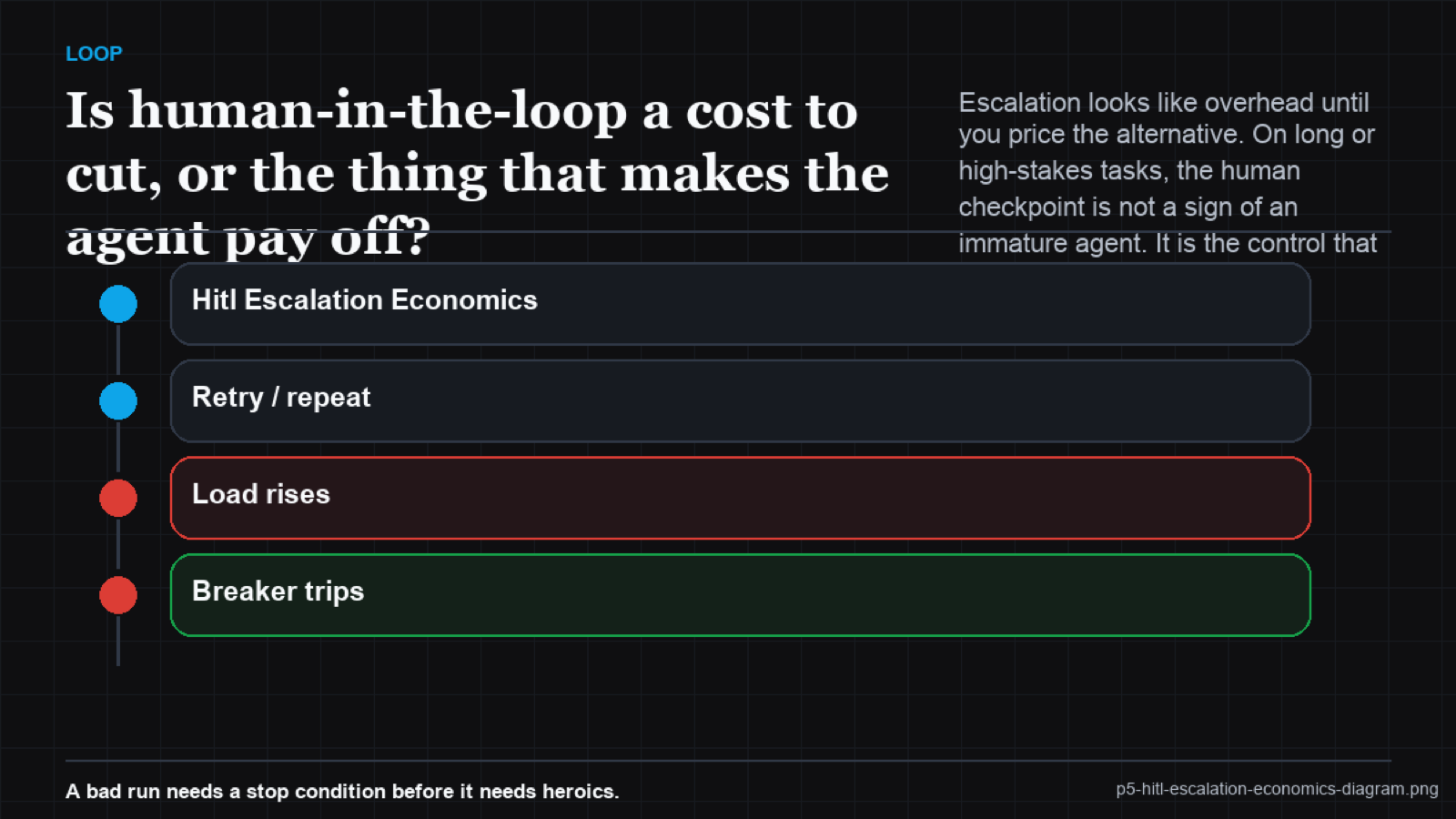
Because the cost of a wrong autonomous action is not symmetric with the cost of a human glance. A human checkpoint on a high-stakes step costs minutes of attention. An unchecked wrong action on the same step can cost a refund, a compliance event, or a production incident, which is orders of magnitude more. So the question is never "is the agent good enough to skip the human." It is "is this specific step cheap enough to be wrong." For short, low-consequence tasks the answer is often yes, and you can run unsupervised. For long or high-consequence tasks the METR numbers say the agent will be wrong often enough that removing the human turns a manageable error rate into an expensive incident rate.
The "immaturity" framing gets the causality backwards. Teams that treat escalation as a temporary crutch to be removed once the agent improves are betting on a horizon that is still measured in minutes. Teams that treat escalation as a permanent, priced control put the human exactly where the reliability curve falls off, and they get a system whose economics work today rather than one that works in the slide deck.
Where does the human checkpoint earn its keep?
It earns it at the points where being wrong is expensive and where the task runs past the model's reliable horizon. That is a small fraction of steps in a well-scoped agent, which is the whole trick. You do not put a human on every step. You put one where the consequence is high or the horizon is long, and you let the agent run free everywhere else. Done that way, escalation is not a tax on the whole workflow. It is targeted insurance on the few steps that would otherwise carry the incident cost. The teams that price it this way keep both the speed of autonomy and the reliability that makes the speed worth having.
| Step type | Run unsupervised? | Why |
|---|---|---|
| Short, low-consequence | Yes | Within reliable horizon; cheap to be wrong |
| Long-horizon | Checkpoint | Reliability falls toward 50% (METR) |
| High-consequence / irreversible | Human gate | Incident cost dwarfs review cost |
| Regulated / auditable | Human gate | Oversight is a requirement, not a choice |
The Pattern Intelligence Layer is where you decide which steps get a human and which run free, by pattern rather than by guess. Each action pattern carries its reliability and its consequence, so the escalation lands on the steps where the math says it pays and nowhere else. Reliability at the pattern level is what turns human-in-the-loop from a blanket cost into a precise control that makes the agent profitable instead of risky.
Frequently asked questions
Won't human-in-the-loop disappear as models improve?
Not soon. METR's frontier time horizon is doubling roughly every seven months but is still measured in minutes. For long or high-stakes tasks, the human checkpoint stays the cheaper option for the foreseeable future.
Doesn't escalation kill the cost savings of automation?
Only if you apply it everywhere. Targeted at the few high-consequence or long-horizon steps, it is cheap insurance, and the agent still runs unsupervised on the rest.
Is needing a human a sign the agent is not ready?
No. It is a sign you priced the downside. The reliability curve falls with task length regardless of model, so the checkpoint is an economic choice, not a maturity gap.