

Key facts.
- Agent cost can grow super-linearly as conversation and context length increase, so a long research session is disproportionately more expensive than a short one, not just proportionally. source
- METR finds the reliably-completable task length for frontier models is on the order of tens of minutes, so genuinely open-ended work is broken into many bounded bursts and handoffs rather than one long autonomous run. source
- On GAIA, an assistant benchmark of real open-ended questions, capable models trail humans by a wide margin, so open work triggers retries and exploration rather than a clean single pass. source
Why is open-ended cost a distribution, not a number?
Research runs until satisfied, so its cost rides a long tail growing faster than linearly as context expands; a frontier model does not tame it, METR puts reliable horizons at tens of minutes. (arXiv:2503.14499)
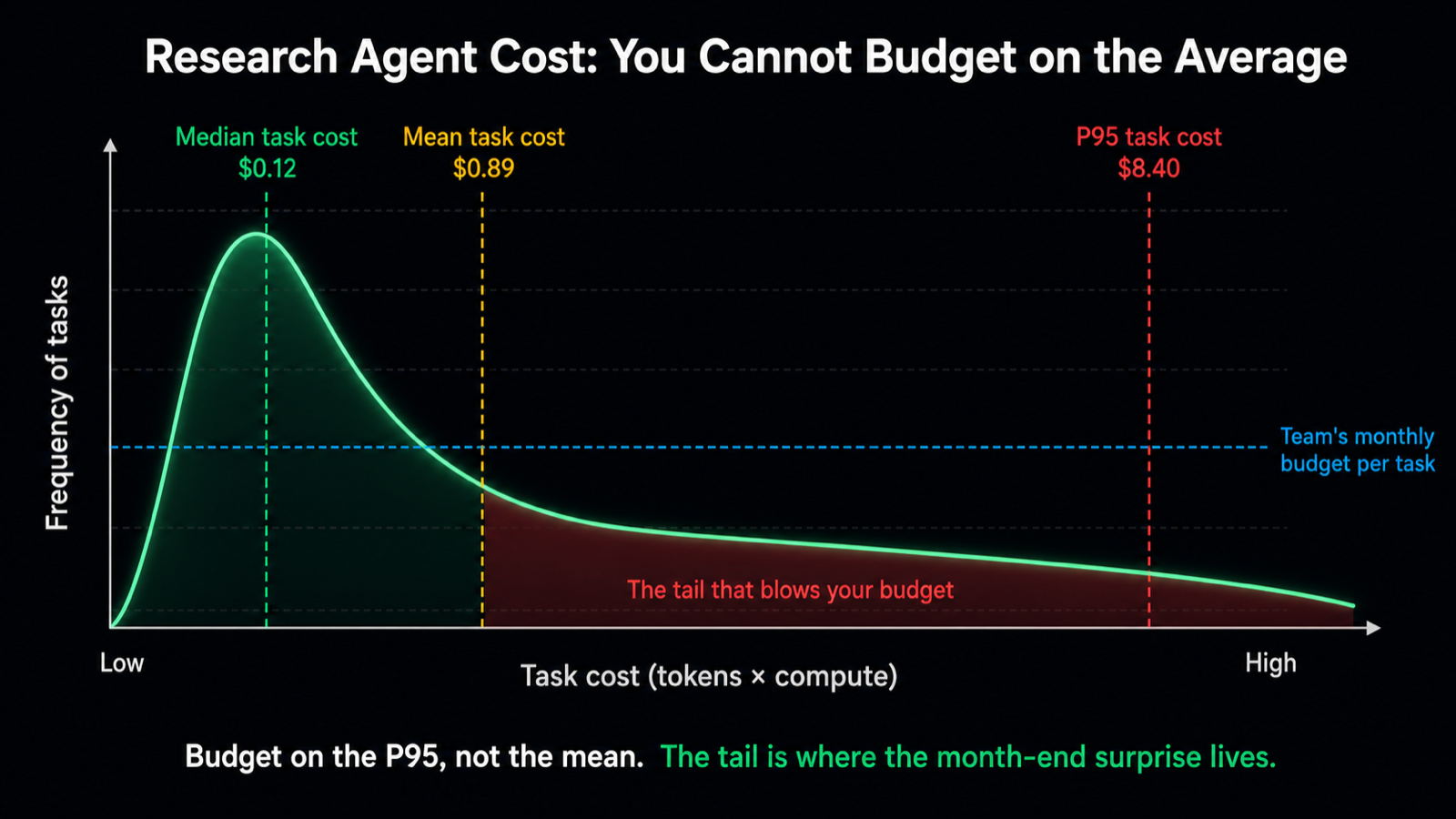
Because the agent decides when it is done and on open work that decision varies enormously. A creative or research task has no fixed step count: an easy question resolves in a few loops, a hard one keeps exploring, re-reading context, calling tools and reasoning until it converges or gives up. The token spend tracks that variation directly, so the cost of "a research task" is not a single figure, it is a spread from cheap to very expensive. Budget on the mean and the hard tasks, the ones that matter most, are exactly the ones that overrun, because they sit in the tail the mean averages away. The cost is variable by the nature of the work, not by a fault in the agent.
A stronger model shifts the distribution without removing the tail. The production-systems finding is the useful frame: even deployed agents are held to short bursts before a human checkpoint, so genuinely open work runs as many bounded bursts and handoffs rather than one clean pass. A more capable model resolves more tasks in fewer loops, which trims the average, but the long tail of genuinely hard, open-ended work remains and the quadratic-cost effect makes that tail expensive. The variance is a property of open-ended work meeting a bounded autonomy and the model upgrade narrows it rather than ending it.
How do you budget for the tail?
Cap each task, so an open-ended loop stops at a cost ceiling instead of running unbounded and surfaces for a human decision rather than silently billing. Route by expected difficulty, sending the likely-cheap tasks to a cheaper model and reserving the expensive one for where depth is needed, so the tail does not all run at the top rate. Track the distribution, not just the total, so you can see the tail forming and size the budget to it. And set the stopping criteria deliberately, because "until satisfied" is the most expensive instruction you can give an open-ended agent. Budgeted on the distribution with caps and routing, the research agent's tail becomes a planned cost rather than a monthly surprise.
| Cost control | Budget on the average | Budget on the distribution |
|---|---|---|
| Hard tasks | Overrun silently | Capped, surfaced |
| Routing | One model for all | By expected difficulty |
| Stopping | Until satisfied | Explicit criteria |
| Visibility | Monthly total | Live cost distribution |
The Pattern Intelligence Layer is where the tail is governed. Per-task cost is tracked as a distribution at the pattern level, so the expensive open-ended runs are visible, capped and routed before they dominate the bill. Reliability at the pattern level is what turns an unpredictable research cost into one you have sized and bounded on purpose.
Frequently asked questions
Why does my research agent's cost swing so much?
Open-ended work has no fixed step count, so the agent runs until satisfied. Hard tasks iterate far more and the quadratic-cost effect makes those long runs disproportionately expensive.
Can I just take an average cost and budget on it?
Not safely. The average hides a long tail and the expensive tail tasks are often the important ones. Budget the distribution and cap per task instead.
Does a stronger model fix the unpredictability?
It narrows it. A better model resolves more tasks in fewer loops, but bounded autonomy and human checkpoints mean genuinely open work still iterates, so the tail and its cost remain.