

Even frontier models are confidently wrong: alignment training leaves them poorly calibrated, so the agent gives no internal warning before it executes a high-stakes mistake.OpenAI's own evaluation showed a model's calibration degrades after reinforcement learning from human feedback, which is why a human gate on irreversible actions is a backstop, not a courtesy (OpenAI GPT-4 System Card, 2023).

Key facts.
- The need is rooted in miscalibration: alignment training degrades a model's calibration, so it expresses high confidence in incorrect outputs and executes a high-stakes error with no internal signal that anything is wrong (OpenAI GPT-4 System Card, 2023).
- Human oversight of high-impact, autonomous actions is a named governance control: the NIST AI Risk Management Framework calls for mechanisms to monitor, intervene in, and override AI system actions, especially for consequential decisions (NIST AI RMF 1.0, 2023).
- Governance guidance is explicit that agentic systems need human oversight on uncertain or high-risk actions, not just at the end (OpenAI, Practices for Governing Agentic AI Systems, 2024;Anthropic, Building Effective Agents, 2024).
- Calibration stays poor, so a bolted-on gate floods or gets bypassed; a more capable model is just confidently wrong. (OpenAI GPT-4 System Card)
Why is human-in-the-loop essential, not optional?
Because the agent can't reliably tell you when it's wrong. Models are poorly calibrated, attaching high confidence to incorrect outputs, so there's no internal uncertainty signal that would stop a high-stakes mistake before it executes (OpenAI GPT-4 System Card). that's precisely the gap a human gate fills: an external check on the actions that matter most, the irreversible, financial, or compliance-relevant ones, where a confident error is expensive. The risk has a name, excessive agency, over-broad autonomy without human checks, and the prescribed control is least privilege plus human approval for high-impact actions, the kind of oversight and override mechanism the NIST AI Risk Management Framework asks for on consequential decisions (NIST AI RMF 1.0). Governance guidance from model developers says the same: keep a human in the loop for uncertain or high-risk steps (OpenAI;Anthropic). HITL isn't a courtesy; it's the backstop for a known limitation.
Why does HITL fail in practice?
Because it's usually designed badly or not designed at all. Three failure modes recur. it's bolted on as an afterthought, with no risk-tiering, so it either blocks everything, overwhelming reviewers until they rubber-stamp, or blocks nothing meaningful. The thresholds aren't wired into the system, so the gate is advisory and gets skipped under latency pressure or automation bias, the agent's confident "done" is treated as authoritative. And the review itself is starved of context, the human sees an output but not the reasoning, the alternatives, or the expected effect, so the approval is uninformed. The result is the worst of both: chronic over-escalation that negates the agent's value, or under-escalation that lets a confident error through. A gate that's propped open, or that no one can act on, isn't a safety net.
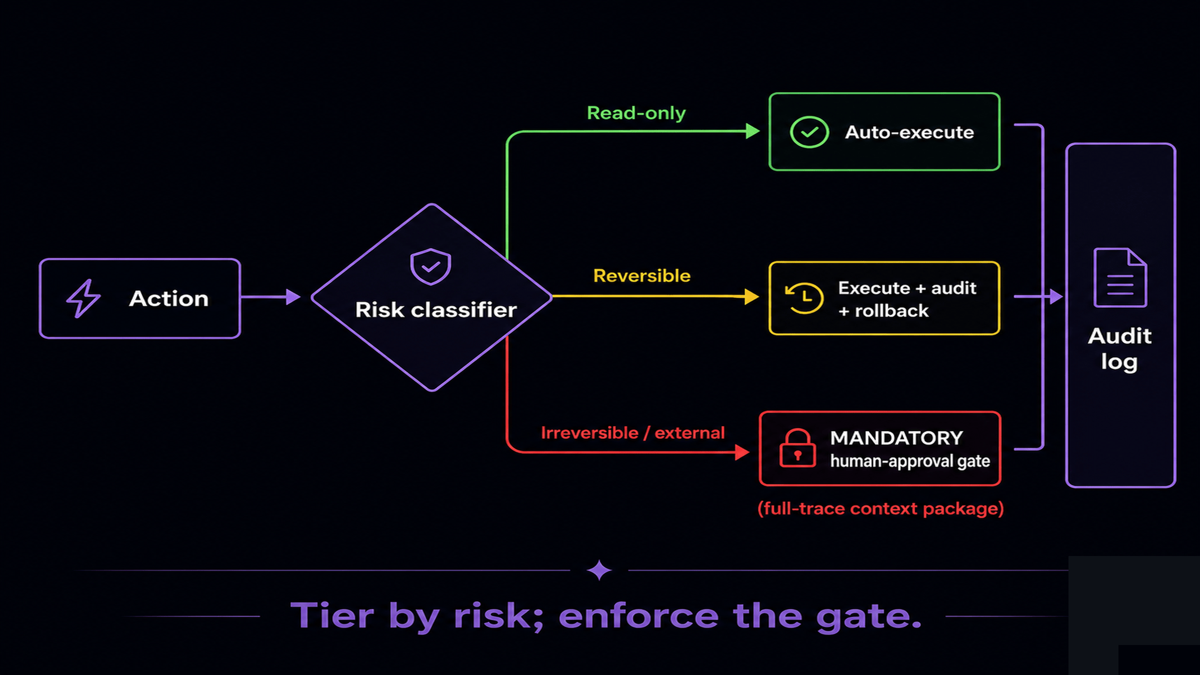
# Route by action risk; enforce the gate mechanically
risk = classify(action) # read-only | reversible | irreversible/financial/external
if risk == "read_only": execute(action) # auto
elif risk == "reversible": execute(action); audit(action) # audit + rollback path
else: require_human(action, context=full_trace) # mandatory gate
How do you design HITL that holds?
Tier the actions and enforce the gate in the system, not in a prompt. Define an action-risk taxonomy up front, read-only actions run automatically, reversible ones run with an audit trail and a rollback path, and irreversible, financial, external, or compliance-relevant ones require human approval before execution, and wire the routing to confidence and risk scores so it can't be skipped for speed. Make reviews asynchronous and context-rich: hand the human the full reasoning trace, the alternatives considered, the expected outcome, and a rollback plan, so the decision is informed rather than a rubber stamp. Pair HITL with automated verifiers so humans only see what genuinely needs judgment, keeping the escalation load sustainable. Log every escalation and override for audit, and relax thresholds only after measured accuracy justifies it. The gate then catches the confident high-stakes errors the agent can't catch itself.
Bad HITL versus designed HITL
| Aspect | Bolted-on HITL | Designed HITL |
|---|---|---|
| Routing | All or nothing | Risk-tiered by action |
| Enforcement | Advisory, bypassed for speed | Wired in, mechanically enforced |
| Review context | Output only | Full trace, alternatives, rollback |
| Reviewer load | Floods or rubber-stamps | Sustainable, verifier-filtered |
| Auditability | Overrides untracked | Every escalation logged |
The pattern is that agents are confidently wrong and can't flag their own high-stakes errors, so a human gate is the necessary backstop, but only if it's risk-tiered, enforced in the system, and given enough context to act on. Tier actions by risk, wire the gate so it can't be skipped, and hand reviewers the full trace, and HITL stops being a bypassed speed bump and becomes a real control. Designing the human gate as an enforced, context-rich layer rather than an afterthought is reliability at the pattern level, which is what VibeModel builds as the Pattern Intelligence Layer.
Frequently asked questions
Doesn't human review just slow everything down?
Only if you gate everything. Tier by risk: read-only and reversible actions run automatically or with an audit trail, and a human reviews only irreversible or high-stakes ones, so most work is still fast.
Why does HITL get bypassed?
Because it's advisory rather than enforced, and the agent's confident output invites automation bias under time pressure. Wire the gate into the system on risky actions so it can't be skipped, and pair it with verifiers to keep the load sustainable.
What makes a human review effective?
Context. Give the reviewer the full reasoning trace, the alternatives considered, the expected outcome, and a rollback plan, not just the final output, so the approval is an informed decision rather than a rubber stamp.