


Key facts.
- PALADIN found agents recover from failure only 23.75% of the time before explicit recovery training, meaning they often do not recognize when to stop and hand off.source
- Recognizing the need to escalate is a detection problem the agent must be built for, not a behavior it exhibits by default.source
- A mishandled handoff that drops context forces the customer to repeat everything, compounding the original frustration.source
Why does escalation fail so often?
Untrained tool agents recover 23.75% from failure; a better model blind to its miss cannot escalate, a handoff turns incident. (arXiv:2509.25238)
Two ways and both are design gaps. First, the agent does not detect that it should escalate. It is built to resolve, not to recognize its own limits and the PALADIN baseline shows how rarely an untrained agent handles a situation going wrong. So it keeps attempting the resolution it cannot reach, looping or guessing, while the customer's patience drains. Second, even when it does hand off, the handoff is poor. The human receives the customer with no context. The customer repeats the whole story and the escalation that was supposed to help becomes a fresh insult. The customer started with a routine issue and ends up angry, not because the issue was hard. Because the agent neither knew when to stop nor handed off cleanly when it did.
This is why escalation deserves to be treated as a first-class feature rather than an afterthought. The cases that escalate are, by definition, the ones the agent could not solve. Are the cases where the customer is already closest to frustration. Botching the handoff is botching the moment that mattered most.
What makes escalation reliable?
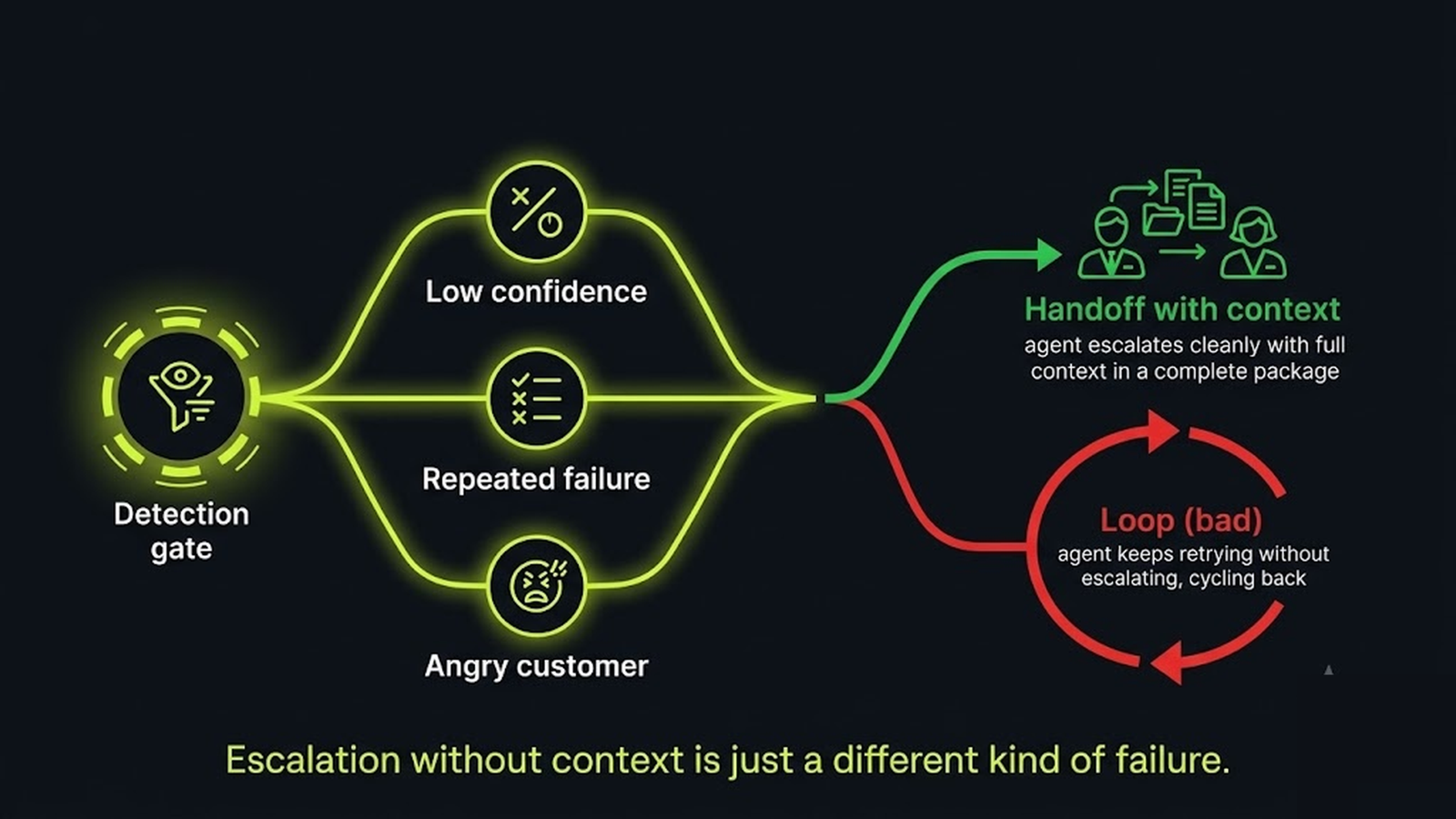
Build the detection and the handoff with equal care. Give the agent explicit signals for when to escalate, low confidence, repeated failure, an angry customer. A policy exception and make crossing any of them trigger a handoff rather than another attempt. Then make the handoff carry everything: the full context, what was tried and what the customer needs. The human picks up mid-stream instead of from zero. A good escalation feels smooth to the customer because the agent knew its limit and the human was handed the thread intact.
| Escalation design | Customer experience |
|---|---|
| No detection, poor handoff | Agent loops, then human restarts from zero |
| Detected limit, context-rich handoff | Clean transfer, human continues the thread |
Designing that detection and handoff is part of what VibeModel does as the Pattern Intelligence Layer. We model the patterns that mean an agent has reached its limit and what a human needs to continue. Escalation happens at the right moment and carries the context that makes it feel effortless.
Frequently asked questions
When should the agent escalate?
On low confidence, repeated failure, detected frustration or a policy exception. Make any of these trigger a handoff, not another attempt.
What must the handoff carry?
Full context, what was already tried and the customer's goal, so the human does not restart the conversation.
Is escalation a failure of the agent?
No. Knowing its limit and handing off well is the agent succeeding at the hardest part of the job.