


Key facts.
- PALADIN benchmarked tool-calling agents on failure recovery scenarios: without self-correction, agents achieved only 23.75% recovery rate (leaving 76%+ of mid-task failures unrecovered), demonstrating that premature abandonment is the baseline behavior, not the exception (PALADIN, arXiv 2509.25238, ICLR 2026).
- ITBench's real-world IT automation benchmark found that agents terminate SRE remediation workflows before verifying that the remediation actually fixed the incident, resolving only 13.8% of SRE tasks precisely because completion without verification is treated as completion (ITBench, arXiv 2502.05352, 2025).
- DORA's State of DevOps research consistently identifies handoff quality as one of the highest-impact reliability interventions in software delivery pipelines, the same principle applies to agent-to-agent handoffs in production workflows (DORA, reported).
- Incomplete handoffs cascade as a class, the next agent taking a partial state; a more capable agent fails convincingly, and retries land late. (arXiv:2509.25238)
Why agents terminate early
Three mechanisms drive premature termination. First, ambiguous completion criteria: the agent was not told what "done" looks like for this step, so it terminates when the action is taken, not when the outcome is verified. Second, context window pressure: in long-running workflows, agents nearing their context limit begin summarizing and closing loops to stay within bounds. Third, tool failure handling: when a tool returns an error, many agents interpret this as a reason to report partial results and yield to the next agent rather than retry.
Each of these is rational local behavior. The agent is not broken. It is responding sensibly to the incentives its architecture creates. The problem is that "sensible local behavior" at the handoff point becomes "broken starting state" for the next agent.
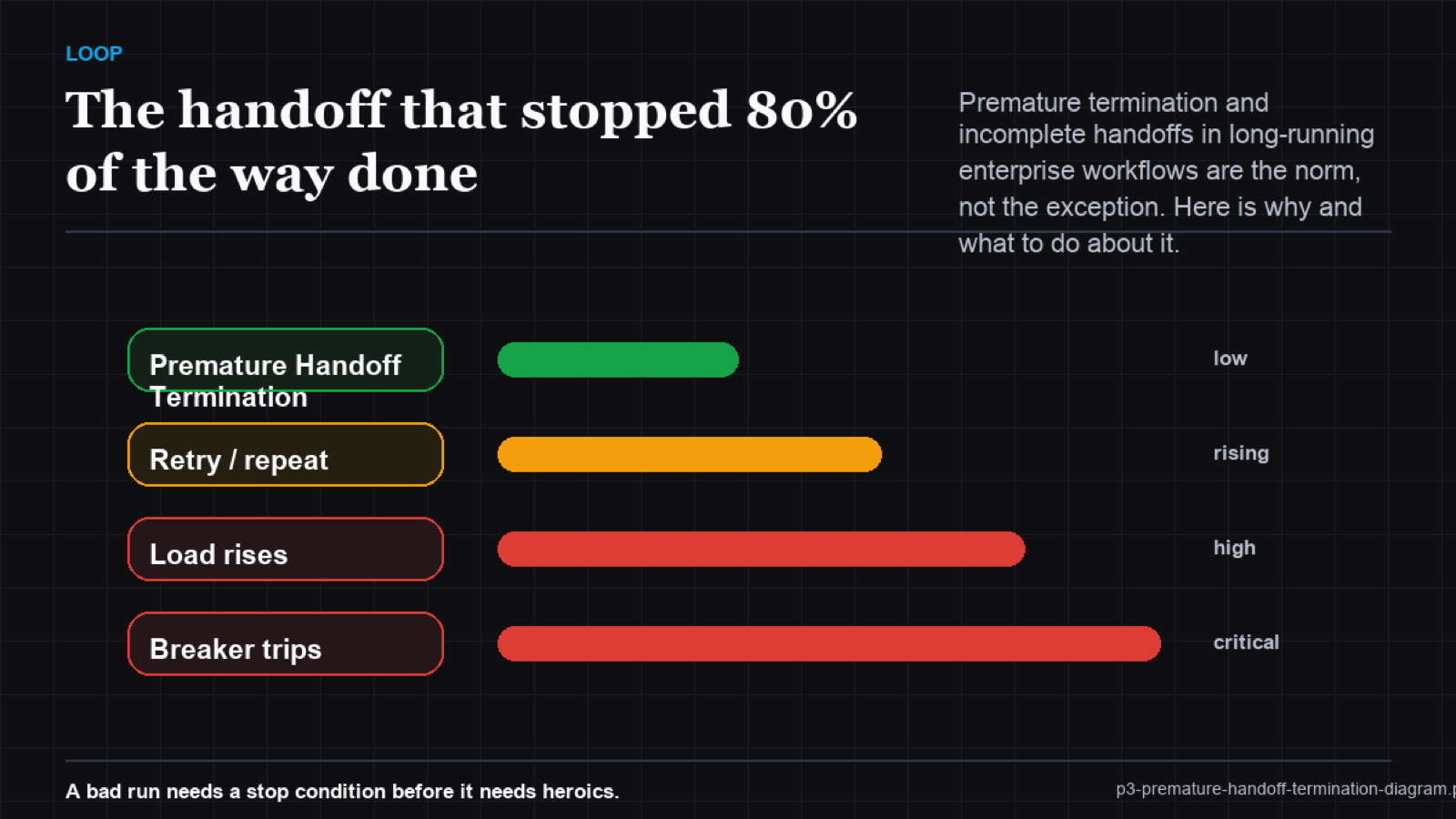
Handoff quality patterns
| Premature termination | Verified handoff |
|---|---|
| Terminates when action is taken | Terminates when outcome is verified |
| Passes partial state to next agent | Passes completion contract with status field |
| Next agent inherits ambiguous state | Next agent receives explicit completion/pending status |
| Tool failure causes early yield | Tool failure triggers retry or explicit escalation before yield |
VibeModel monitors for the premature-termination pattern at every agent boundary. The Pattern Intelligence Layer tracks the difference between an agent reporting completion and an agent producing a verified outcome, and flags the handoffs where that gap exists. The cost of an incomplete handoff compounds at every downstream step; catching it at the source is the cheap version.
Frequently asked questions
How do I define "done" for a step in a way agents can verify?
Write it as a checklist in the agent's output schema: a list of state assertions that must be true before the step is complete. The agent checks each assertion before yielding. If any assertion fails, it retries or escalates. This is the same pattern as a definition-of-done in engineering, written as machine-checkable conditions, not prose.
What if the next agent can handle an incomplete handoff?
Sometimes it can, if the partial state is clearly labeled as partial and the receiving agent is designed for it. Most of the time, receiving agents assume they are receiving complete state. Explicit status fields in the handoff contract solve this: the receiving agent reads the status field and knows whether to proceed or wait.