


Key facts.
- MAST analyzed seven multi-agent frameworks across 200+ tasks and defined fourteen failure modes in three categories: specification issues, inter-agent misalignment and task verification. source
- Inter-agent misalignment, where one agent's output is misread or misused by the next, is a core failure category, not an edge case. source
- Under equal budgets, adding agents does not automatically add reliability, because each handoff can lose information rather than add it. source
Why do the handoffs fail when the agents work?
MAST calls inter-agent misalignment a core failure: each step works while the upgrade leaves the handoff broken, where the rework hides. (arXiv:2503.13657)
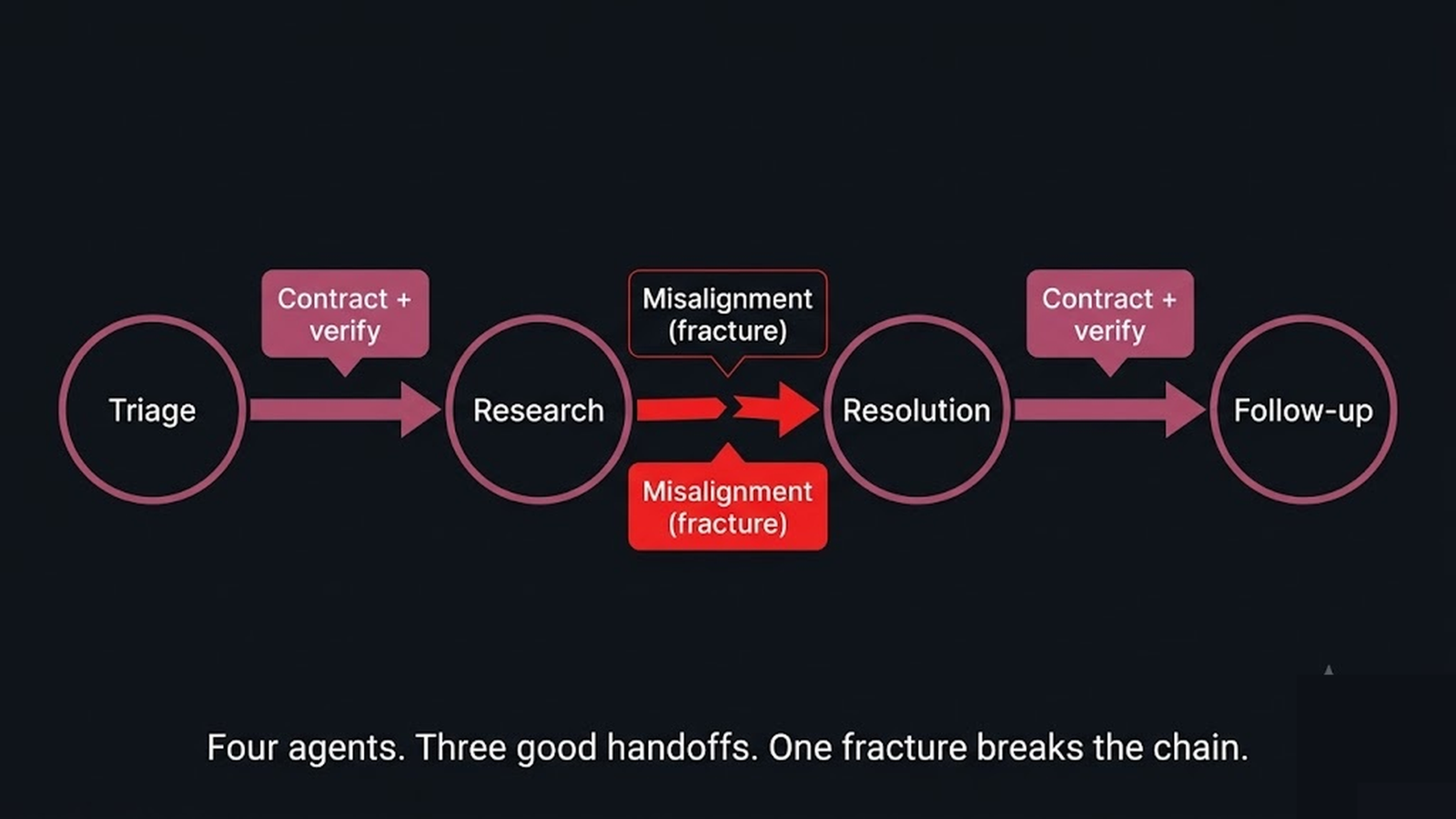
Because a handoff is an assumption that did not travel. The triage agent classifies the issue, the research agent looks it up, the resolution agent acts, the follow-up agent confirms and each one is reasonable in isolation. The failure is in the seams: triage labels the issue slightly wrong and research investigates the wrong thing, research returns a finding the resolution agent interprets differently than intended, resolution acts and follow-up confirms something that did not actually happen. MAST names this inter-agent misalignment and finds it pervasive, because each agent assumes the previous one's output means what it would have meant to a human and that assumption breaks quietly. The pipeline looks like four competent specialists and behaves like a game of telephone.
The tempting fix, more specialized agents, often makes it worse, because every new agent adds a new handoff and the work on single-versus-multi-agent systems shows handoffs lose information rather than create it. You can end up with a more elaborate pipeline that is less reliable than a single agent doing the whole job, because you added coordination surface without adding coordination discipline.
What makes the coordination hold?
Make the handoffs explicit and verified. Define a contract for what each agent passes to the next, the fields, the format, the meaning, so the receiving agent is not guessing at intent. Verify the handoff: the resolution agent confirms it understood the research finding before acting, the follow-up agent checks the resolution actually happened before closing. Treat the spaces between agents as the place to invest, because MAST says that is where the failures live. The goal is a pipeline where one agent's output cannot become the next one's silent wrong assumption.
| Pipeline design | Where it breaks | |
|---|---|---|
| Trust clean handoffs | Inter-agent misalignment, telephone effect | |
| Contracts plus verification | Handoff errors caught at the seam |
Securing those seams is part of what VibeModel does as the Pattern Intelligence Layer. We model the patterns of a clean handoff between support agents and verify them at each boundary, so a triage-to-resolution pipeline holds together instead of losing the request between specialists.
Frequently asked questions
Should I just use a single agent then?
Often, yes, for support flows that do not cleanly parallelize. Add agents only when the work genuinely splits and you can discipline the handoffs.
What is inter-agent misalignment?
When one agent's output is misread or misused by the next. MAST finds it a core failure category in multi-agent systems.
How do I verify a handoff?
Have the receiving agent confirm its understanding against a contract before acting and check downstream that the action actually happened.