


Key facts.
- HBR Analytic Services research found AI adoption stays high while value lags without genuine workflow integration across functions, the cross-functional gap most rollouts underestimate. source
- MAST, a study of multi-agent system failures, finds 41 to 87% of runs fail across leading frameworks, with a large share traced to coordination and handoff breakdowns rather than single-step errors. source
Why does spanning departments make an agent fragile?
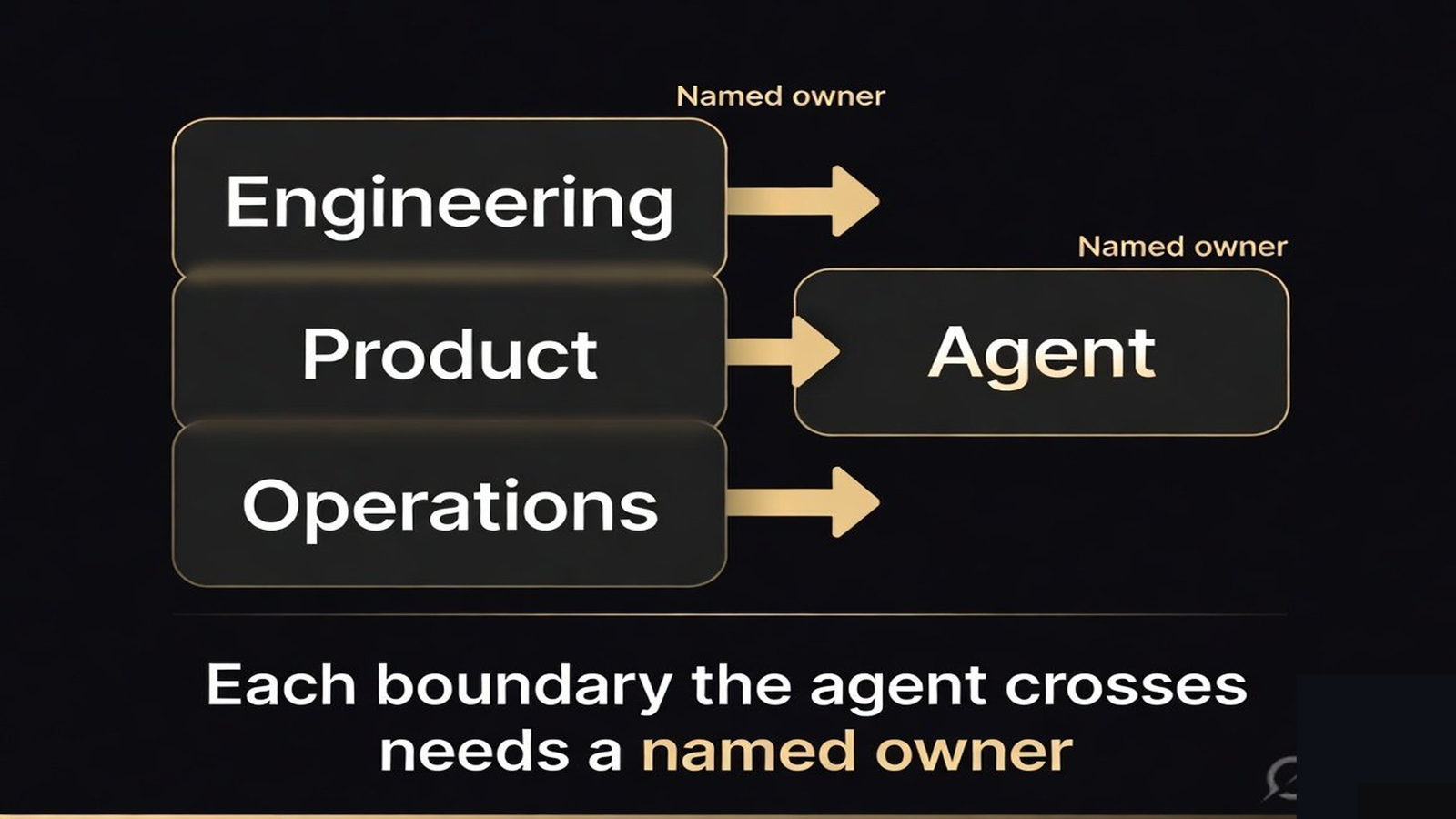
An agent that handles a process touching sales, finance and operations inherits every seam between those teams. Sales owns the workflow it starts in, finance guards the data it needs midway, operations owns the action it ends with and no single one of them owns the agent. So when it stumbles at a handoff, sending the wrong field to finance, taking an action operations did not expect, the response is three teams each assuming another will handle it. The MAST result is the technical mirror of this org problem: multi-component systems fail most at the boundaries and a cross-functional agent is one long chain of boundaries.
The fix is to make the cross-functional ownership explicit before the agent ships. Name who owns each boundary, agree what passes across it and in what shape and integrate the workflow so a handoff is a defined contract, not a hopeful toss over a wall. HBR's finding that value lags without workflow integration is the same lesson from the adoption side: the agent only pays off when the work across functions is actually connected, not just automated in pieces.
What does cross-functional ownership look like?
| Element | Implicit | Explicit |
|---|---|---|
| Boundary ownership | Assumed, unassigned | Named owner per handoff |
| Handoff contract | Hopeful toss | Defined inputs and outputs |
| When it fails | Three teams point sideways | The boundary owner acts |
| Result | Drops in the gaps | Handoffs hold |
Handoffs hold when the behavior at each boundary is consistent and checkable, which is what VibeModel provides as the Pattern Intelligence Layer. When the agent handles each cross-functional pattern the same correct way every time, the contract between teams is something you can verify rather than hope for and the coordination that sinks most multi-component systems becomes the part you engineered on purpose.
Frequently asked questions
Is a more capable model enough to coordinate across teams?
No bigger model fixes a handoff nobody owns; on MAST, 41 to 87% of runs fail at those seams, late. (arXiv:2503.13657)
Is the problem the model or the org?
Both meet at the handoff. MAST shows multi-component systems fail at boundaries and unowned organizational boundaries are where a cross-functional agent has the most of them.
Who should own a boundary?
The team that receives the handoff, with an agreed contract for what crosses it. Receiving-side ownership stops the sideways finger-pointing when something breaks.
Can you avoid cross-functional agents?
Often you should start within one function and earn the boundary crossings. Span departments only when the ownership and integration are in place.