


Key facts.
- GDPR Article 22 gives individuals the right not to be subject to solely automated decisions with significant effect and a right to human intervention, an obligation that attaches to any agent touching personal data regardless of which department runs it. source
- Regulations like HIPAA for protected health information and SOX for financial reporting controls apply by the data and actions involved, so one agent can fall under several regimes at once. source
- GhostCite (arXiv:2602.06718) found leading models fabricate citations at rates from about 14% to 95%, a failure that lands differently on legal, finance and customer-facing teams sharing one agent. source
- Spanning sales, finance and legal, an agent serves three masters and one action can sit under GDPR, financial-controls and sector rules at once; a better model does not reconcile them, defined roles do. (arXiv:2602.06718)
Why does shared ownership become no ownership?
Because responsibility that is split without structure dissolves. When an agent touches three departments, each one sees a partial view: sales sees the customer interaction, finance sees the transaction, legal sees the compliance exposure. No single team sees the whole agent and when an incident crosses their boundaries, each can reasonably believe another owns the response. The result is the diffusion-of-responsibility failure, where the very fact that three teams are involved makes it less likely any one acts. The compliance dimension makes this sharper: GDPR Article 22 attaches obligations to automated decisions affecting individuals, HIPAA and SOX attach by data and action type and a cross-functional agent can trigger all of them, yet no department fluent in one regime necessarily understands the others.
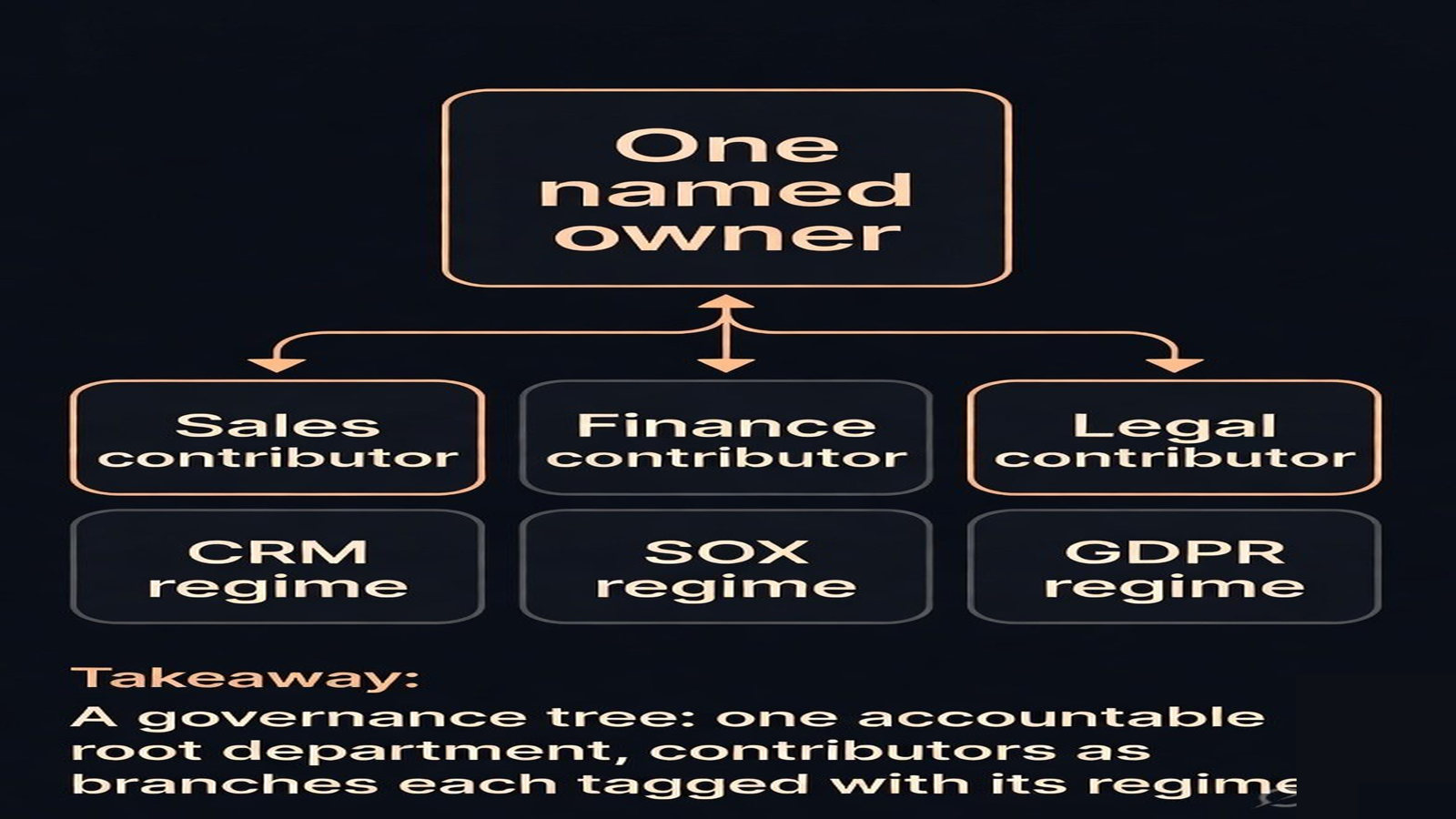
A more capable model does not assign the ownership, because the gap is structural. What resolves it is a defined model: one accountable owner who answers for the agent as a whole and a named contributor from each department who owns their slice of the boundaries, controls and compliance. The owner is not necessarily the builder; they are the person accountable when the agent acts, the way a service has an on-call owner regardless of who wrote it. GhostCite is a reminder of why the shared failure modes matter: a fabricated output from one agent lands as a legal problem, a financial error and a customer-trust hit at the same time, so the response has to be coordinated by someone whose job is the whole agent, not one department's view of it.
What does a cross-functional governance model define?
A single accountable owner, so there is one person who answers for the agent end to end. A contributor role per department, so each team owns its boundaries, controls and compliance obligations within the shared agent. A map of which compliance regimes apply to which actions, so no obligation falls in the gap between teams, the GDPR, HIPAA, and SOX exposures each having a named owner. And a coordinated incident path, so a failure that crosses departments has a defined response rather than three teams waiting on each other. This is the structure that turns shared ownership from a diffusion of responsibility into a division of it. The agents that fall through the cracks are the ones where everyone was a stakeholder and no one was accountable.
| Element | Unstructured sharing | Defined model |
|---|---|---|
| Accountability | Diffuse across teams | One named owner |
| Department roles | Partial views | Defined contributor slices |
| Compliance regimes | Fall in the gaps | Each mapped to an owner |
| Incident response | Teams wait on each other | Coordinated path |
The Pattern Intelligence Layer gives a cross-functional agent one place to be governed. Behavior, boundaries and compliance-relevant actions are tracked at the pattern level across every department the agent touches, so the accountable owner sees the whole agent and each contributor sees their slice. Reliability at the pattern level is what keeps a multi-department agent from being everyone's concern and no one's responsibility.
Frequently asked questions
Can't the departments just co-own the agent?
Co-ownership without structure becomes no ownership. You need one accountable owner for the whole agent plus defined contributor roles or the response diffuses across teams.
Why do compliance regimes complicate cross-functional agents?
Because GDPR, HIPAA, and SOX apply by data and action, so one agent can trigger several at once and no single department is fluent in all of them without a deliberate map.
Does the owner have to be technical?
No. The owner is accountable for the agent's behavior and response, like a service owner. Department contributors hold the specialized slices.