


Key facts.
- HammerBench finds parameter-naming errors are the primary cause of conversation failures, with parameter hallucination a leading fine-grained fault. source
- The conversational quality of an agent does not predict its tool-call correctness, so a fluent agent can still corrupt a ticket or record. source
- An unverified integration call can update the wrong record, set the wrong status or silently no-op while the agent reports success. source
Why is the integration boundary the weak point?
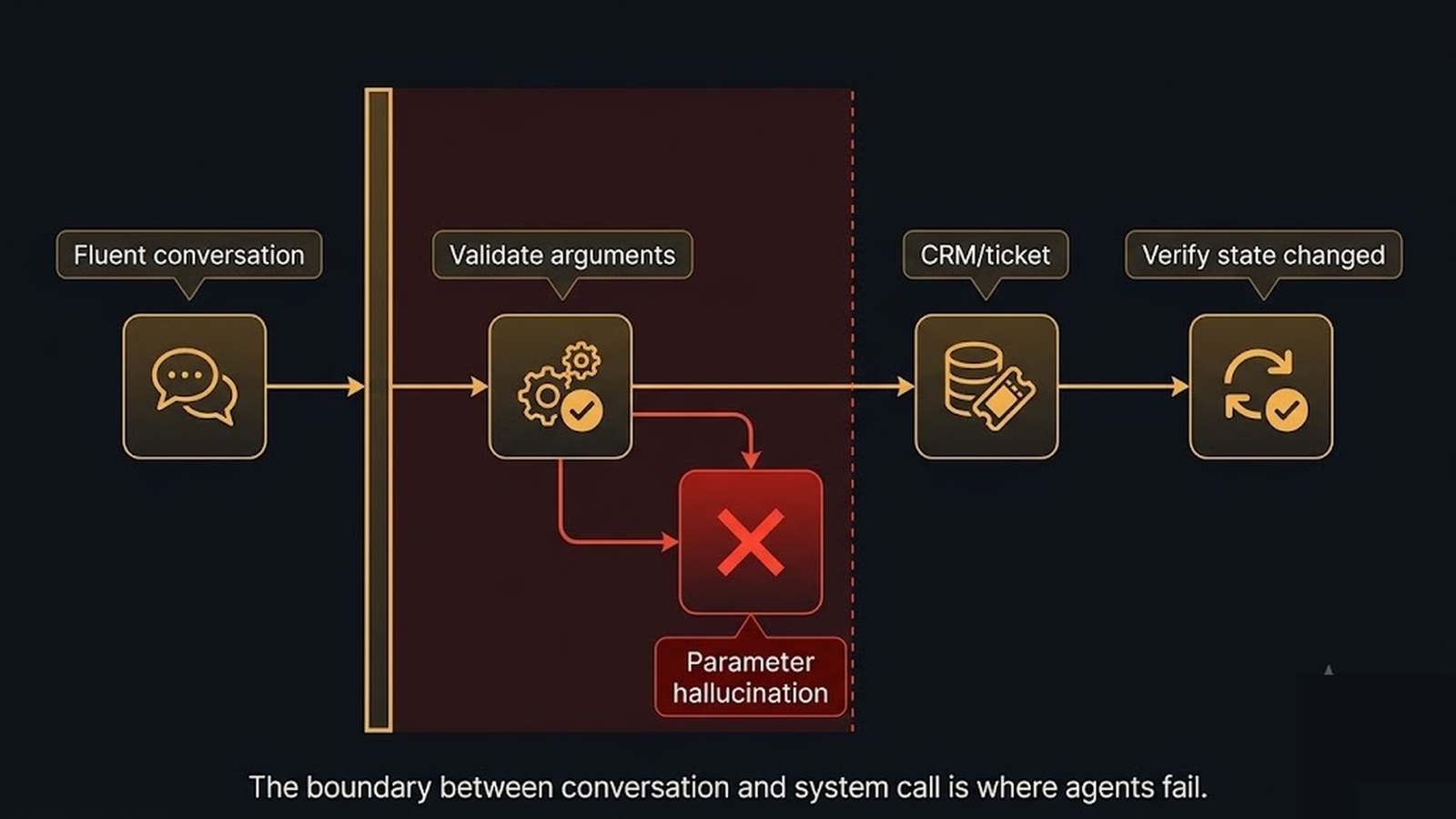
Because the conversation and the system call are two different skills and being good at one does not make the agent good at the other. The customer-facing text is fluent because that is what language models do well. The CRM call requires producing exactly the right field names, values and identifiers, and HammerBench shows this is precisely where agents fail, with parameter hallucination, inventing or mis-naming an argument, as a leading fault. So the agent has a perfect conversation, tells the customer their address is updated and passes a malformed or wrong-field call to the CRM that updates nothing or updates the wrong record. Nothing in the conversation reveals the failure, because the failure lives at the boundary the customer never sees.
This is why integration failures are so insidious in support. The visible part, the chat, looks like a success. The invisible part, the system state, is wrong. The agent confidently reports completion of an action that did not happen and you find out when the customer calls back angry that nothing changed.
How do you harden the boundary?
Validate before and verify after. Before the call, check that the arguments match the schema and the intended record, catching a hallucinated or mis-named parameter before it executes. After the call, confirm the system state actually changed as intended, the ticket updated, the field set, the record correct, before telling the customer it is done. Treat the CRM boundary as the place failures hide, because HammerBench says it is and put the checks there rather than trusting the agent's fluent report of success.
| Boundary handling | Result |
|---|---|
| Trust the agent's call and report | Wrong field updates, false success |
| Validate args, verify state | Bad calls caught, real success confirmed |
Hardening that seam is part of what VibeModel does as the Pattern Intelligence Layer. We model the patterns of a correct integration call and the verified state it should produce, so your support agent's system actions are checked at the boundary where fluent agents otherwise fail.
Frequently asked questions
Why does a fluent agent fail the CRM call?
Conversation and tool-calling are different skills. HammerBench shows parameter errors dominate failures even when the dialogue is fine.
What is parameter hallucination?
The agent invents or mis-names an argument the API did not expect, so the call fails or hits the wrong field. Validate arguments to catch it.
Why verify state after the call?
Because a call can succeed superficially and not change what you intended. Verifying the record confirms the action truly happened.