

Key facts.
- HammerBench finds parameter-naming errors are the primary cause of conversation failures, with parameter hallucination a leading fine-grained fault. source
- A fluent conversation does not predict a correct system write, so an agent can sound right and corrupt the record. source
- In HRIS and payroll, a wrong field means a wrong paycheck, a missed benefit or a compliance error with direct impact on an employee. source
- HammerBench hides parameter hallucination in clean dialogue; an HR agent writes the wrong field, the upgrade too, cost hits pay. (arXiv:2412.16516)
Why does the integration boundary fail?
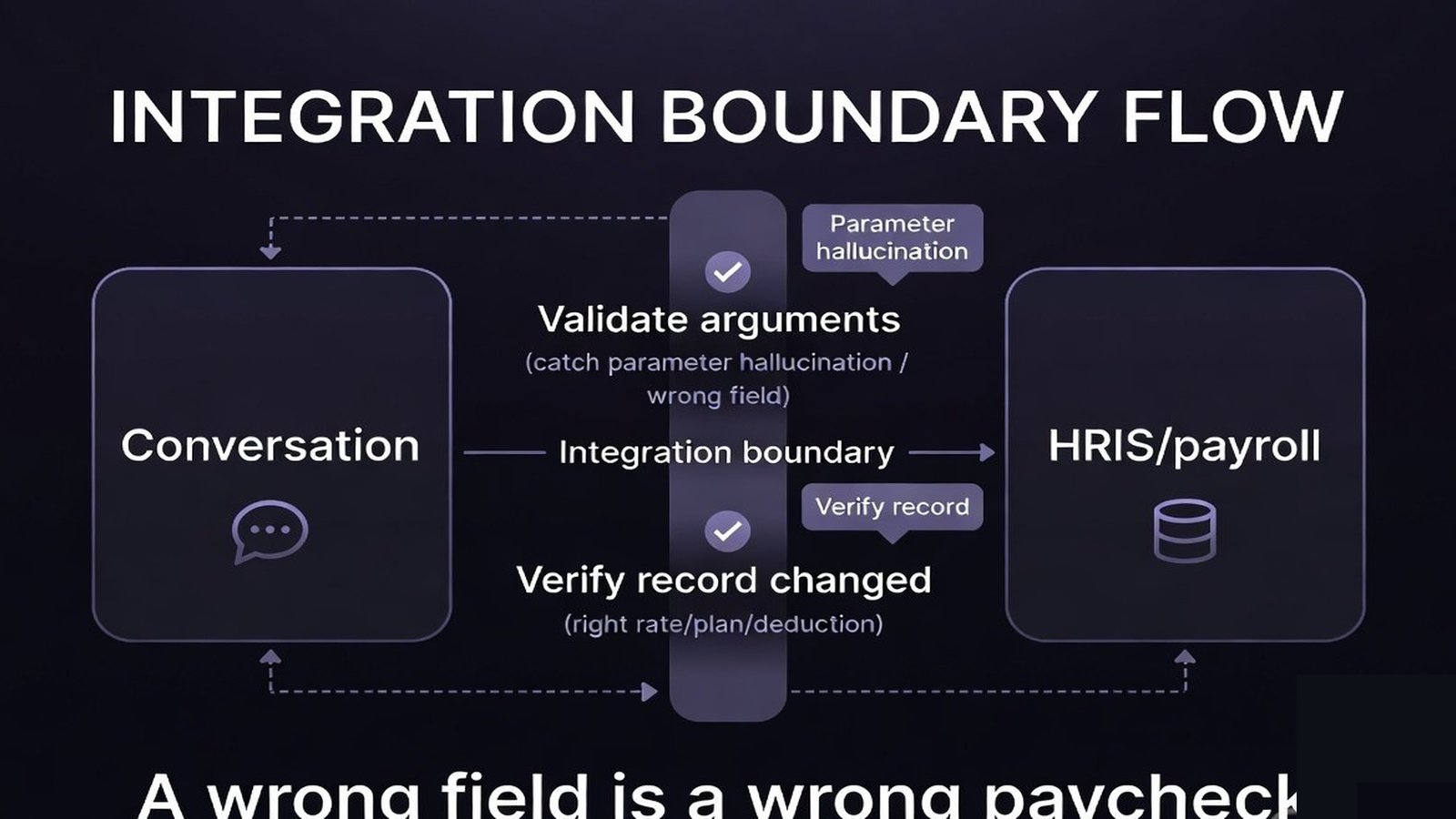
Because handling a conversation and writing correctly to a system are different skills, and HammerBench shows the system write is where agents fail, on parameter naming and hallucinated arguments. An HR agent can discuss an employee's benefits election or salary change fluently, then produce an HRIS or payroll call with the wrong field, the wrong value or a hallucinated parameter and nothing in the smooth conversation reveals it. In payroll the consequence is immediate and personal: a wrong deduction, an incorrect pay rate, a benefit set to the wrong plan, each landing on a real employee's paycheck or coverage. The agent reports the change made, the employee is told it is done and the system holds a corrupted value that surfaces as a wrong paycheck or a denied benefit, by which point trust is damaged and the fix is manual and urgent.
The personal stakes are what make this worse than a generic integration bug. A corrupted record in payroll is not an abstract data-quality issue, it is an employee shorted on pay or missing a benefit they enrolled in, which is both a trust failure and often a legal compliance problem under wage and benefits law.
How do you protect the payroll system?
Validate before and verify after, at the integration boundary. Before the write, check the arguments against the schema and the intended employee and field, catching a hallucinated or mis-named parameter before it executes. After the write, confirm the record actually changed as intended, the right rate, the right plan, the right deduction, before telling the employee it is done. Treat the HRIS and payroll boundary as the place failures hide, because HammerBench says it is and never confirm a change to an employee on the agent's report alone. The conversation can be fluent; the system write must be verified.
| Boundary handling | Result |
|---|---|
| Trust the agent's call and report | Wrong paycheck, missed benefit, false confirmation |
| Validate args, verify record | Bad writes caught, real change confirmed |
Hardening that boundary is part of what VibeModel does as the Pattern Intelligence Layer. We model the patterns of a correct payroll or HRIS write and the verified record it should produce, so an HR agent's system actions are checked where fluent agents otherwise corrupt the data that determines an employee's pay.
Frequently asked questions
Why does a fluent agent fail the payroll write?
Conversation and tool-calling are different skills. HammerBench shows parameter errors dominate failures even when the dialogue is perfect.
Why is payroll especially sensitive?
A wrong field is a wrong paycheck or a missed benefit, an immediate personal harm and often a wage-and-benefits compliance issue.
What does verification check?
That the record actually changed correctly, the right rate, plan and deduction, before the change is confirmed to the employee.