


Key facts.
- HammerBench reports parameter-name hallucination, missing parameters, and argument shifts as significant failure sources across multi-turn function-calling scenarios (HammerBench, 2024).
- Conway's Law: a system's structure mirrors the communication structure of the teams that produced it; agent systems inherit the same dynamic across their handoffs (Conway, 1968).
- Unstated conventions (units, date formats, null handling, status codes) are the silent boundary bugs that no single agent owns.
Why doesn't the receiving agent just ask?
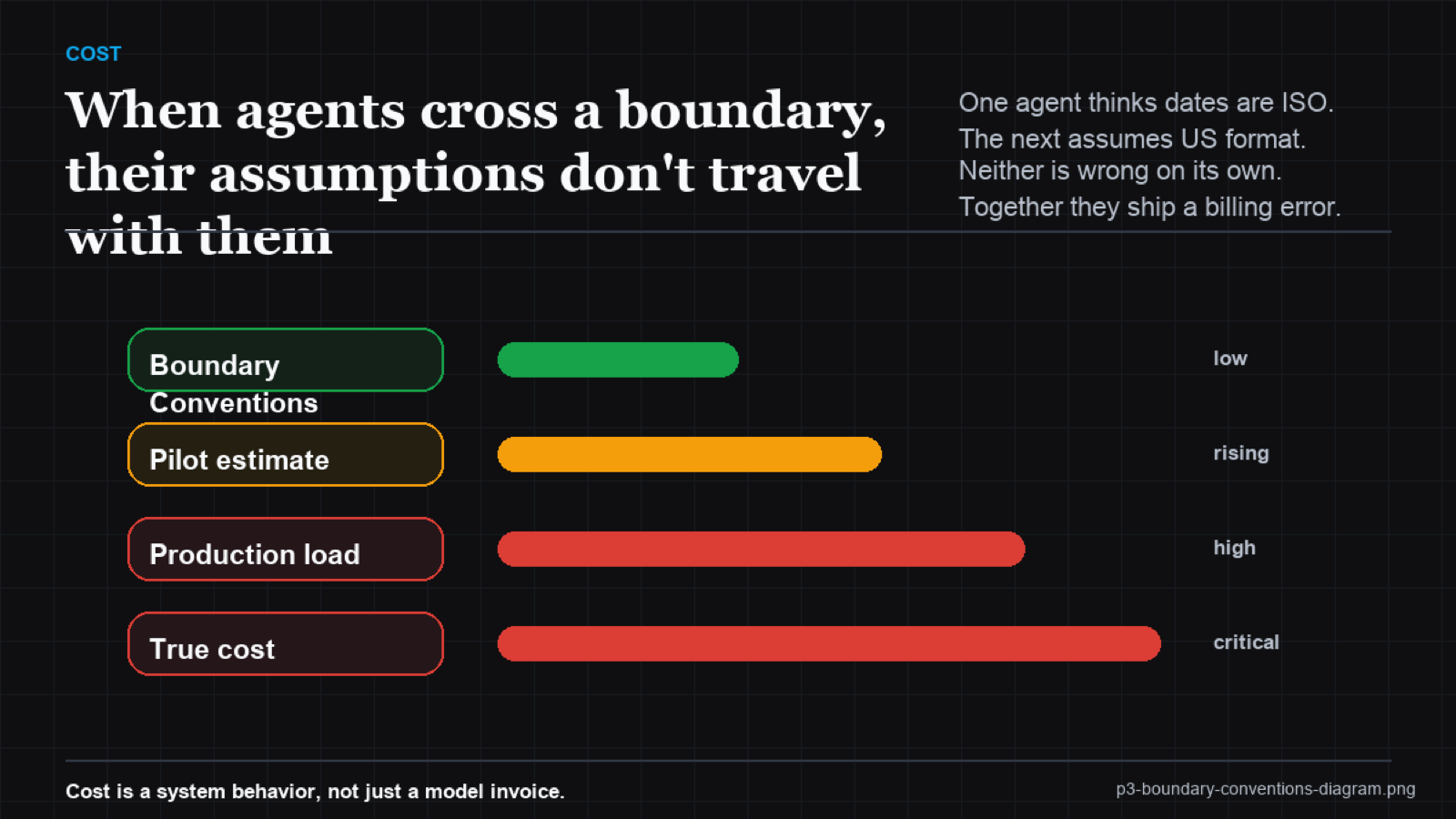
Because the handoff usually does not carry a question. The producing agent emits a result that looks complete; the consuming agent reads it as if its own conventions hold. Neither has a reason to pause. A human team eventually catches this in review or over coffee. An agent team catches it when the billing error lands. The fix is an explicit boundary contract: state the units, the formats, the null rules, and validate them at the handoff rather than assuming them.
Implicit handoff vs. contracted boundary
| Implicit handoff | Contracted boundary |
|---|---|
| Conventions assumed on both sides | Conventions declared and validated |
| Mismatch surfaces in production | Mismatch caught at the handoff |
| No owner for the boundary | The contract is the owner |
VibeModel's Pattern Intelligence Layer learns the conventions on each side of a boundary and flags when a handoff violates them. A units mismatch or a format drift is a pattern, and patterns are what we catch. You write the contract; we make sure both agents keep honoring it.
Frequently asked questions
Can a smarter model infer the conventions a handoff drops?
Unstated conventions never cross a handoff, and a frontier model inherits the mismatch, so the rework lands after integration. (arXiv:2412.16516)
Isn't strict typing enough?
Types catch shape, not meaning. A field typed string can still be the wrong date format. You need semantic contracts at the boundary, not just structural ones.
Does this apply when one team owns all the agents?
Yes. Different agents, different prompts, different assumptions. The boundary exists even inside one team.