

Agents quietly map dates and fiscal periods to the wrong values. In financial-data retrieval, agents make "period confusion" errors, pulling the wrong fiscal year entirely, because they mis-map calendar and regional conventions (FinRetrieval, arXiv:2603.04403, 2026). Cross a border and a date read day-first silently becomes the wrong day, on data your agent reports with full confidence.

Key facts.
- Locale formats diverge from international standards: dates have a single unambiguous form in ISO 8601 and currencies have three-letter codes in ISO 4217, so an agent parsing raw regional strings can read a day as a month or a symbol as the wrong currency (ISO 8601; ISO 4217).
- Data residency is a legal constraint, not a preference: under the GDPR, transfers of personal data outside the region are restricted, so a tool call or log that crosses a border can be a violation even when storage is nominally compliant (GDPR).
- Agents mis-map locale and calendar conventions in practice: financial-data agents make period-confusion errors, retrieving the wrong fiscal year entirely (FinRetrieval, arXiv:2603.04403, 2026).
Why does geography change the tool?
Like a courier who knows one city, a more capable agent crosses a border and the residency cost lands late. (arXiv:2603.04403)
Because behind one logical tool there are really several. Regions run separate endpoints, return schemas with different field names or nesting, and omit or add fields for local compliance. The values are formatted to local convention: a date that is unambiguous in ISO 8601 arrives as a regional string the agent can read backwards, and a price that should carry an ISO 4217 code arrives as a bare symbol the agent maps to the wrong currency (ISO 4217). An agent built and tested against one region treats that as the universal shape, so the first call into another geography meets a tool it was never designed for, and one region's success payload is another region's misparse.
What is the residency trap?
That correctness and compliance pull in different directions. To answer a query, an agent may retrieve context or call a tool that physically processes data in another region, and under the GDPR moving personal data across that boundary is restricted regardless of where the data finally rests (GDPR). A cross-region failover, a multi-region model router, or a tool that happens to live elsewhere can each carry regulated data over a line it was not allowed to cross, and the agent will not flag it because nothing in its reasoning is residency-aware. The failure is silent and legal rather than a crash, which is exactly the kind that surfaces in an audit instead of an error log.
How do you build a global agent that holds?
Make the agent geography-aware at the boundary. Put a routing layer in front of tools that selects the right regional endpoint, and normalize every response to canonical internal forms, ISO 8601 for dates, ISO 4217 for currencies, explicit units, through per-region adapters so the model only sees standardized values. Generate the tool schemas from each region's live spec rather than assuming one shape. Enforce residency with a policy engine that checks, before a call runs, whether this data may be processed in that region, and partition context and logs accordingly. Test per market with locale and schema variance, and keep an audit trail of region, endpoint, and raw response. The agent then behaves the same everywhere and keeps regulated data where it belongs.
# Normalize to standards; enforce residency before the call
date = to_iso8601(raw_date, region) # "03/04/26" is ambiguous; region resolves it
price = Money(amount, iso4217[region]) # attach the currency code, never a bare symbol
if not residency_ok(data, region): # policy check BEFORE any cross-border call
 raise ResidencyViolation(region)
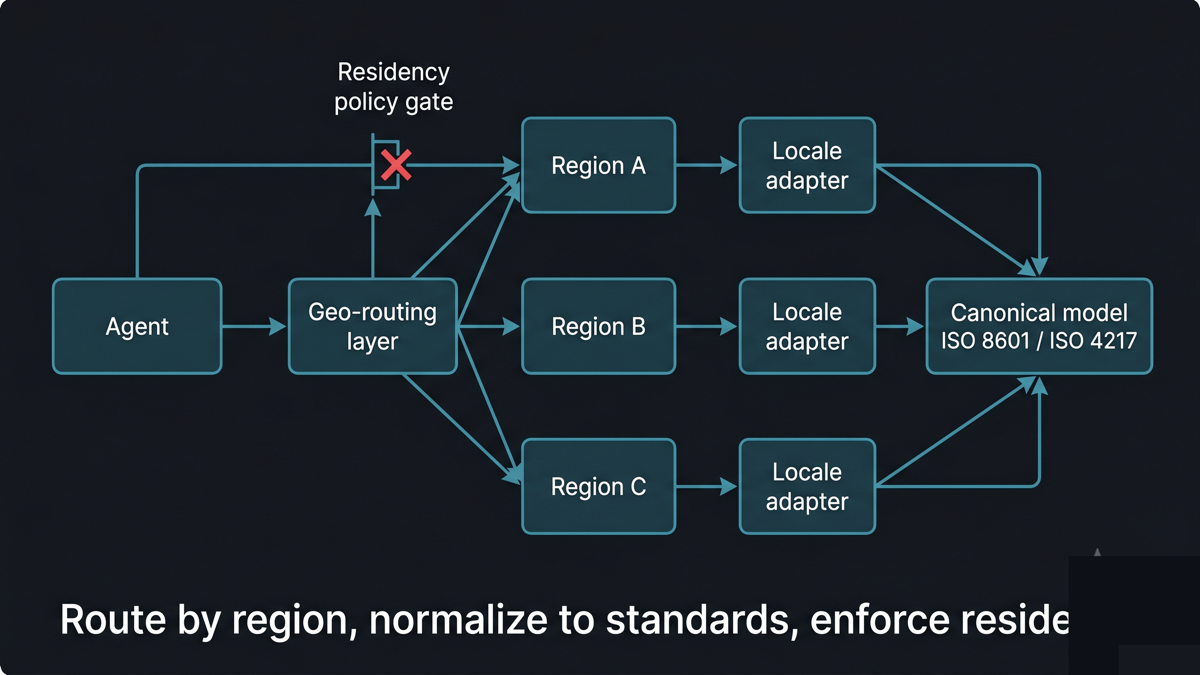
What changes at the border and how to handle it
| Regional difference | Failure | Fix |
|---|---|---|
| Separate regional endpoints | Calls the wrong or blocked region | Geo-aware routing layer |
| Different response schema | Misparse, dropped fields | Per-region adapter to a canonical model |
| Locale date/number/currency | Day read as month, wrong currency | Normalize to ISO 8601 / ISO 4217 |
| Data-residency rules | Silent cross-border violation | Pre-call residency policy engine |
| Region-specific fields | Hallucinated or missing data | Schema generated from each region's spec |
The pattern is that global is not one API, it is a different tool per geography with its own schema, formats, and legal limits, and an agent built against a single assumed surface fails the moment it crosses a border. Route by region, normalize to standards, and enforce residency before the call, and the agent behaves consistently while keeping regulated data in place. Treating each regional boundary as something the agent verifies and routes, rather than assumes, is reliability at the pattern level, which is what VibeModel builds as the Pattern Intelligence Layer.
Frequently asked questions
Why normalize to ISO formats?
Because a raw locale string is ambiguous to the model, a date can be read day-first or month-first, and a bare symbol can map to the wrong currency. Normalizing to ISO 8601 and ISO 4217 removes the ambiguity before the agent reasons.
How does an agent violate residency without storing data abroad?
By processing it abroad. A cross-region tool call, failover, or model route can carry personal data over a restricted border in transit, which the GDPR limits regardless of final storage. Check residency before the call.
Do I need separate agents per region?
No. One agent with a geo-routing layer, per-region adapters, and a residency policy engine handles many regions while presenting the model a single canonical surface.