


Key facts.
- Bain's Technology Report 2025 found companies lack instrumentation across the full development lifecycle and the causal analysis to attribute behavior to a cause, the gap that lets the same agent behave differently in different places. source
- Agents are non-deterministic, producing different outputs from the same input, so behavior diverges across environments unless configuration and policy are governed to be identical. source
- DORA (EU Regulation 2022/2554) requires consistent, documented ICT risk controls across a financial entity, the regulated analogue of governing an agent the same way everywhere it runs. source
- Same agent, different behavior per team is a fleet governance failure, not a model quirk: configs differ and nothing enforced sameness, an upgrade compounds it and the drift is rework. (arXiv:2503.14499)
Why does the same agent behave differently in different places?
Because "the same agent" is usually a fiction. What looks like one agent is a model plus a prompt plus a set of tools plus permission scopes plus a model version plus a policy binding and any of those can differ between staging and production or between two teams that each deployed their own copy. The model gives you non-determinism for free; identical inputs already produce varying outputs. Layer on configuration that differs by environment and the behavior diverges in ways that look mysterious but are entirely governable. Bain's 2025 finding that teams lack lifecycle instrumentation and causal attribution is exactly this gap, because most teams configure each environment by hand and nothing enforces that the configurations match.
A more capable model makes the divergence worse, not better, because more capability means more places for ungoverned configuration to send behavior in different directions. The fix is not a better model; it is governance that treats the agent's full configuration as a versioned, controlled artifact promoted identically across environments. DORA's requirement for consistent, documented ICT controls across a financial entity is the regulated version of the same idea: an organization that runs a control differently in different places does not actually have the control. An agent governed to behave the same everywhere is one whose configuration and policy were promoted, not reinvented, per environment.
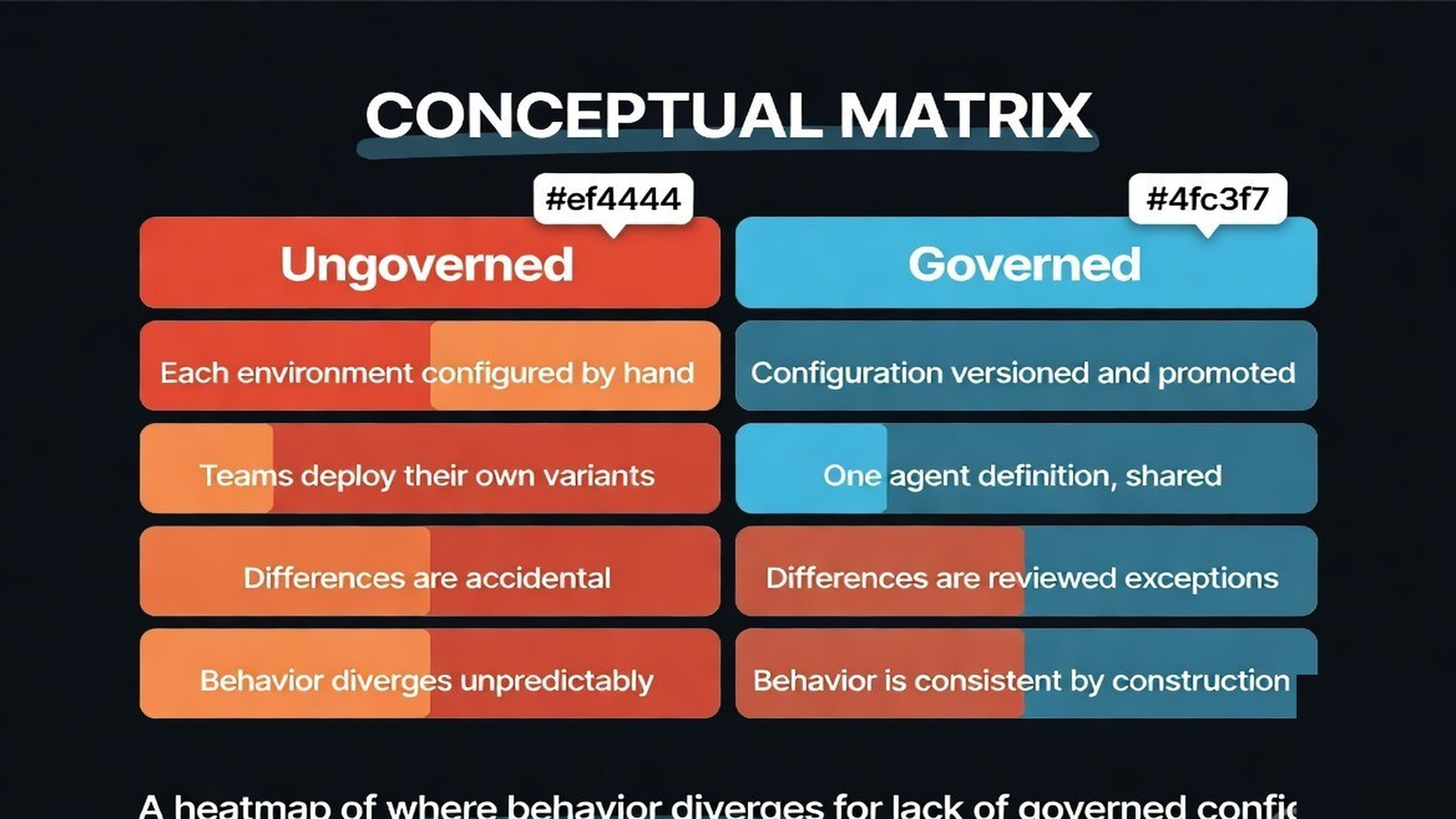
What do you govern to get consistency?
The whole configuration, as one versioned unit. The prompt and its version. The tool set and each tool's scope. The permission grants. The model and model version. The policy bindings that say what the agent may and may not do. Promote that unit across environments unchanged, so production runs what staging validated and every team runs the same governed agent rather than its own variant. Where a difference is genuinely required, it becomes an explicit, reviewed exception, not an accident of local setup.
| Ungoverned | Governed |
|---|---|
| Each environment configured by hand | Configuration versioned and promoted |
| Teams deploy their own variants | One agent definition, shared |
| Differences are accidental | Differences are reviewed exceptions |
| Behavior diverges unpredictably | Behavior is consistent by construction |
The Pattern Intelligence Layer is where consistency becomes governed rather than hoped for. Prompts, tools, scopes, model versions and policy bindings are tracked as one versioned pattern, so the agent behaves the same across environments and teams because the same governed configuration runs everywhere. Reliability at the pattern level is what turns "same agent, different behavior" from a mystery into a controlled property.
Frequently asked questions
Isn't inconsistent agent behavior just non-determinism?
Non-determinism is the floor. The large, repeatable divergences across environments come from ungoverned configuration differences, which are fixable by governing the configuration.
What exactly should be versioned?
The full unit: prompt, tools and their scopes, permissions, model version and policy bindings, promoted unchanged across environments so each one runs the same governed agent.
What if an environment genuinely needs to differ?
Make it an explicit, reviewed exception rather than a local accident. A documented difference is governable; an unnoticed one is the source of the inconsistency.