


Key facts.
- Elite-performing teams have 4x lower change failure rates, largely from testing environment parity across all deployment regions (DORA State of DevOps 2024).
- EU AI Act Article 12 requires logs sufficient for post-hoc analysis; GDPR Articles 44-49 restrict which agent logs can cross borders, creating a compliance gap for globally deployed agents (EU AI Act 2024/1689).
- AWS, Azure, and GCP offer region-specific API features. Some AI services hit us-east-1 months before eu-west-1. Some never reach certain jurisdictions at all.
- NIST AI RMF 1.0 recommends explicitly including geographic and jurisdictional variations as risk factors requiring separate evaluation (NIST AI RMF 1.0).
- Enterprise agents connecting to payment processors, identity services, and communication platforms face different rate limits, response schemas, and feature availability by region, often undocumented in the main API reference.
The three regional failure patterns
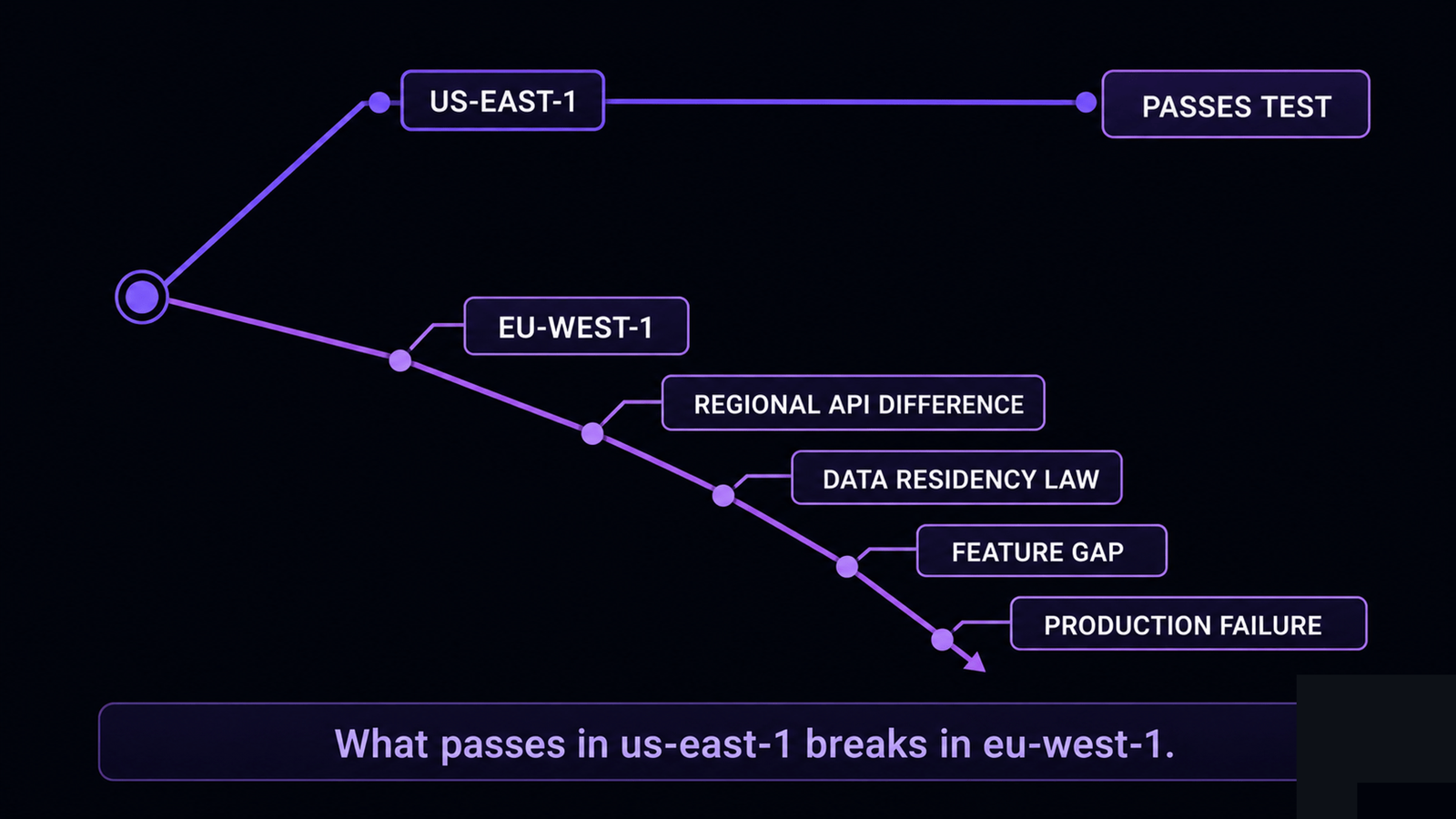
Pass in us-east-1, fail in eu-west-1, and the model never changed, the tools did; a more capable model fails it too. (DORA State of DevOps 2024)
Regional failures cluster into three types. First: feature availability. A tool the agent depends on isn't in the target region, the agent calls an endpoint that doesn't exist or a fallback that returns a different schema. Second: data residency. The agent tries to retrieve or write customer records across a jurisdictional boundary the data governance layer blocks at the API level. Third: schema variance. The same endpoint returns different field names, date formats, or currency handling by region.
All three fail silently unless the scaffolding validates responses against region-specific schemas. A date returned as "MM/DD/YYYY" in the US and "DD/MM/YYYY" in the UK parses without error in most systems. The wrong appointment doesn't announce itself until the customer calls back.
Building region-aware agent architecture
Treat region as a first-class configuration parameter for every tool call, not an environment variable set at deployment time. Each tool wrapper carries a region context that routes to the correct endpoint, applies the correct schema transformation, and enforces the correct data residency rules. Integration tests run against regional sandbox environments for every region in scope, not just the primary deployment target.
GDPR's data residency requirements add a governance layer: agents processing EU citizen data can't route tool calls containing that data through non-EU infrastructure. Most agent frameworks have no native concept of data-residency-aware tool routing. You have to build and test it explicitly, because the failure mode is a compliance incident, not a crash.
Regional compliance and feature gaps
| Failure type | Example | Detection method | Mitigation |
|---|---|---|---|
| Feature unavailable | AI service not in target region | Regional integration tests | Fallback tool or regional routing |
| Schema variance | Date format differs by locale | Schema validation per region | Normalization layer in tool wrapper |
| Data residency block | GDPR restricts cross-border data | API returns 403 or data omitted | Data-residency-aware routing |
| Rate limit variance | Lower limits in restricted regions | Rate limit header parsing | Region-specific throttle config |
VibeModel's Pattern Intelligence Layer surfaces regional failure patterns by learning which tool call sequences fail consistently in specific deployment contexts. When a pattern that succeeds in 98% of us-east-1 sessions shows a 40% failure rate in eu-west-1, the system flags the discrepancy before it becomes a production incident. Regional variance is a pattern problem, not a model problem, and pattern-level detection is where it gets caught.
Frequently asked questions
Do we need separate agent deployments per region?
Not necessarily, but you need region-aware tool configuration for every deployment. A single codebase can serve multiple regions if the tool wrappers carry region context and integration tests cover each target region explicitly.
How do we find regional API differences before production?
Get region-specific sandbox access from your API vendors and run your full integration test suite against each. Most vendors offer regional sandboxes but don't document regional schema differences in their main docs.
Is data residency compliance the agent's responsibility or the platform's?
Both. The platform enforces at the infrastructure level; the agent scaffolding must know which data categories are residency-restricted and route tool calls accordingly. Neither alone is enough.