


Key facts.
- Med-HALT tests memory-based hallucination, the failure of recalling or retrieving correct information, as distinct from reasoning hallucination. source
- Retrieving the correct medical record or fact is a distinct, failure-prone task for LLMs, not a solved one. source
- In EHR and claims systems, retrieving the wrong record or writing the wrong field has direct clinical or billing consequences. source
Why is EHR integration uniquely error-prone?
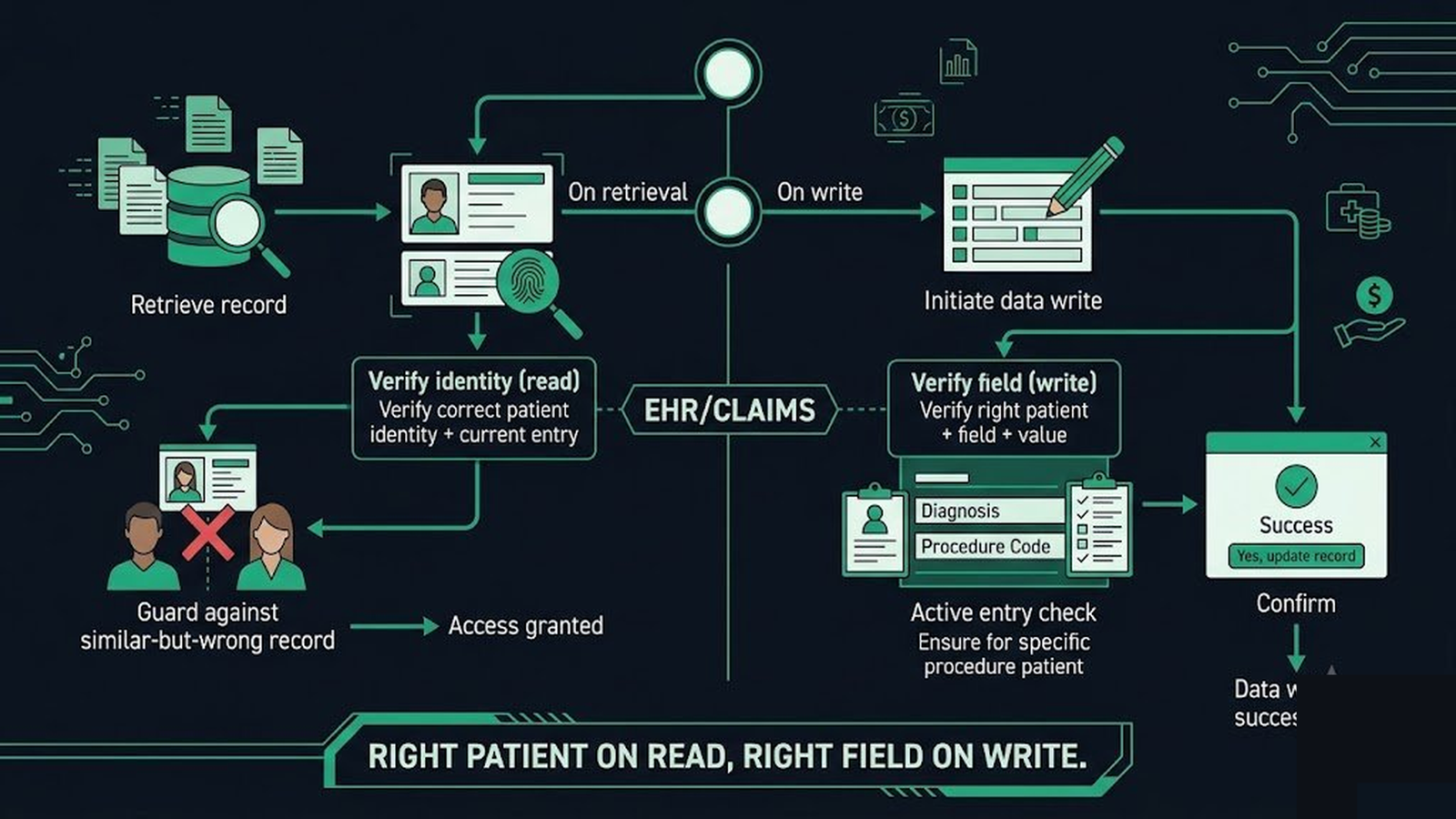
Because the agent has to read and write the patient record correctly and both retrieval and writing are tasks LLMs fail at, in a context where the failure has clinical weight. Med-HALT's inclusion of memory-based hallucination as a distinct test category is the relevant signal: recalling or retrieving the correct information is a separate failure mode from reasoning and models fail at it, which in an EHR context means the agent can retrieve the wrong patient's record, pull an outdated or incorrect entry or confuse one record for another that looks similar. On the writing side, the integration has the same parameter-and-field correctness problem that breaks agents at tool boundaries generally, but here a wrong field is a wrong medication on a record, a wrong code on a claim, a wrong entry on a patient's chart. So the EHR and claims integration concentrates two failure modes, wrong retrieval and wrong write, in the one system where being wrong has the most consequence, because the data is a patient's medical and billing record. An agent that summarizes a patient's history from the wrong record or writes an update to the wrong patient, has made an integration error that is also a clinical or compliance error and the smooth interaction around it can hide that the underlying record operation went to the wrong place. The boundary with the EHR is both the most critical and the most failure-prone part of a healthcare agent's operation.
The similarity of records makes retrieval especially risky. Patients with similar names, repeated visit types and standardized record structures create many opportunities for the agent to retrieve a plausible but wrong record and a memory-based hallucination here is not a citation error, it is acting on the wrong person's medical data.
What makes EHR integration safe?
Verification of identity on retrieval and field on write, at the EHR boundary. On retrieval, confirm the agent pulled the correct patient's record and the current, correct entry, with identity checks that prevent acting on a similar-but-wrong record. On write, validate that the update targets the right patient and the right field with the right value before it is committed and verify the record reflects the intended change after. Treat the EHR and claims boundary as the most consequential integration, because a retrieval or write error here is a clinical or billing error and never trust the agent's smooth interaction as evidence the underlying record operation was correct. The verification at this boundary is what keeps the agent from acting on or writing to the wrong patient's record.
| EHR integration handling | Result |
|---|---|
| Trust the agent's retrieval and write | Wrong record acted on, wrong field written |
| Verify identity on read, field on write | Correct patient and entry confirmed |
Verifying that boundary is part of what VibeModel does as the Pattern Intelligence Layer. We model the patterns of a correct record retrieval and write in EHR and claims systems and verify patient identity and field, so a healthcare agent operates on the right patient's record rather than a plausible wrong one.
Frequently asked questions
Why is retrieval a distinct risk?
Med-HALT tests memory-based hallucination separately because recalling or retrieving the correct information is its own failure mode and in an EHR that means the wrong record.
Why are similar records dangerous?
Similar names and standardized structures create many chances to retrieve a plausible but wrong record, which means acting on the wrong patient's data.
What must integration verify?
Correct patient identity on retrieval and correct patient, field and value on write, with confirmation that the record reflects the intended change.