


Key facts.
- Med-HALT's False Confidence Test measures whether a model can judge the validity of a medical answer and models often cannot, so confidence is not a safe basis for action. source
- Medical hallucinations carry clinical consequences, so being wrong in healthcare can harm a patient, not just produce an error. source
- When the agent cannot self-assess and the stakes are clinical, verification, governance and human oversight are the conditions of responsible deployment. source
Why are these non-negotiable in healthcare?
Because the two things that would let you trust an agent more, its ability to know when it is wrong and a low cost of being wrong, are both absent in healthcare. Med-HALT's False Confidence Test directly measures the first, whether a model can judge the validity of its own medical answer and the finding that models often cannot means you cannot rely on the agent's confidence to tell you when to trust it; a confident medical answer and a wrong one look the same. The second, the cost of error, is uniquely high here, because a wrong medical action can harm a patient, which is why research specifically studies the healthcare impact of medical hallucinations. Put those together and the conclusion is forced: an agent that cannot tell when it is wrong, operating where being wrong can hurt someone, has to be wrapped in verification that catches its errors, governance that bounds what it is allowed to do and human oversight on the consequential decisions, because none of those can be replaced by the agent's own judgment. This is the same conclusion that recurs across every domain, planning, support, coding, finance, HR, legal, supply chain, IT ops, that the agent proposes and a verified, governed, overseen system decides and in healthcare it stops being a best practice and becomes a hard requirement, because the patient is the one who bears the cost of getting it wrong.
This is the throughline of the whole series. Across domains, the failures share a root: agents act confidently on outputs they cannot verify, in systems where the consequence of being wrong is real. The fix is consistently the same, verification, governance and oversight built around the agent and healthcare is where that fix is least optional, because the stakes are a person's health and the agent's confidence is documented to be untrustworthy as a guide to its own accuracy.
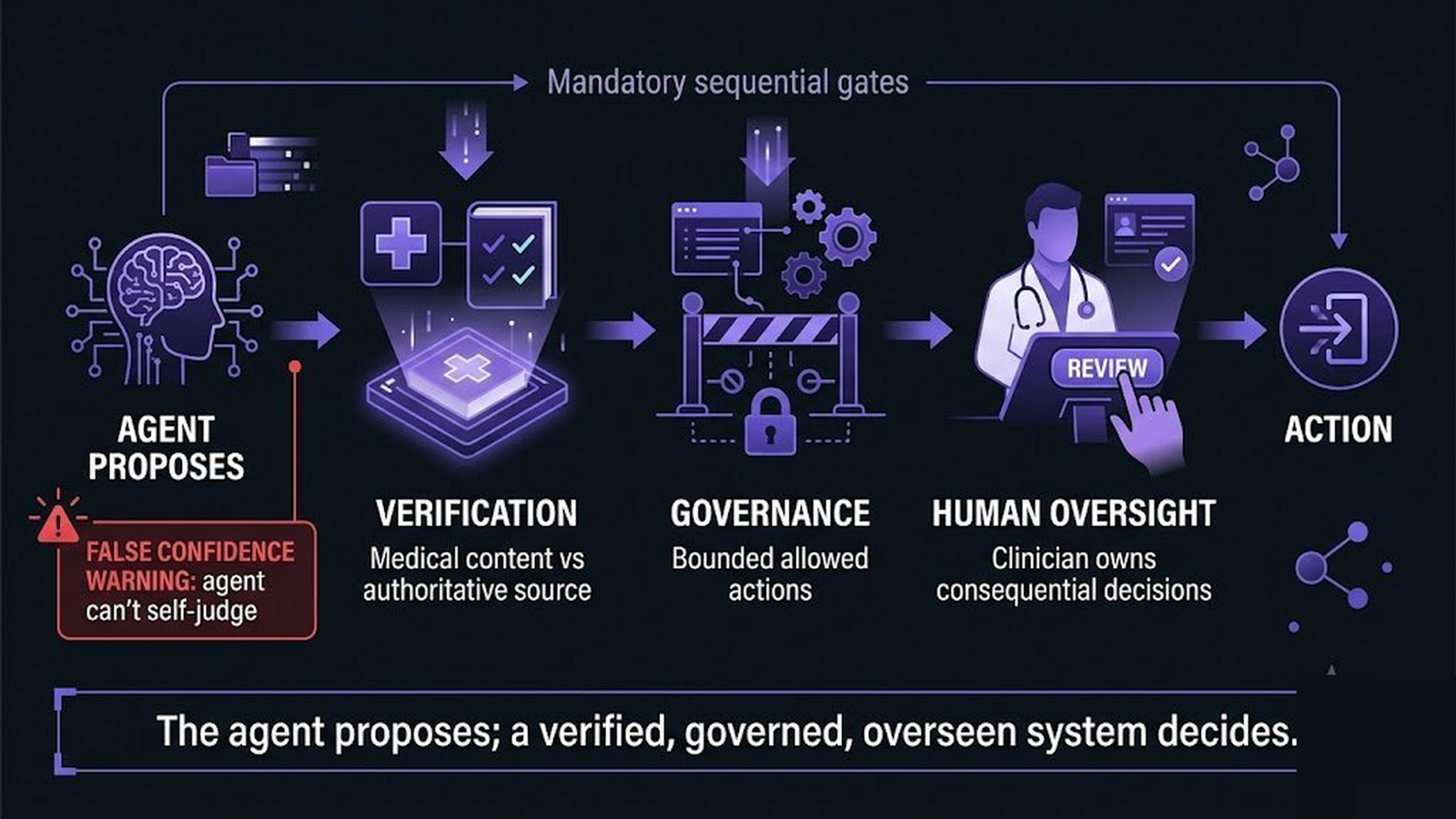
What does responsible healthcare deployment require?
Verification of the agent's medical outputs, governance of its allowed actions and human oversight on consequential decisions, all as hard requirements. Verify medical content against authoritative sources before any action, because the agent cannot judge its own validity. Govern what the agent is permitted to do, bounding it to actions whose errors verification can catch and keeping irreversible or high-consequence clinical actions out of its unilateral reach. And keep human oversight on the decisions where a wrong call harms a patient, so a clinician owns the consequential judgment. These are the conditions of responsible use, not optional safeguards, because the agent's confidence is not a reliable signal and the cost of error is clinical. The healthcare agent that earns deployment is the one that proposes within a verified, governed, overseen system, which is the lesson of the whole series made absolute by the stakes.
| Deployment posture | Outcome when the agent is wrong |
|---|---|
| Trust the agent's confident output | A wrong medical action reaches a patient |
| Verified, governed, human-overseen | The error is caught before it causes harm |
Medical hallucinations carry clinical harm and Med-HALT shows models cannot judge their own answers; a more capable model inherits both, so oversight is the condition of use. (arXiv:2307.15343)
Building that verified, governed, overseen system is the core of what VibeModel does as the Pattern Intelligence Layer. We model the patterns a healthcare agent must satisfy and where verification and human oversight belong, so the agent proposes and a reliable system decides, which across every domain and most of all in healthcare, is what turns a capable agent into a trustworthy one.
Frequently asked questions
Why can't I trust a confident healthcare agent?
Because Med-HALT's False Confidence Test shows models often cannot judge the validity of their own medical answers, so confidence does not indicate correctness.
Why is healthcare the strictest case?
Because the agent cannot self-assess and the cost of error is clinical, harm to a patient, so verification, governance and oversight become hard requirements.
Is this conclusion unique to healthcare?
No, it recurs across every domain: the agent proposes and a verified, governed, overseen system decides. Healthcare makes it absolute because of the stakes.