

Even purpose-built legal AI with retrieval still invents law: leading tools hallucinated roughly 17% to 33% of the time, and general models far more.In a regulated domain the company that deploys the agent owns every one of those errors, so a usually-right model is still a liability machine without verification (Hallucination-Free? Assessing Legal AI Tools, arXiv:2405.20362, 2025).

Key facts.
- General models hallucinate heavily on verifiable legal questions: rates ran from about 58% for GPT-4 to about 88% for Llama 2 on specific federal-court case queries (Large Legal Fictions, arXiv:2401.01301, 2024).
- Specialized legal tools don't remove the problem: leading retrieval-augmented legal research tools still hallucinated roughly 17% to 33% of the time (Hallucination-Free? Assessing Legal AI Tools, arXiv:2405.20362, 2025).
- Liability lands on the deployer: a tribunal held Air Canada responsible for its chatbot inventing a refund policy and rejected the argument that the chatbot was a separate legal entity (Moffatt v. Air Canada, 2024 BCCRT 149).
Why does regulation force verification?
Because regulated decisions carry duties an unverified agent can't meet. Health and legal contexts demand auditability, accountability, non-discrimination, and data minimization, the minimum-necessary handling of personal information, and an agent that produces a fluent answer with no record of how it got there satisfies none of them. The HIPAA Security Rule requires audit controls and technical safeguards over protected health information, so an agent touching that data needs access control, sanitization, and an immutable log by design. Without a verification layer there's no reliable audit trail, no enforcement of minimum-necessary disclosure, and no defensible basis for a decision that affects someone's care or rights. Regulators are codifying this directly: under the EU AI Act, high-risk AI systems must meet traceability, record-keeping, and human-oversight obligations, with the high-risk rules applying from August 2, 2026 (Regulation (EU) 2024/1689). Verification is how an agent's output becomes something a regulator can inspect and an organization can stand behind.
Why isn't a careful model enough?
Because the error rates are high and the mistakes are fluent. On specific, verifiable legal questions, general models hallucinated most of the time, from about 58% to about 88% depending on the model, and they often failed to correct a user's false premise (Large Legal Fictions). Purpose-built legal tools with retrieval improved things but didn't solve them, still hallucinating roughly 17% to 33% of the time, including fabricated citations and misattributed cases (Hallucination-Free?). These errors are confident and plausible, which is exactly what makes them dangerous in a domain where a wrong citation or a wrong eligibility determination has legal weight, and where the deployer pays: Air Canada was held liable for its chatbot's invention and couldn't offload the blame onto the bot (Moffatt).
What does a compliant verification layer look like?
Mandatory checks before any regulated action, plus a record of everything. Put an automated verifier between the agent and the action, ground every factual claim against authoritative sources and verify citations, validate outputs against domain rules, valid medical codes, refund eligibility, jurisdiction, and require human review for any decision affecting rights, payments, or protected health information. Keep an immutable, queryable audit log of every input, output, and verification result, sized to the retention the rule demands. Enforce access control and data minimization technically, not by prompt, and put the right contracts in place, a business associate agreement where health data is involved. Audit the verification layer itself on a schedule. The agent then operates inside controls that make its decisions auditable and its errors catchable before they reach a patient or a court.
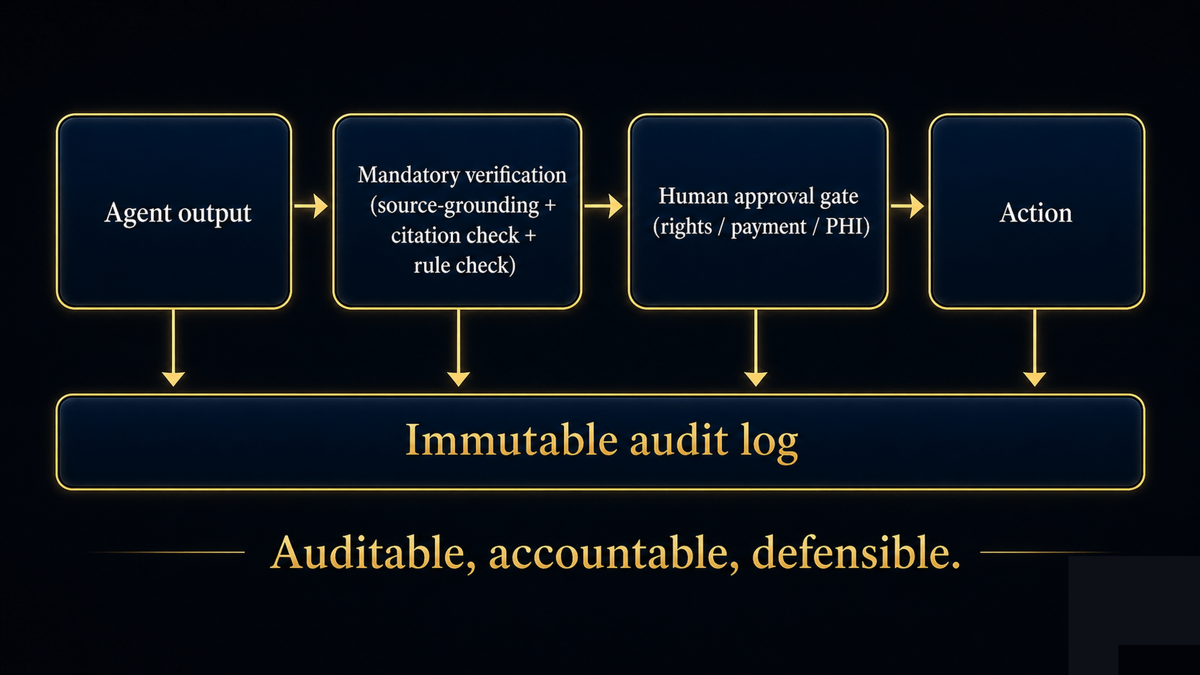
Why regulated domains demand more
| Regulatory duty | Unverified agent | Verification layer |
|---|---|---|
| Auditability | No record of reasoning | Immutable input/output/verify log |
| Accuracy of facts | 58-88% hallucination on legal Qs | Source-grounded citation verification |
| Minimum necessary (PHI) | Over-broad data access | Access control + sanitization |
| Accountability | Deployer liable anyway | Human gate on rights/payment/PHI |
| Defensibility | Fluent, unprovable answer | Validated, logged decision |
At volume the hallucination is liability; a more capable model still misstates verified facts, so the audit trail is cost. (arXiv:2405.20362)
The pattern is that in healthcare and law the standard isn't usually right, it's auditable, accountable, and defensible, and the deployer owns the liability when a fluent answer is wrong. Ground facts, validate against domain rules, gate high-impact decisions to a human, and log everything immutably, and the agent meets the duty instead of becoming the liability. Making mandatory verification and audit a built-in layer rather than an afterthought is reliability at the pattern level, which is what VibeModel builds as the Pattern Intelligence Layer.
Frequently asked questions
Doesn't retrieval-augmented generation fix legal hallucination?
It reduces it but doesn't remove it: leading legal RAG tools still hallucinated roughly 17-33% of the time, including fabricated and misattributed citations. In regulated work you still need citation verification and human review.
who's liable when the agent is wrong?
The organization that deployed it. A tribunal held Air Canada responsible for its chatbot's invented policy and rejected the idea that the bot was a separate legal entity, so the deployer can't offload the blame.
what's non-negotiable for a HIPAA-touching agent?
Technical access control and data minimization over protected health information, an immutable audit trail, and human review on decisions that affect care or eligibility, backed by the appropriate agreements, not a prompt asking the model to be careful.