


Key facts.
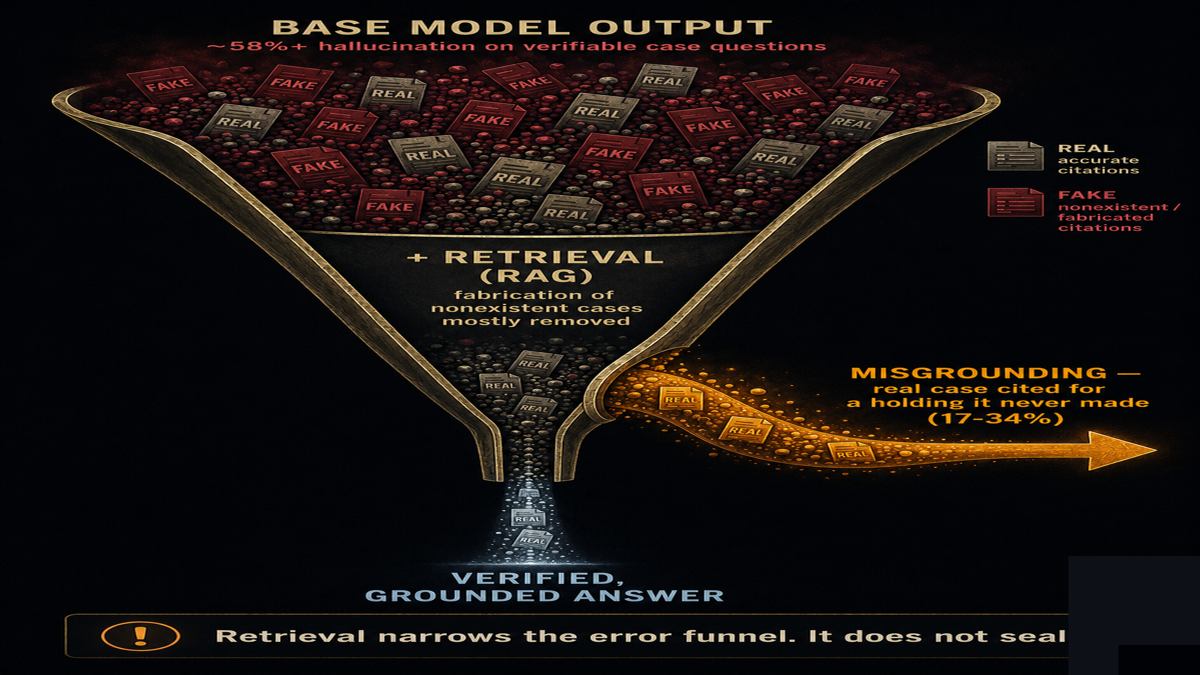
- Base LLMs hallucinate on at least58%of direct, verifiable questions about federal cases; GPT-4 was best at roughly 58%, Llama 2 worst at about88%(Dahl, Magesh, Suzgun & Ho,"Large Legal Fictions," arXiv:2401.01301, J. Legal Analysis, 2024).
- With retrieval, the leading commercial tools still hallucinate: the preregistered Stanford RegLab study found Lexis+ AI and Thomson Reuters tools wrong17% to 33%of the time, and Westlaw AI-Assisted Research above34%(Magesh et al., "Hallucination-Free?", preregistered March 2024; J. Empirical Legal Studies, 2025).
- Those tools were marketed as "hallucination-free." The study called the claims overstated; Thomson Reuters disputed the exact numbers and cited lower internal results (Stanford RegLab, 2024).
- Lawyers are already paying. Mata v. Avianca (S.D.N.Y., June 2023): $5,000 sanction for a brief full of fabricated ChatGPT citations. The follow-on cases in 2024-2025 kept coming, Gauthier v. Goodyear (E.D. Tex., 2024) among them.
Retrieval fixes the name. It doesn't fix the reading.
From the gap between retrieving a document and understanding it. Retrieval-augmented generation does one thing well: it pulls real documents from a real corpus, which mostly stops the model from inventing a case name and citation wholesale. But the model still has to read what it retrieved, pick the relevant passage, and state the holding accurately, and that's a reasoning task retrieval doesn't touch. So the dominant failure shifts from fabrication tomisgrounding: the tool cites a real, findable case, but for a proposition that case doesn't support. The citation checks out in the reporter. The holding attached to it's fiction. that's more dangerous than an obviously fake case, because a real citation carries a real signal of authority, and a busy reader who confirms the case exists may never confirm it says what the model claims.
How big is the gap between the marketing and the measurement?
| System | Measured hallucination rate |
|---|---|
| Base GPT-4 (no retrieval) | ~58%+ on verifiable case questions (Dahl et al., 2024) |
| Lexis+ AI (retrieval) | ~17%+ (accurate on ~65% of queries) |
| Westlaw AI-Assisted Research (retrieval) | above 34% |
| Thomson Reuters Ask Practical Law AI | accurate only ~18% of the time; often incomplete |
Retrieval roughly halves the base-model error rate, which is real progress, and also lands nowhere near the "hallucination-free" that the products were sold on. For most software a one-in-five error rate is a quality bug. For a legal filing it's a professional-responsibility problem, because the lawyer who signs the brief owns every citation in it.
So what actually keeps you out of trouble?
Retrieval kills invented names, not the 17 to 34 percent a newer model still misgrounds; the sanction is late. (arXiv:2401.01301)
Treat the tool as a starting point. Verify against the primary source every time. Does the cited case actually stand for that proposition, in that jurisdiction, without being overruled? Use tools that link to the source passage so verification is fast. Citation check is a required step, not optional. Keep a human signature on anything that leaves the building. This is the same duty of candor that predates AI, applied to a tool that's confident, fluent, and wrong often enough to matter. Retrieval shifts the error from "invented case" to "misread real case." Harder to catch. Verification has to be at the level of the proposition. That's what VibeModel's Pattern Intelligence Layer builds into the loop.
Frequently asked questions
Doesn't retrieval make legal AI safe to rely on?
It makes it safer, not safe. The leading retrieval-backed tools still hallucinate 17-34% of the time in Stanford's testing, much of it misgrounding, so unverified reliance is still how lawyers get sanctioned.
what's misgrounding, exactly?
The tool cites a real, existing case, but for a holding or proposition that case doesn't actually support. The citation is verifiable; the legal claim attached to it's wrong.
Did the vendors accept these numbers?
Not fully. Thomson Reuters disputed the rates and pointed to lower internal testing; Stanford stood by its preregistered, expert-coded methodology and called the "hallucination-free" marketing overstated.