

Key facts.
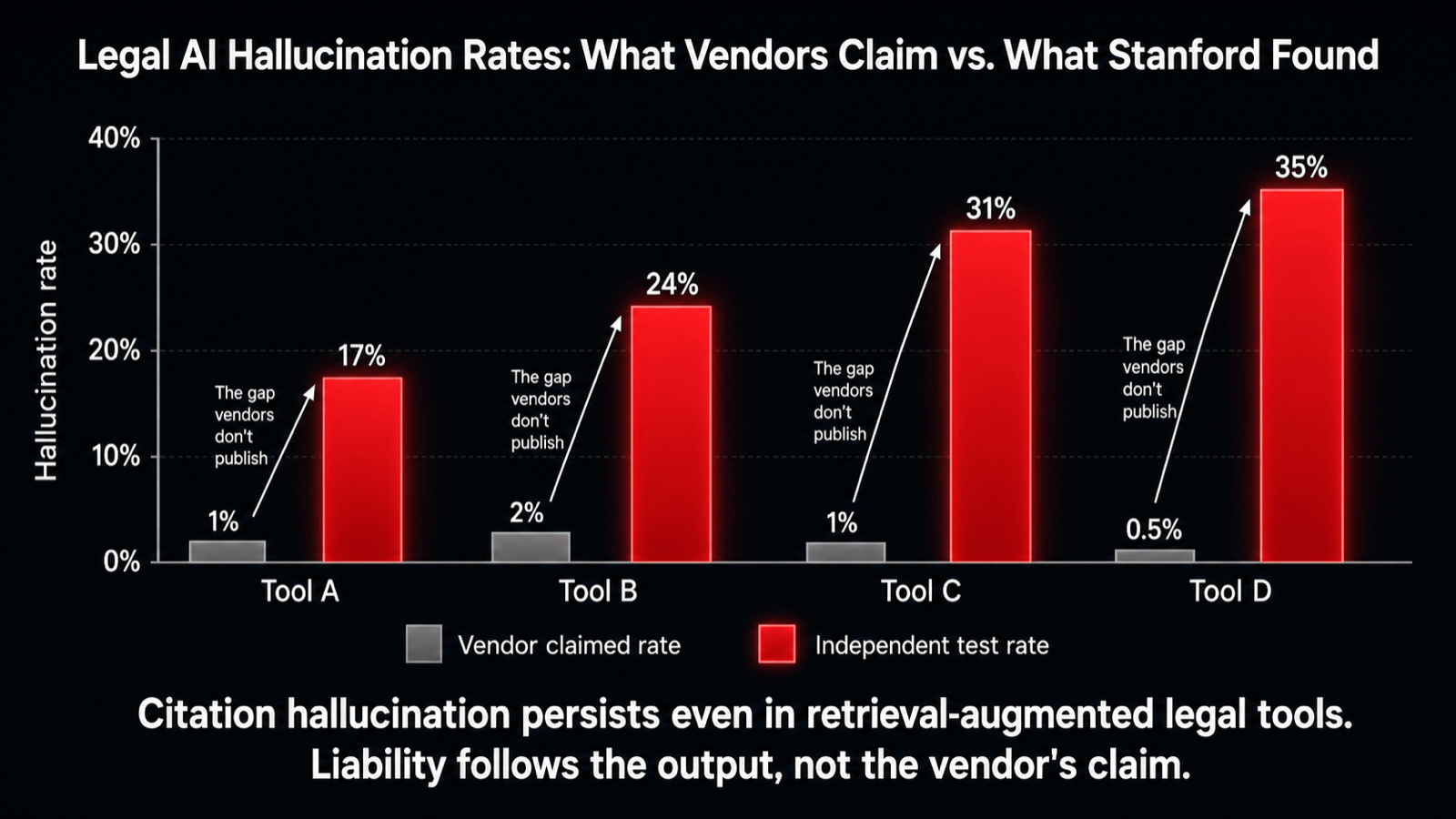
- A Stanford study found Lexis+ AI hallucinated ~17% of the time and Westlaw AI-Assisted Research ~33%, with GPT-4 at ~43%, despite vendor hallucination-free claims. source
- These were retrieval-augmented tools marketed specifically as avoiding hallucination, so RAG reduced but did not eliminate it. source
- It was the first preregistered empirical evaluation of AI legal research tools, testing the vendors' reliability claims directly. source
Why does a hallucination-free claim fail?
Because retrieval reduces hallucination without removing it and the gap between reduced and eliminated is exactly where liability lives. The vendors had a real point: grounding a legal answer in retrieved authority does cut fabrication substantially compared to an ungrounded model. But the Stanford study, the first rigorous test of these claims, found the leading tools still hallucinated between roughly one in six and one in three responses, which is far from the zero the marketing implied. In law, that residual rate is not a minor caveat, it is the rate at which a tool you were told to trust will hand you a fabricated case, a misstated holding or an invented citation and if you relied on the hallucination-free claim and skipped verification, you filed it. The liability does not care that the tool was better than an ungrounded model; it cares that you presented a fabrication as authority and the Mata-style consequences follow. A claim of hallucination-free that is actually 17 to 33% fallible is, for liability purposes, a trap, because it invites the exact over-reliance that produces sanctions.
The lesson is to treat the vendor's reliability claim as a marketing position, not a verification substitute. Even the best-performing tool in the study fabricated at a rate no careful lawyer would accept unverified, so the residual risk has to be managed by you, not assumed away by the label on the product.
How do you manage the liability?
Assume the tool hallucinates and build verification around it regardless of the vendor's claim. Treat every cited authority and stated holding as requiring confirmation against the real source, because even the retrieval-grounded tools fabricate at a measurable rate. Do not let a hallucination-free claim reduce your verification, since the study shows that claim does not hold and the over-reliance it invites is precisely what creates liability. The tool can accelerate research; it cannot discharge your duty to verify and the residual error rate the marketing omitted is the rate at which skipping verification will eventually cost you.
| Treatment of the tool | Liability exposure |
|---|---|
| Trust the hallucination-free claim | Over-reliance on a 17-33% fallible tool |
| Assume it hallucinates, verify | Residual error caught before it is filed |
Managing that residual risk is part of what VibeModel does as the Pattern Intelligence Layer. We model the patterns of a legal claim that must be verified regardless of the tool's marketing, so the residual hallucination the vendor did not advertise is caught before it becomes your liability.
Frequently asked questions
Does retrieval not fix legal hallucination?
It reduces it substantially but not to zero. The Stanford study found leading RAG legal tools still hallucinated 17-33% of the time.
Can I rely on a vendor's hallucination-free claim?
No. The study tested those claims and found them false. Treat the claim as marketing and verify regardless.
Why is a reduced rate still a liability?
Because in law presenting any fabrication as authority is the violation and a 17-33% rate guarantees it will happen if you do not verify.