


Key facts.
- Mata v. Avianca: six fabricated cases filed without a check, $5,000 sanction, competent lawyers and model. The failure was skipped verification, not model weakness.source
- Legal AI hallucinates at meaningful rates regardless of model generation, so the controls that matter are verification, grounding and human review.source
- Firms that avoid sanctions made verification non-skippable. Firms that got sanctioned treated it as optional under pressure.source
Why is verification the dividing line?
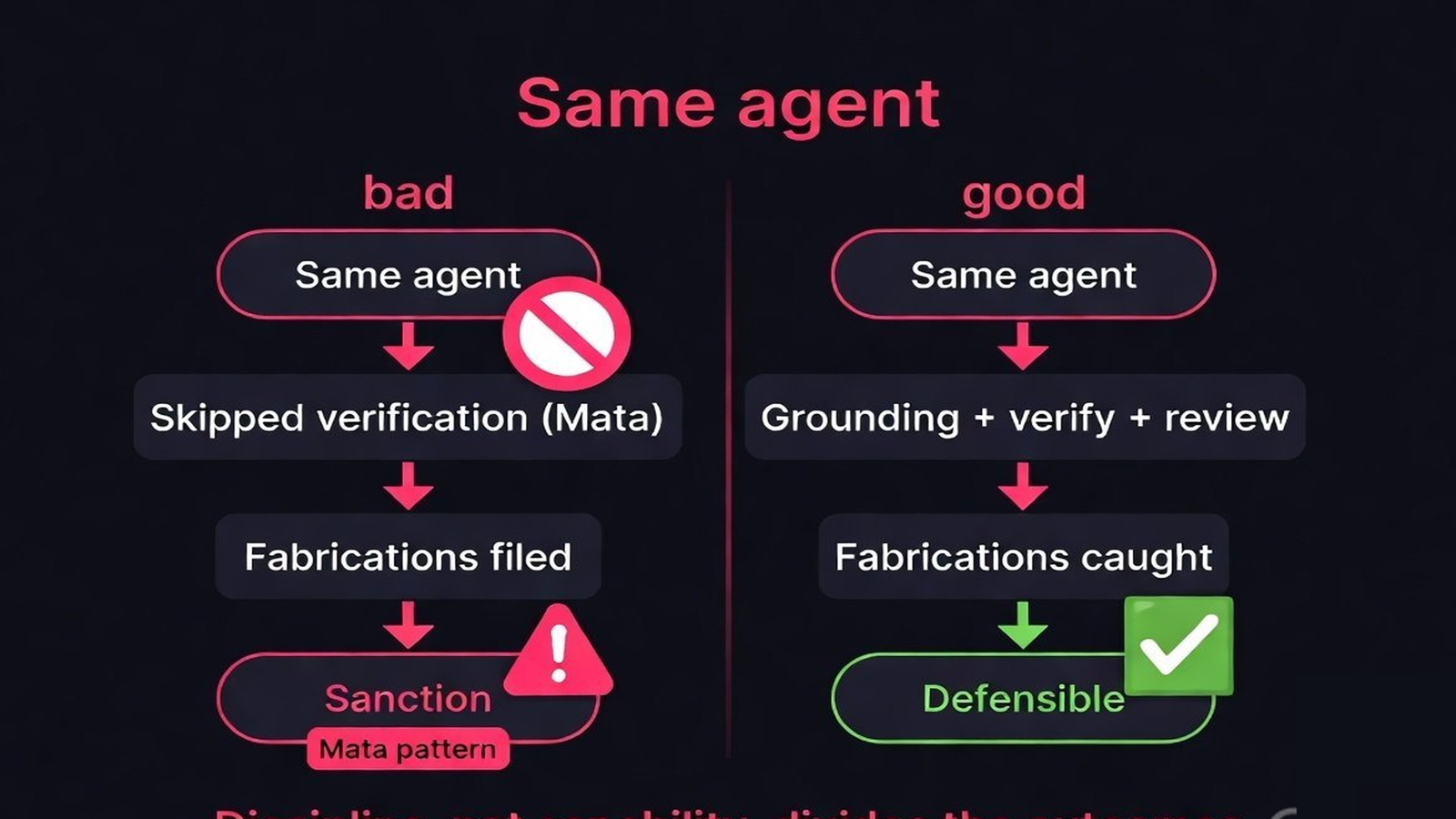
Mata v. Avianca was not a capability problem. Both lawyers and model were competent. What killed them was no enforced verification step, so six fabricated cases went straight into a federal filing. A smarter model would have changed nothing. The fabrication rate is knowable and constant; what varies is whether the workflow catches it before it reaches a court. Legal AI fails at that last step when verification is optional, pressured out, or just not built in. The firms that are running this well grounded their agents in real authority, made citation checks non-skippable and put a human between the agent's output and anything consequential. That's it. Same tools as Mata, opposite result.
Legal AI does not change a lawyer's duties. It just makes it faster to produce unverified work. The duty to check authority predates the technology; the agent just raises the stakes on skipping it. Use it to draft fast, then verify hard. That sequencing is what separates a $5,000 sanction from a working deployment.
What does a working legal deployment build in?
Start by grounding the agent in real, current, jurisdiction-specific authority. That alone cuts the fabrication rate. Then make citation checks non-skippable on anything consequential. A lawyer under pressure will skip optional steps; the workflow has to remove the option. Add a human review gate before any output reaches a court, client or counterparty. Log what got verified, so the record is defensible. Those four things, together, are what the careful firms built after Mata. Not new technology. Not a better model. Just workflow discipline that the original Mata team didn't have.
| Deployment | Outcome |
|---|---|
| Capable agent, verification skippable | Fabrications filed, sanctions (the Mata pattern) |
| Grounding, enforced verification, human review | Fabrications caught, work defensible |
Mata's lawyers and model were both capable; the $5,000 sanction cost came from skipped verification a more capable model won't do for you. (arXiv:2405.20362)
Building that discipline into the workflow is part of what VibeModel does as the Pattern Intelligence Layer. We model the patterns of grounding, verification and review a legal deployment needs, so your legal agent is used like the deployments that work rather than the one that became the cautionary case every lawyer now cites.
Frequently asked questions
Was Mata v. Avianca a capability failure?
No. The lawyers and the model were capable. The failure was the absence of verification before filing, which is a workflow discipline issue, not a model one.
Does a better model reduce the risk?
Only marginally. The tools still hallucinate at meaningful rates, so verification and human review remain the controls that determine success.
What is the core of a working deployment?
Grounding in real authority, enforced verification of every citation and claim, mandatory human review and a defensible record.