


Key facts.
- Stanford found the leading AI legal research tools hallucinated about 17% to 33% of the time, so a meaningful share of outputs contain a fabrication a human must catch. source
- The residual error rate persists even with retrieval grounding, so no current tool is reliable enough to skip review on consequential work. source
- The professional and legal consequences of an uncaught fabrication fall on the lawyer, making review a duty rather than an option. source
Why must the review gate be mandatory?
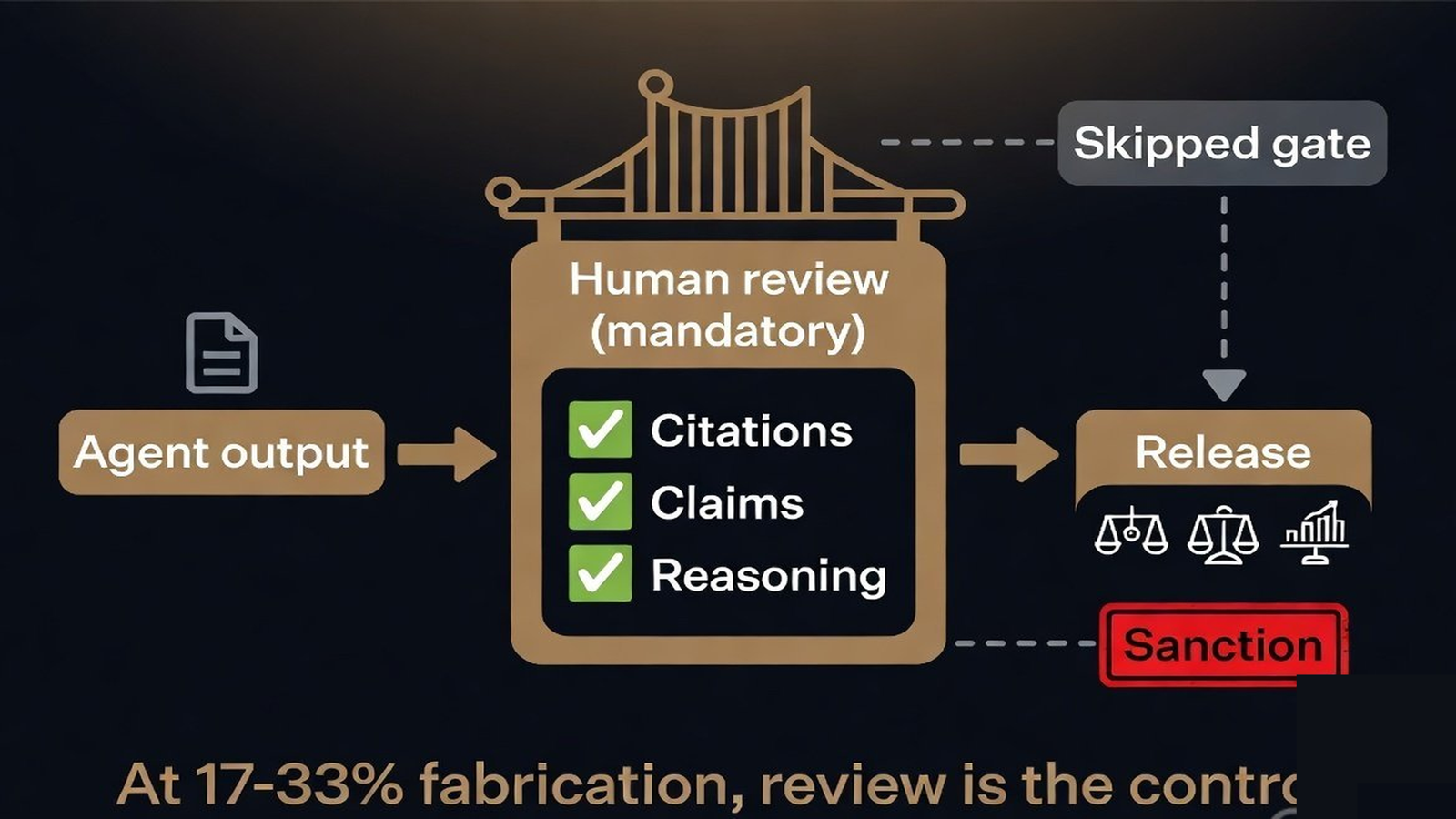
Grounded legal tools still hallucinated 17% to 33% in Stanford's test; an upgrade trims that, so review is the gate before a costly sanction. (arXiv:2405.20362)
Because the error rate is high enough that skipping review is not a calculated risk, it is a near-certain eventual failure. The Stanford numbers make the math concrete: at a 17 to 33% hallucination rate, a lawyer who relies on the agent's output without review will, across enough filings, present a fabrication to a court or a client and the consequences, sanctions, malpractice exposure, harm to the client, fall on the lawyer, not the tool. So the review gate is not there to improve quality at the margin; it is there because the base rate of fabrication guarantees that unverified output will eventually be wrong in a way that matters. Making review mandatory rather than discretionary removes the failure mode where time pressure or misplaced trust lets an output through unchecked, which is exactly how the well-known sanctions cases happened. The gate has to be a hard requirement, positioned before any output reaches a destination where an error has consequences, because a discretionary review is one that gets skipped on the busy day that produces the sanctionable filing.
The position of the gate matters as much as its existence. It belongs before the output leaves the lawyer's control, on any work that will be filed, sent or relied upon, because that is where the residual error turns into a professional failure. Internal drafts can tolerate lighter review; anything consequential cannot.
What does effective review require?
A defined, enforced gate with the right scrutiny for the stakes. Require human review of every agent output destined for a court, client or counterparty, with the reviewer checking citations against authority, claims against the law and reasoning for soundness, the verification the residual hallucination rate demands. Match the depth of review to the consequence, lighter for internal drafts, rigorous for filings and make the gate non-skippable for high-stakes work. The agent accelerates the drafting; the human review is what makes the output safe to rely on and at a 17 to 33% fabrication rate that review is the difference between a useful tool and a liability.
| Review posture | Outcome at 17-33% hallucination |
|---|---|
| Discretionary or skipped | Fabrication eventually filed, sanctions |
| Mandatory gate before release | Residual error caught before consequence |
Placing that gate correctly is part of what VibeModel does as the Pattern Intelligence Layer. We model the patterns of an output that requires human review before release, so the legal agent's residual fabrication is caught at a mandatory gate rather than discovered after it has reached a court or a client.
Frequently asked questions
Can a good enough tool remove the need for review?
Not currently. Even the best legal tools tested hallucinate 17-33% of the time, which is far too high to skip review on consequential work.
Why make review mandatory rather than encouraged?
Because discretionary review gets skipped under time pressure, which is how the known sanctions cases happened. A hard gate removes that failure mode.
Where should the gate sit?
Before any output reaches a court, client or counterparty, with depth of review matched to the stakes of the work.