


Key facts.
- Large Legal Fictions found LLM hallucination rates of 58% to 88% on specific legal questions, so a meaningful share of outputs contain fabrications. source
- When legal work is challenged, the defense requires showing how it was produced and that it was verified against authority. source
- An after-the-fact reconstruction of how an output was produced is weaker than a contemporaneous record, especially under scrutiny. source
Why is the audit trail the defense?
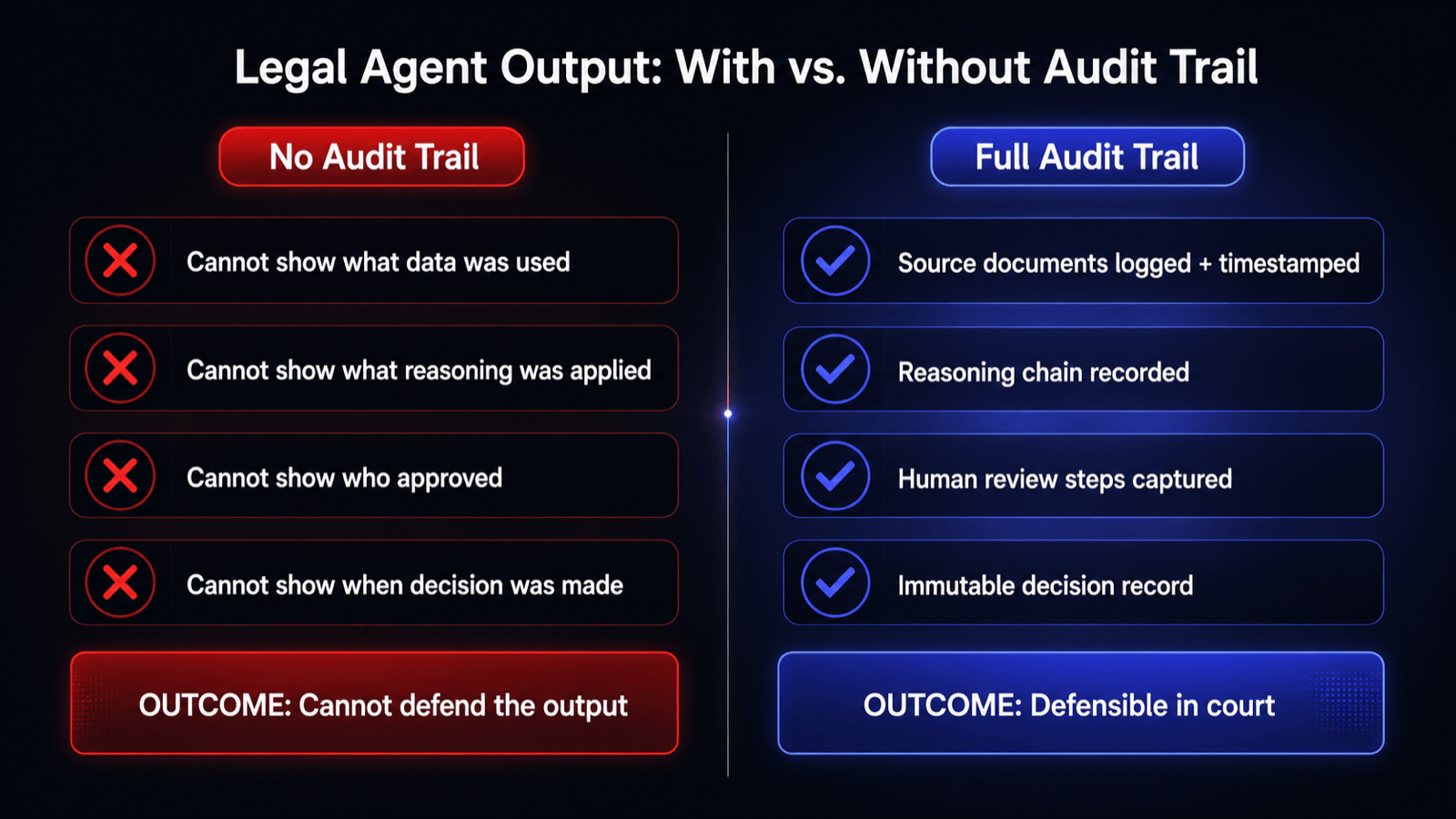
Because when a legal output is questioned, the question is not only whether it was right but whether it was produced responsibly and only a record answers that. Given hallucination rates as high as Large Legal Fictions documents, a challenge to a legal agent's output is a realistic event and when it comes, you need to show the authorities the agent relied on, the reasoning that connected them and the verification a human performed before the output was used. With that trail, you can defend the work: here is the law it was based on, here is how it was checked, here is why it was sound. Without it, you have an output and no account of how it came to be, which under scrutiny is indistinguishable from the unverified fabrications that get lawyers sanctioned. The audit trail is what separates a defensible piece of work from an indefensible one, because in law the process is part of the proof and an output you cannot show was produced and verified soundly is an output you cannot stand behind.
The record has to be contemporaneous. Reconstructing after a challenge how an output was produced and whether it was checked is far weaker than a trail captured as the work happened and under the pressure of an actual challenge, a reconstruction looks like exactly what it is, an after-the-fact justification rather than a record of responsible process.
What does a defensible trail capture?
The authorities the output relied on, the reasoning that used them, the verification a human performed and when, recorded as the work happens and retained so it can be produced if the work is challenged. Enough that you can demonstrate not just what the agent produced but that it was grounded in real law and checked by a person before it was relied upon. Given the documented hallucination rates, this record is the practical defense against the fabrication that will eventually occur, letting you show the outputs you stood behind were verified and the process was sound. The trail is not bureaucracy; it is the evidence that the work was done responsibly, which is what defensibility means in law.
| Record kept | Defensibility when challenged |
|---|---|
| Output only, no trail | Cannot show it was produced or verified soundly |
| Authorities, reasoning, verification recorded | The work can be defended on the record |
Capturing that defensible record is part of what VibeModel does as the Pattern Intelligence Layer. We model the patterns of a legal output's authorities, reasoning and verification, recorded as it happens, so the work can be defended when challenged rather than apologized for after.
Frequently asked questions
Why does legal work need an audit trail specifically?
Because outputs get challenged and the defense requires showing the work was grounded in real authority and verified, which only a record provides.
Can't I reconstruct it later?
A reconstruction is weaker than a contemporaneous record and, under a real challenge, looks like after-the-fact justification rather than evidence of sound process.
What does the trail need to contain?
The authorities relied on, the reasoning and the human verification performed, captured as the work happens and retained for production if challenged.