


Key facts.
- Med-HALT, the first medical-domain hallucination benchmark, tests reasoning and memory hallucination and includes a False Confidence Test for whether a model can judge a medical answer's validity.source
- Earlier and even medical-purpose LLMs often began at low hallucination resistance, so the tendency to fabricate medical detail is real.source
- In healthcare admin, a hallucinated detail in scheduling, billing or records carries clinical or compliance weight, not mere inconvenience.source
Why does the medical domain make admin agents error-prone?
Med-HALT exists because LLMs hallucinate on medical content and misjudge their answers; a more capable model inherits that, a wrong record is a clinical incident. (arXiv:2307.15343)
Because the same admin task carries far more weight when the content is medical and the model hallucinates on exactly that content. Scheduling an appointment, processing a bill or updating a record is routine. In healthcare each of these touches medical information, a procedure code, a diagnosis, a medication, a provider specialty, and Med-HALT exists because LLMs hallucinate on medical content, fabricating plausible-sounding details that are wrong. So a healthcare admin agent does not just risk the ordinary admin error of a wrong date or a mistyped amount. It risks confidently inserting a hallucinated medical detail, a wrong procedure code that misbills, an incorrect medication note in a record, a fabricated clinical justification and the False Confidence Test in Med-HALT shows models are often poor at recognizing when their medical answer is invalid, so the agent does not flag its own fabrication. The consequence escalates because the domain is medical: a hallucinated billing code is a compliance and fraud risk. An incorrect record detail can affect care and a confidently wrong answer to a patient about their medication or appointment can cause real harm. The admin task looks routine. But the medical content makes the agent's hallucination a clinical and compliance hazard rather than a clerical one.
The False Confidence finding is what makes this dangerous to automate naively. An agent that could reliably say "I am not sure about this medical detail" could be gated on its uncertainty. Med-HALT shows models often cannot judge the validity of their own medical answers, so the fabrication arrives with the same confidence as the truth and flows into the schedule, the bill or the record unflagged.
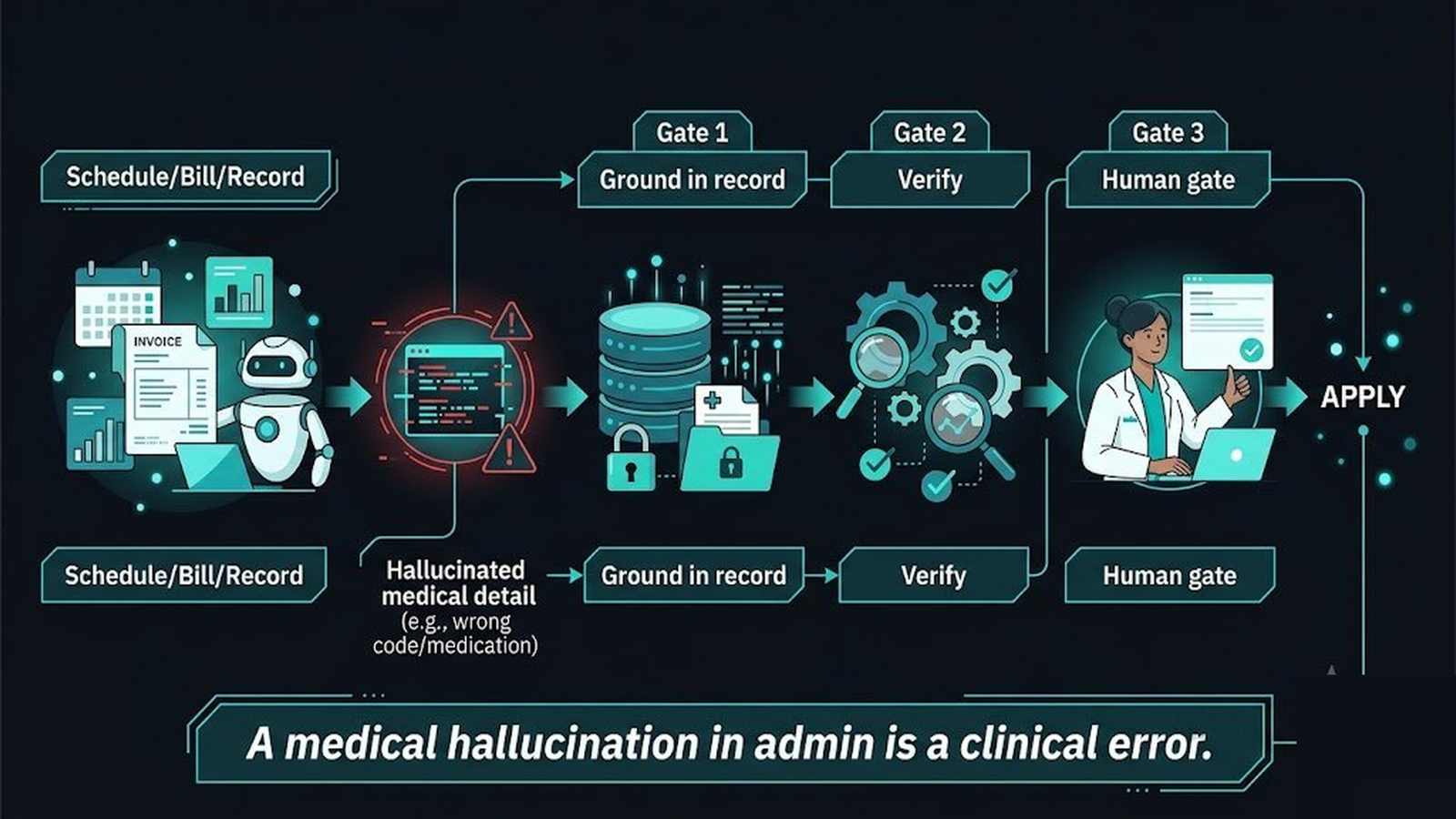
What makes a healthcare admin agent reliable?
Grounding in the authoritative record and verification of every medical detail before action. Answer and act only from the actual patient record and the authoritative coding, scheduling and billing systems. The agent cannot insert a hallucinated medical detail it generated. Verify any medical content, a code, a medication, a diagnosis reference, against the source before it is applied to a schedule, a bill or a record. That happens because the agent cannot reliably judge its own medical accuracy. Where the agent is uncertain or the content is high-consequence, route it to a human. The reliability comes from never letting a generated medical detail reach a healthcare admin action unverified. That happens because in this domain the hallucination the model produces is a clinical and compliance error, not a clerical one.
| Agent handling | Outcome in a medical domain |
|---|---|
| Trust generated medical detail | Hallucinated codes, records, answers with clinical weight |
| Ground in record, verify, gate | Medical detail confirmed before it is applied |
Grounding and verifying that medical content is part of what VibeModel does as the Pattern Intelligence Layer. We model the patterns of a medical detail that must be grounded in the record and verified before action. A healthcare admin agent acts on confirmed information rather than the hallucinations the medical domain provokes.
Frequently asked questions
Why is a medical admin error worse than an ordinary one?
Because the content is medical: a hallucinated code is a billing and compliance risk and a wrong record detail can affect care. The domain raises the stakes.
Can the agent flag its own medical errors?
Often not. Med-HALT's False Confidence Test shows models are poor at judging the validity of their own medical answers, so fabrications arrive confidently.
What makes the agent reliable?
Grounding every output in the authoritative record, verifying medical detail before action and routing uncertain or high-consequence items to a human.