


Key facts.
- Research on medical hallucinations in foundation models examines their impact on healthcare specifically, because a fabricated medical detail is a patient-safety and compliance event. source
- HIPAA imposes strict requirements for protecting and controlling access to protected health information. source
- Healthcare demands auditable, defensible decisions, so an unexplainable agent action is also an audit failure. source
Why does healthcare amplify an agent's failure?
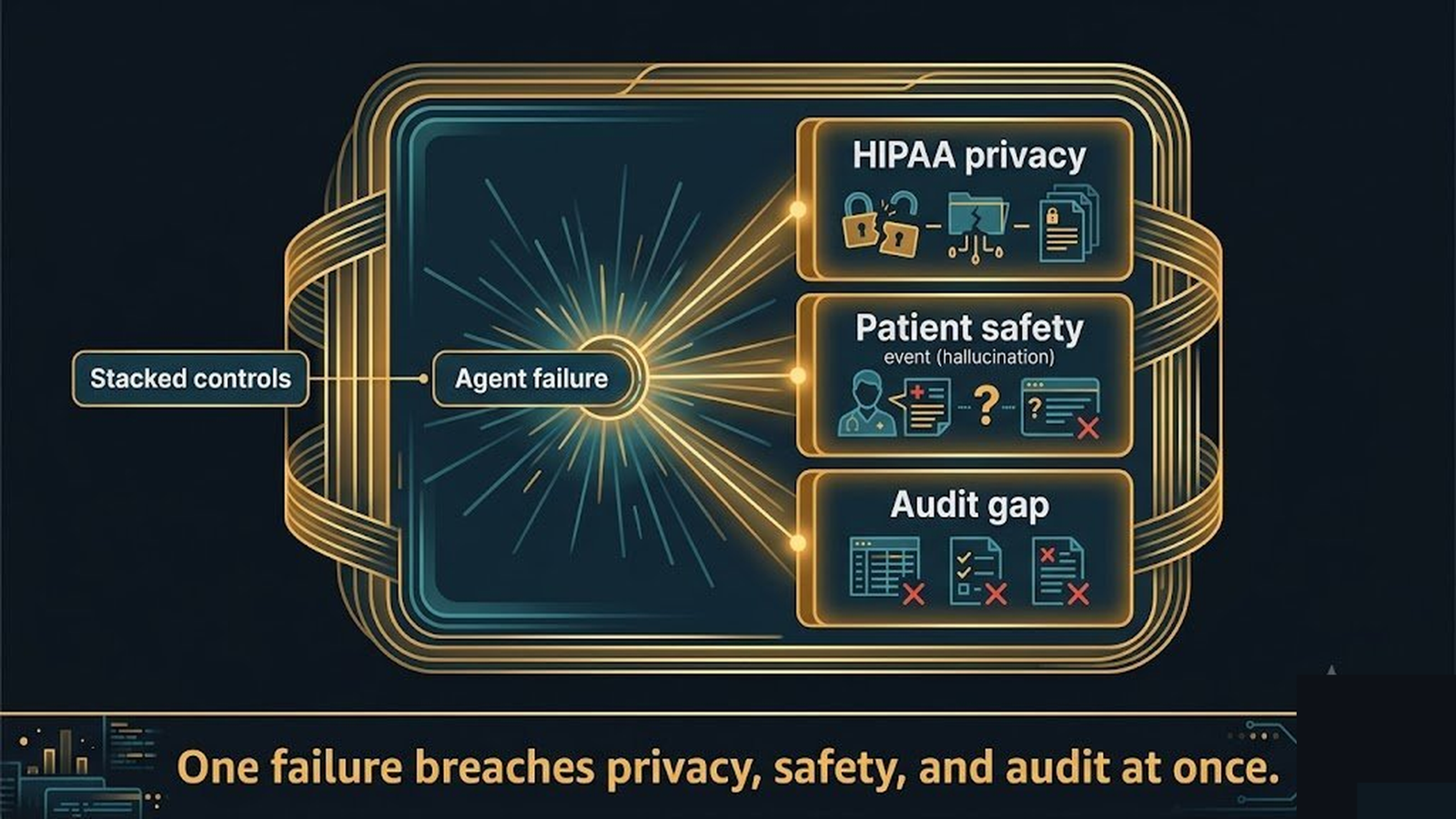
Because three demanding requirements, privacy, accuracy and auditability, all apply at once, so a single failure breaches several of them together. Consider a healthcare agent that mishandles a patient interaction: if it discloses protected health information improperly, that is a HIPAA violation with regulatory and financial consequences; if it acts on a hallucinated medical detail, that is a patient-safety risk, which is exactly why research studies medical hallucinations for their healthcare impact specifically; and if its decision cannot be explained or reconstructed, that is an audit and compliance failure. In most domains an agent error hits one of these dimensions; in healthcare the dimensions stack, so the same failure can be a privacy breach and a safety event and an audit gap simultaneously, multiplying the consequence. The accuracy requirement is uniquely unforgiving here because the stakes are clinical: a hallucinated medication, dosage or diagnosis reference is not a wrong number, it is a potential harm to a patient and the model's documented tendency to hallucinate medical content makes that a real and recurring risk rather than a rare one. HIPAA adds that the data the agent handles is among the most protected there is, so the access that lets the agent help is also the access that, mishandled or hijacked, becomes a serious privacy violation. And the audit requirement means the agent must not only be right but be able to show why or its decisions are indefensible.
The amplification is the point. A healthcare agent failure is not contained to one kind of problem, so the controls cannot be either; they have to address privacy, accuracy and auditability together, because a deployment that secures one and neglects another still fails on the dimension it skipped and in healthcare each dimension carries serious consequence.
What does a healthcare deployment require?
Controls for all three requirements, built together. Protect health information with least-privilege access and output controls that meet HIPAA, treating the data the agent reads as both protected and a potential injection vector. Ensure clinical accuracy by grounding medical content in authoritative sources and verifying it, because the model hallucinates medical detail and the consequence is patient safety. And capture an audit trail of the agent's decisions and their basis, so every action is defensible. These are not separable; a healthcare agent has to satisfy privacy, accuracy and auditability simultaneously, because its failures violate them simultaneously and the deployment that builds all three is the one whose inevitable agent error is contained rather than amplified into a privacy, safety and compliance event at once.
| Deployment | When the agent fails |
|---|---|
| Secures one requirement, neglects others | Failure breaches the neglected dimension |
| Privacy, accuracy and audit controls together | Failure contained across all three |
Medical-hallucination research treats a fabricated fact as a safety event (arXiv 2503.05777); a newer model trims it, one slip costs HIPAA, accuracy, audit. (arXiv:2503.05777)
Building those stacked controls is part of what VibeModel does as the Pattern Intelligence Layer. We model the patterns a healthcare agent must satisfy for privacy, accuracy and auditability together, so a failure is contained rather than amplified into a violation of all three at once.
Frequently asked questions
Why is a healthcare error worse than other domains?
Because HIPAA, clinical accuracy and audit requirements all apply at once, so one failure can be a privacy violation, a safety event and an audit gap simultaneously.
Why is accuracy uniquely critical?
Because the stakes are clinical: a hallucinated medication or diagnosis is a potential patient harm and the model is documented to hallucinate medical content.
Can I address these requirements separately?
No. They stack, so a deployment must satisfy privacy, accuracy and auditability together or it fails on the dimension it neglected.