


Key facts.
- WebArena benchmark: the best-performing agents complete only 14.4% of real web tasks, versus 78.2% for humans, with multi-step task specification failures among the most frequent breakdown categories (WebArena, arXiv 2307.13854).
- NIST AI Risk Management Framework 1.0 identifies ambiguous system specifications as a top-tier risk factor for AI deployments in enterprise settings, particularly in multi-component AI systems where roles interact (NIST AI RMF 1.0, 2023).
- McKinsey's State of AI research found that teams deploying multi-agent systems in enterprise settings most commonly cited inadequate task decomposition and unclear agent responsibilities as the primary source of coordination failures in production (McKinsey, reported).
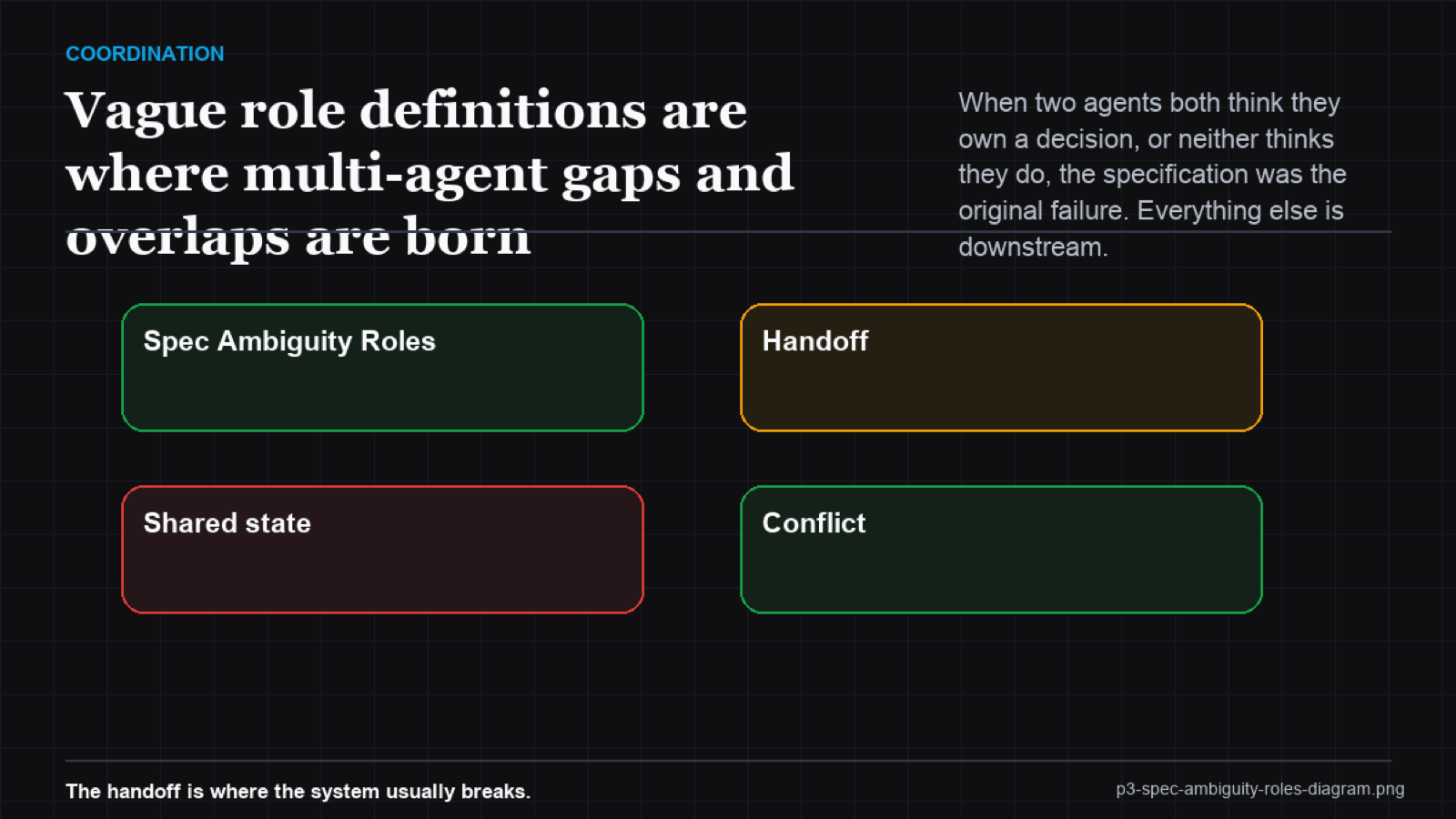
Gaps vs. overlaps: two faces of the same problem
Ambiguous roles breed gaps and overlaps that multiply per agent; a newer model inherits them, and the fix costs more after integration. (arXiv:2307.13854)
A gap appears when a task exists in the workflow that falls between agents' defined responsibilities. Agent A is responsible for customer research. Agent B is responsible for proposal drafting. Neither is responsible for validating that the customer data Agent A retrieves is current enough for Agent B's purposes. That validation step falls in the gap. It doesn't happen. The proposal goes out with stale data.
An overlap appears when two agents both have "customer communication" in their role description. Both agents, working on different sub-tasks, decide their sub-task justifies a customer touchpoint. The customer receives two messages that each assume the other doesn't exist. The agents were both following their specifications. The specifications allowed both to claim the overlap.
What tight specifications look like
| Ambiguous specification | Tight specification |
|---|---|
| "Handle customer communications" | "Draft, do not send, communications. Route all drafts to Orchestrator before dispatch." |
| "Research customer needs" | "Retrieve and return structured data fields X, Y, Z from CRM as of today's date. Flag if data older than 30 days." |
| "Support the proposal process" | "Validate input data fields provided by Research Agent. Do not source additional data. Return validation result." |
| "Coordinate across agents" | "Sequence actions per workflow step order. Surface conflicts to human overseer. Do not resolve conflicts autonomously." |
The Pattern Intelligence Layer monitors for the signature of specification-driven failure, two agents claiming the same action, or a required action type with no agent owning it. VibeModel surfaces these patterns before they compound into an incident, at the layer where the specification itself is auditable. Fixing the spec is cheaper than fixing the downstream failures it generates.
Frequently asked questions
How long should a role specification be?
Long enough to answer three questions unambiguously: what actions can this agent take without asking, what actions require approval before taking, and what actions are never permitted. If any of those three questions has an ambiguous answer, the spec is underwritten.
What if the workflow is dynamic and roles need to adapt?
Design the adaptation as an explicit protocol: the orchestrator can expand or narrow an agent's scope through a role-update message that the agent must acknowledge. Ad hoc role expansion by inference is where specification gaps are created at runtime.