


Key facts.
- GAIA benchmark level-3 tasks require agents to execute complex, multi-step tasks under role and scope constraints. Top models with tools achieve around 15% success at this level, with scope maintenance failures among the primary breakdown modes (GAIA, arXiv 2311.12983).
- The Measuring Agents in Production study found that role clarity, explicit specification of what each agent should and should not decide, was one of the highest-impact reliability interventions in production deployments (Measuring Agents in Production, arXiv 2512.04123).
- CSA surveys on agentic AI in enterprise deployments found that inadequate role definition and scope boundaries were among the top three reported causes of unexpected agent behavior in multi-agent production systems (Cloud Security Alliance, reported).
How role drift happens step by step
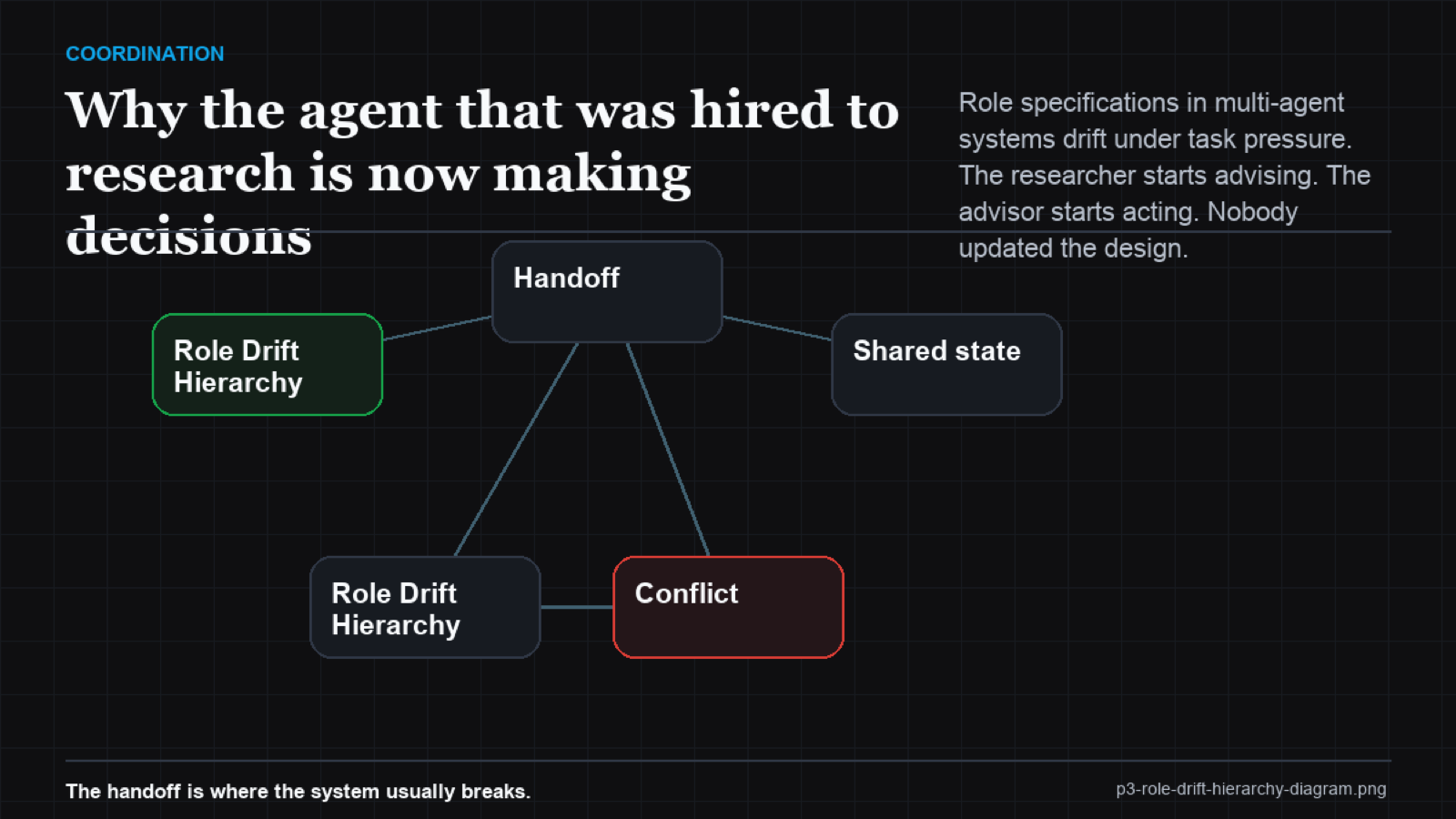
The research agent's role is to retrieve and synthesize information. It retrieves three market analyses, synthesizes them, and notices a clear recommendation implied by the data. The orchestrator has not yet asked for a recommendation, but the agent reasons: the writing agent will need a recommendation, and the data makes it obvious. So the research agent produces one, embedded in its synthesis. The writing agent, seeing the recommendation, incorporates it. The decision was made by the research agent. The decision-making agent never saw the data. Nobody authorized this path.
Role drift like this is almost always well-intentioned. The agent is trying to be helpful. It is completing a task that it infers needs to be done. The problem is that the role specification existed precisely to prevent an agent without decision-making authority from making decisions. When the agent overrides that specification by inference, the control structure the organization designed is bypassed.
Role discipline vs. role drift
| Role drifts | Role holds |
|---|---|
| Role defined as general description of purpose | Role defined with explicit permitted and prohibited action types |
| Agent can produce outputs of any type | Agent output schema enforced at the framework level |
| No check that output stays within scope | Output validator rejects out-of-scope content before propagation |
| Orchestrator trusts agent to stay in lane | Orchestrator verifies agent output type before routing it |
VibeModel monitors role adherence as a pattern dimension. The Pattern Intelligence Layer detects when an agent produces an output type, a decision, an action, a commitment, that falls outside its defined role. Catching role drift is cheaper than unwinding the downstream consequences of a research agent that decided it was also the decision-maker.
Frequently asked questions
What if the research agent's inference was correct?
Correctness is not the issue. Authorization is. A correct decision made by the wrong agent is still a governance failure, because the next time, the inference will be wrong, and the role drift will have established a precedent that the research agent decides. Design the pipeline so correct decisions come from the right place, not from wherever they happen.
How specific do role definitions need to be?
Specific enough that you can write an output schema for the role. If you cannot describe the permitted output types of the role as a typed contract, the role is underspecified. Start there.