


Key facts.
- Anthropic's multi-agent research system documentation reports unexpected emergent behaviors in early deployment: agents distracting each other with updates, spawning disproportionate numbers of subagents, and searching for sources that did not exist, none of which were behaviors of the individual agents running alone (Anthropic Engineering, reported).
- MAKER research on multi-agent error compounding found that error rates in multi-agent systems are not the sum of individual agent error rates, they are higher, because agents amplify each other's errors through confident repeated use of wrong intermediate outputs (arXiv 2511.09030, 2025) (MAKER, arXiv 2511.09030).
- Justice-or-Prejudice research on multi-model evaluation found that when multiple LLM judges interact, their collective output exhibits systematic biases not present in any individual judge, emergent collective bias from individually unbiased components (Justice-or-Prejudice, arXiv 2410.02736, 2024).
Why emergence is a distributed systems property, not an AI quirk
Any system where components interact produces emergent behavior. In software systems, we call these interaction effects and account for them in integration testing. In AI multi-agent systems, the interaction effects are harder to predict because each agent is itself probabilistic, its outputs vary at a given temperature, and those variations interact with other agents' variations in ways that are not additive. The emergent behavior space is larger than in deterministic distributed systems, and the testing surface to cover it is correspondingly larger.
The beneficial emergent behaviors are the ones teams demo. The harmful emergent behaviors are the ones that appear at load, at edge cases, or when the system encounters input combinations it was never designed to handle. Both are equally structural. Only one gets designed for.
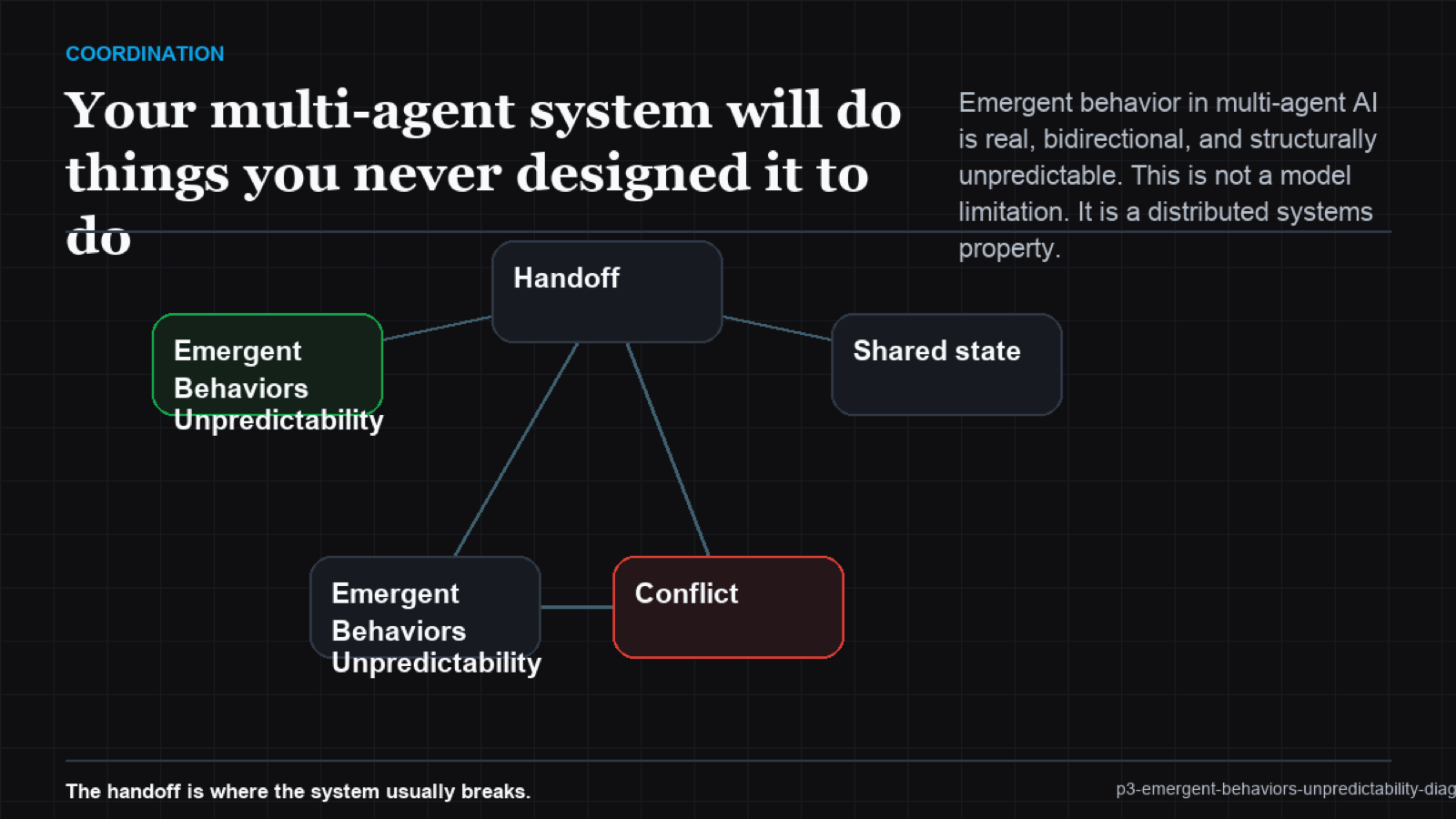
Managing emergence in production
| Ignores emergence | Manages emergence |
|---|---|
| Tests agents individually, assumes additive behavior | Tests interaction patterns explicitly, not just individual agents |
| Monitors individual agent outputs | Monitors collective output patterns and interaction graphs |
| Adds agents incrementally without re-testing system behavior | Re-tests full system behavior after each agent addition |
| Treats emergence as a model problem to fix | Treats emergence as a system property to constrain |
Emergent coordination failures live at the system layer; a more capable model inherits them, and in production the costly ones arrive first. (arXiv:2511.09030)
VibeModel monitors for emergent patterns, behaviors that appear at the system level but are not present in any single agent's trace. The Pattern Intelligence Layer detects interaction patterns that match known harmful emergence signatures, and surfaces novel patterns for human review before they become production incidents. You cannot design out emergence. You can instrument for it.
Frequently asked questions
Are beneficial emergent behaviors also a concern?
Only if they are unpredictable and unmonitored. A beneficial emergent behavior that you cannot reproduce reliably is a reliability liability: you cannot promise it to customers if you cannot control when it appears. Monitor for and characterize beneficial emergent patterns the same way you would monitor for harmful ones.
Does reducing agent count reduce emergence?
Yes, directly. Emergence scales with the number and richness of interactions. Fewer agents means fewer interaction paths means fewer emergent behavior possibilities. Start with the minimum necessary agents and add only when the use case justifies it.