


Key facts.
- MAKER reaches reliability at scale only through per-step error correction, the same way distributed systems tame unreliable nodes (MAKER, 2025).
- Idempotency keys make a retried agent action safe; without them, a retry can double-charge or double-send.
- Timeouts and bounded retries stop a stuck or looping agent from becoming a runaway, and tracing makes the failure findable.
Which distributed-systems primitives matter most for agents?
Idempotency first, because agents retry and an unguarded retry repeats side effects. Timeouts second, because a non-deterministic agent can stall and you need a bound. Bounded retries and circuit breakers third, so a failing dependency doesn't cascade. And tracing throughout, because without it a multi-agent failure is unfindable. None of this is novel. it's the standard playbook for unreliable distributed nodes, applied to nodes that happen to reason in natural language.
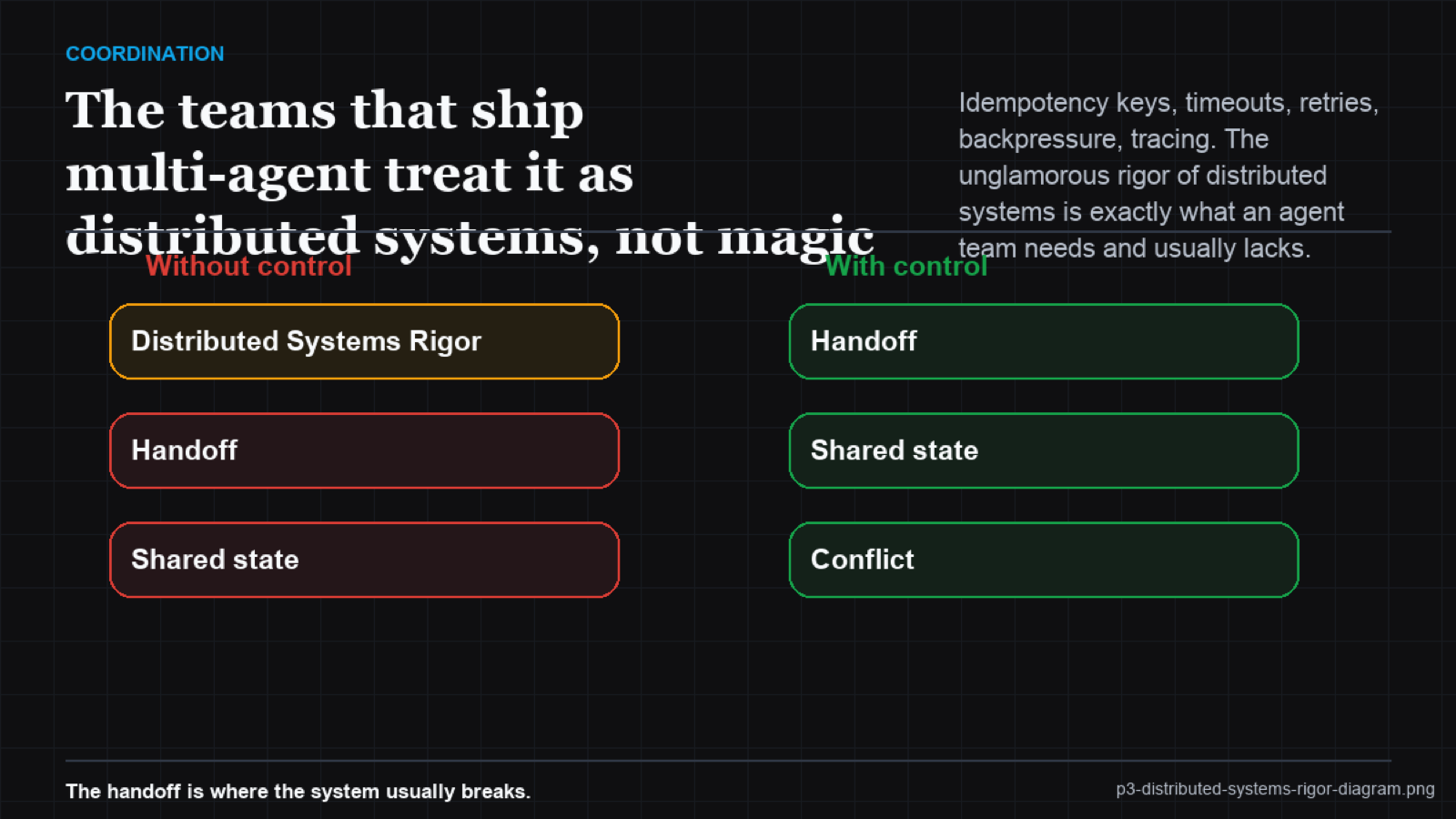
Hobby setup vs. engineered system
| Hobby setup | Engineered system |
|---|---|
| Retries repeat side effects | Idempotency keys make retries safe |
| A stuck agent hangs the system | Timeouts and circuit breakers bound it |
| Failures are unfindable | End-to-end tracing localizes them |
Build it like a distributed system of unreliable nodes and you ship; a better model won't, with none of 57 on WildToolBench past 15% session accuracy. (arXiv:2511.09030)
VibeModel's Pattern Intelligence Layer sits on top of this rigor and watches for the patterns it can't fully prevent: a retry that slipped past idempotency, a handoff that drifted, a loop forming. The primitives are yours to implement; we add the pattern-level eyes that catch what the primitives miss.
Frequently asked questions
Do I really need idempotency for read-only agents?
For read-only steps, less so. The moment an agent takes a side effect, an idempotency key is non-negotiable.
Isn't this a lot of engineering?
it's the engineering that separates a demo from a production system. Skipping it's why so many agent projects stall.