

Key facts.
- MAKER reached zero errors on a million-step task only by decomposing it into atomic steps and voting on each one, evidence that progress tracking and per-step agreement are what hold a long chain together (MAKER, 2025).
- Consensus methods (voting, self-consistency, structured debate) reduce single-shot error by cross-checking outputs before they propagate (self-consistency, 2022).
- Without a shared progress record, agents cannot tell finished work from pending work, so they both repeat and orphan tasks.
What does a shared goal actually look like in code?
It is not a sentence in a system prompt. It is a structured artifact every agent reads and writes: the objective, the subtasks, their status, and the acceptance check for each. When an agent finishes a subtask, it updates the record. When another agent picks up work, it reads the record first. Consensus is the gate before any irreversible action: agree, then act. This is mundane and that is the point. Mundane shared state beats clever prompting.
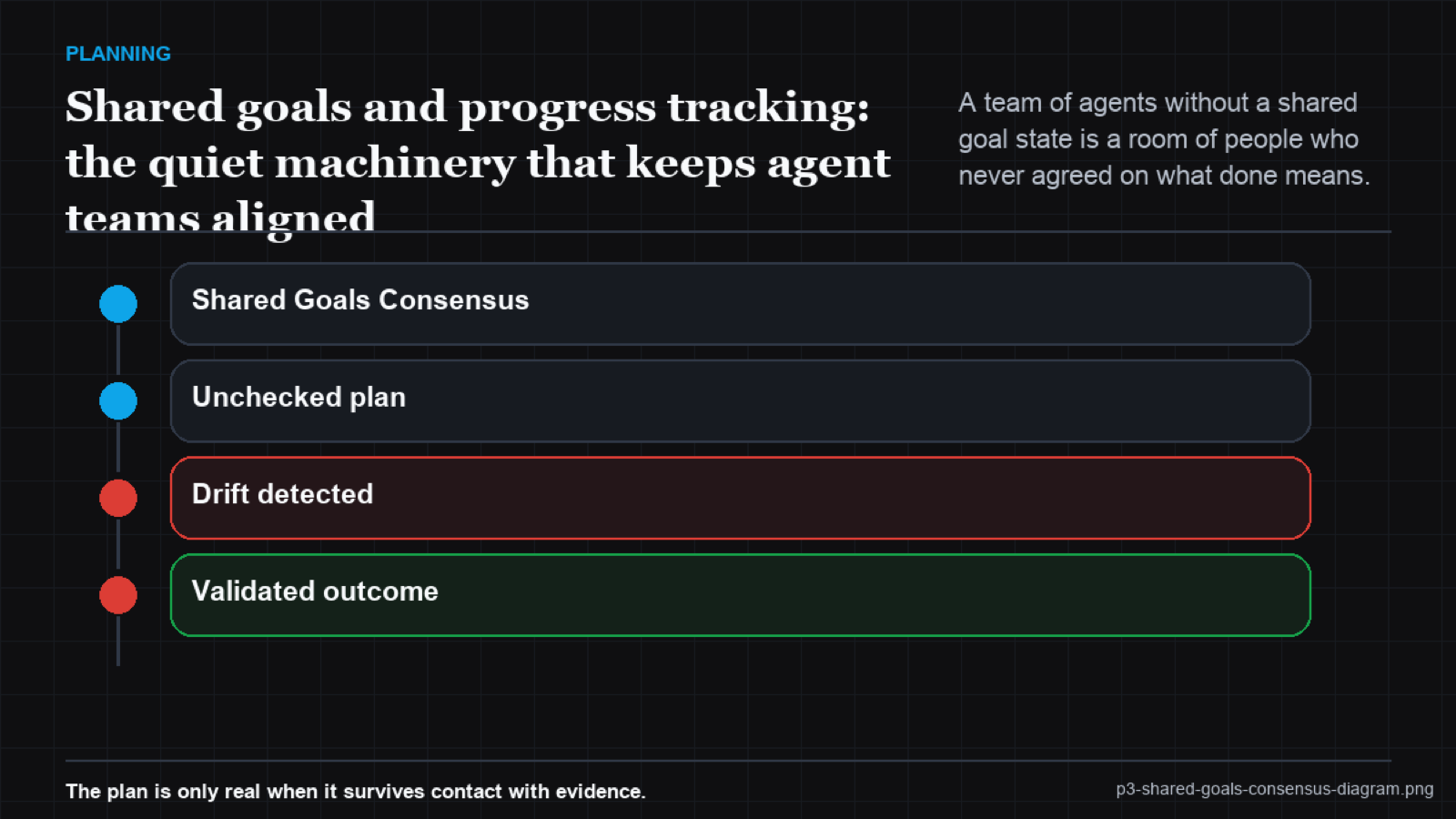
With structure vs. without
| No shared state | Shared goal + progress + consensus |
|---|---|
| Done is implicit, per-agent | Done is explicit, shared, checkable |
| Agents act on private assumptions | Agents agree before irreversible steps |
| Progress is reconstructed after a failure | Progress is visible in real time |
A capable step still fails without shared goals and progress; a more capable model inherits compounding per-step error, and the rework scales. (arXiv:2511.09030)
VibeModel's Pattern Intelligence Layer treats the goal-and-progress structure as a first-class signal. When agents drift from the shared goal or skip the consensus gate, that divergence is a pattern we surface early. You define what done means; we make sure the team keeps agreeing on it.
Frequently asked questions
Is consensus always worth the extra calls?
For irreversible or high-impact actions, yes. For cheap reversible steps, a single agent is fine. Gate by blast radius.
Does a shared goal slow the system down?
A little, and it is worth it. The alternative is reconstructing what happened after a silent misalignment ships.