


Key facts.
- Barnett's "Seven Failure Points of Retrieval-Augmented Generation" documents how real deployments fail in ways a clean demo never surfaces. source
- Research on why language models hallucinate shows confident wrong answers are incentivized by training, so variability outside the tested path produces fabrication. source
Why does happy-path success mislead?
Off the demo path RAG breaks the seven ways Barnett lists and a better model fabricates the off-path case just as convincingly, incident pending. (arXiv:2401.05856)
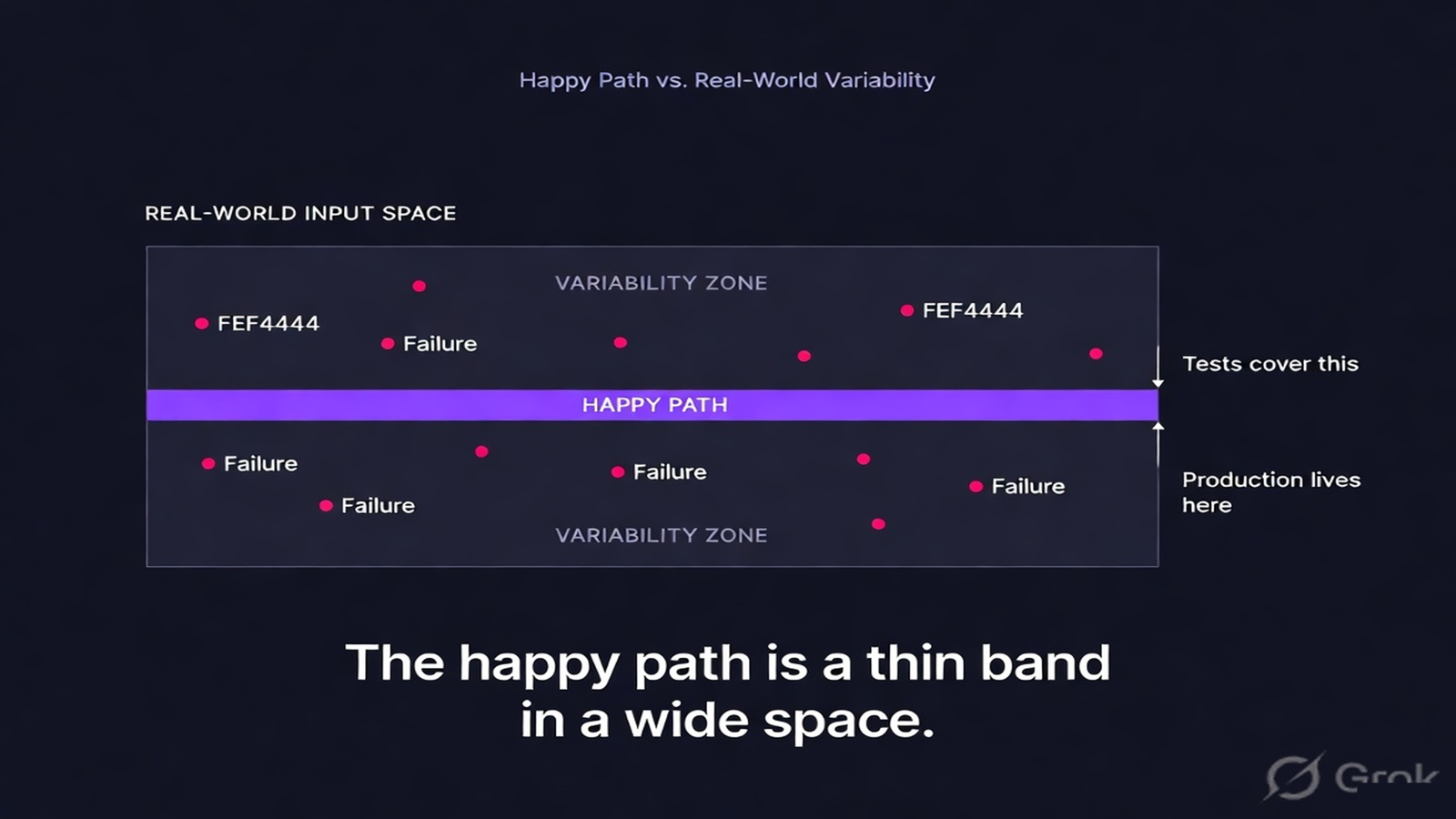
A demo is curated: clean inputs, the expected phrasing, data that looks like the examples. The agent sails through and everyone concludes it works. Production is the opposite of curated. Inputs arrive malformed, users phrase requests in ways no example anticipated, data is stale or contradictory and the agent meets all of it without the guardrails the demo never needed. Barnett's failure-point catalog is the map of where this goes wrong in retrieval systems specifically and the pattern generalizes: the failures cluster exactly in the variability the happy path excluded. An agent validated only on the clean case has been tested against the one scenario production rarely provides.
Variability does not just cause the agent to stall; it causes it to fabricate. The hallucination research shows confident wrong answers are a trained-in tendency, most likely to surface when the input is unfamiliar, which is precisely the off-happy-path case. So the agent that looked flawless in the demo meets an unusual input and produces a confident, plausible, wrong answer rather than an error you would notice. The defense is to make variability a first-class part of design and testing: seed the test set with the messy and the malformed, add detection for out-of-distribution inputs and build the safe fallbacks the happy path let you skip.
How do you design for variability?
| Practice | Built for happy path | Built for variability |
|---|---|---|
| Test set | Clean cases | Messy, malformed, unusual |
| Off-path input | Fabricates confidently | Detected and handled |
| Fallbacks | None needed in demo | Built in for the unexpected |
Knowing when an input has left the reliable path requires defining what that path is, which is what the Pattern Intelligence Layer makes explicit. VibeModel specifies the patterns the agent handles reliably, so real-world variability that falls outside them is recognized and routed to a safe response instead of producing the confident wrong answer that a happy-path-only design invites.
Frequently asked questions
Why does the demo always look perfect?
Because it runs the curated happy path. Production supplies the variability the demo excluded, which is exactly where agents fail.
What kind of failure does variability cause?
Often a confident wrong answer, not an obvious error, because models are trained toward confident outputs and fabricate most on unfamiliar inputs.
How do you prepare for it?
Test against messy and malformed inputs, detect out-of-distribution cases and build safe fallbacks the happy path let you skip.