


Key facts.
- Faith and Fate demonstrates core transformer limits on compositional tasks, so agent failure is inherent not an occasional bug.source
- ALFWorld shows interactive agents fail often even in controlled environments, reinforcing that designing for failure must come first.source
Why design for failure from the start?
The default development path optimizes for success: get the agent working on the intended task. Demo it and treat error handling as something to add later. That order is backwards for a system whose failures are inherent. Faith and Fate shows the limits are core, not incidental. ALFWorld shows agents fail frequently even in controlled settings, so failure is not a rare event to patch but a constant condition to design around. An agent built only for the happy path meets its first real failure with no detection to catch it, no fallback to absorb it and no recovery to continue from. A failure that should have been contained becomes an incident. Adding error handling after the fact rarely fixes this. That happens because the architecture was shaped around the assumption that things go right.
Designing for failure first inverts the assumption. From the start, ask how each step fails and build the response: detection that recognizes If the agent is out of its depth. Safe defaults for when it is, fallbacks and human takeover for the consequential cases and recovery that lets the agent continue from a known-good state. This is the discipline of resilient systems applied to agents and it produces a fundamentally different architecture than happy-path-first development. One where the inevitable failures land in handling that was designed for them rather than in a gap nobody planned. The agent designed for the day it fails is the one that survives that day.
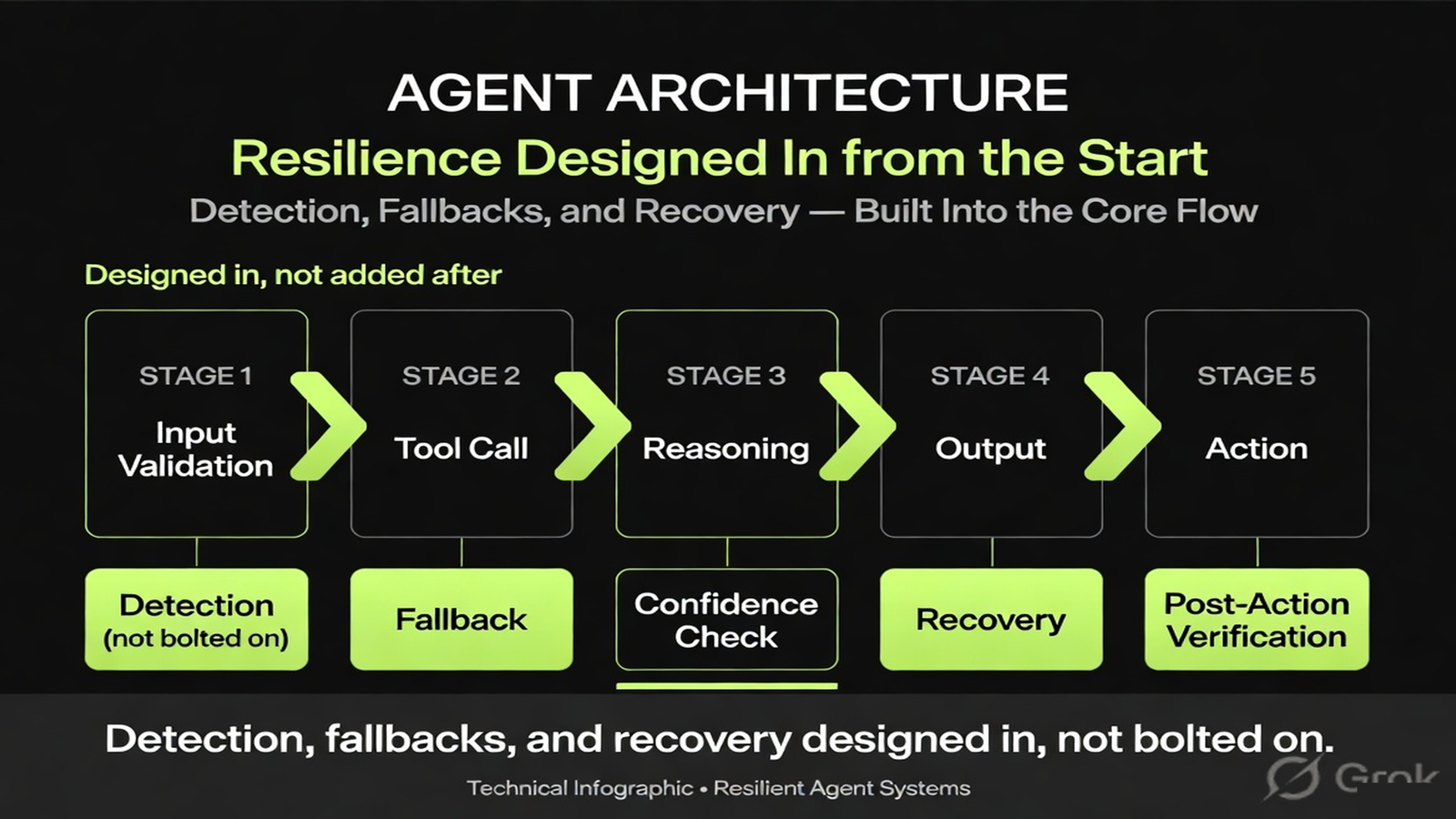
What does designing for failure include?
| Element | Happy-path first | Failure-first design |
|---|---|---|
| Detection | Added later, if at all | Built in from the start |
| Fallbacks | Missing | Safe defaults ready |
| Recovery | None | Continue from known-good |
| First real failure | Becomes an incident | Contained |
Designing for failure requires knowing what success looks like so you can detect departures from it. Is what VibeModel provides as the Pattern Intelligence Layer. By making the agent's correct behavior an explicit pattern, it gives the failure-handling something concrete to detect against. Deviations trigger the fallbacks and recovery designed for them and the inevitable failures land safely instead of in a gap the happy-path design never anticipated.
Frequently asked questions
Why not add error handling later?
Because the architecture gets shaped around the assumption that things go right, leaving no safe place for the inevitable failures. Failure-first design produces a different, sturdier architecture.
Is failure really inevitable?
Yes. Faith and Fate shows core model limits and ALFWorld shows frequent agent failure even in controlled settings, so failure is a constant to design for, not a rare bug.
What does failure-first design include?
Detection, safe defaults, fallbacks and human takeover and recovery from a known-good state, all built in from the first line of design.