

Key facts.
- "Large Language Models Cannot Self-Correct Reasoning Yet" finds models often fail to fix their own errors without external feedback, so an agent will not reliably recover from a partial failure on its own. source
- Cloud Security Alliance survey work on AI consistently points to the need for human oversight and controls on autonomous systems, supporting explicit takeover design. source
Why design for partial failure?
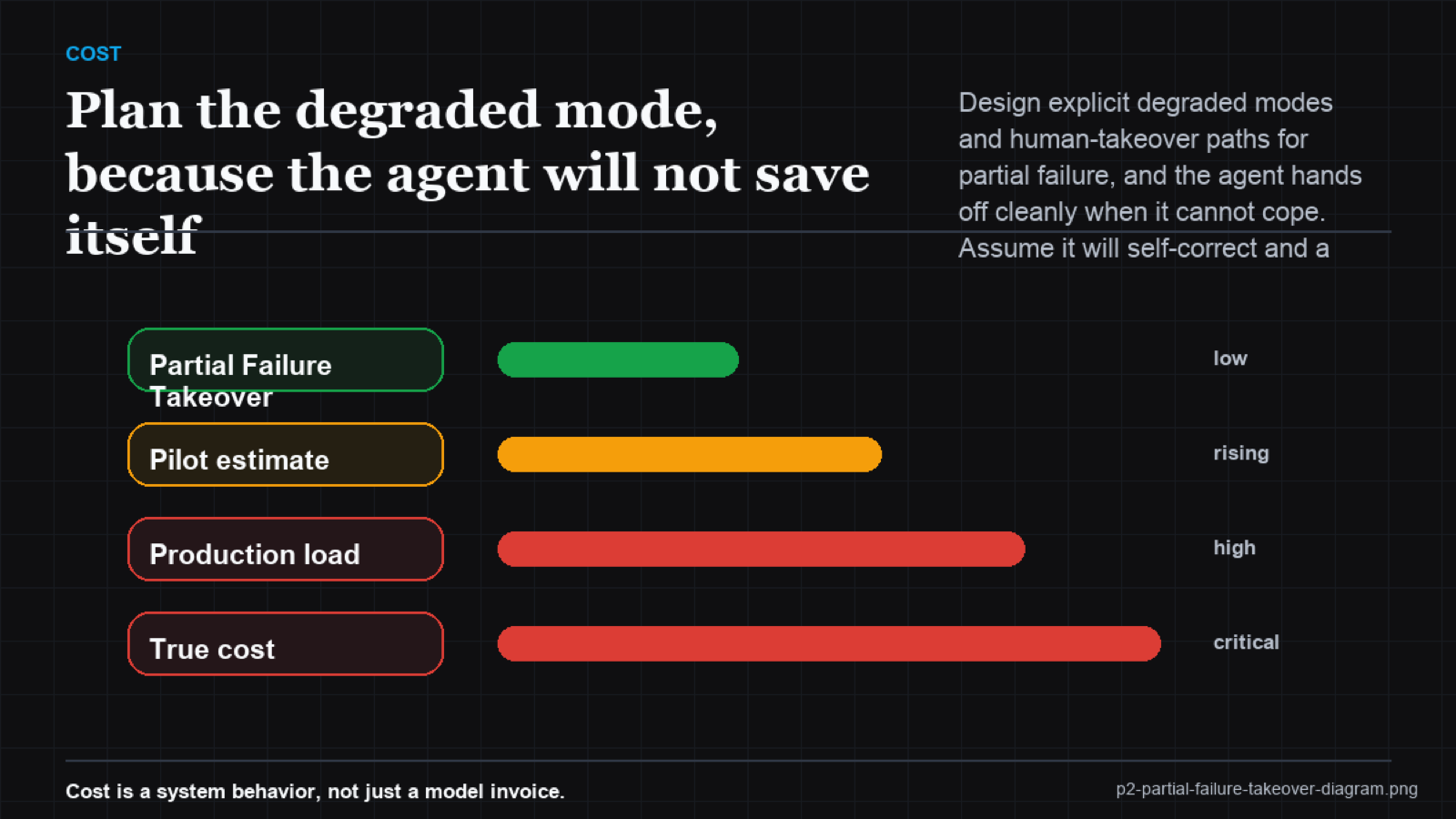
Real systems fail in parts: one tool is down while others work, a data source is stale, a dependency is slow, a step returns degraded but not empty results. A well-designed agent treats these as expected and has a planned response, do the safe subset, flag the limitation or hand off to a human, rather than barreling ahead as if everything were fine. The reason this must be explicit is that the agent will not figure it out alone. The self-correction research is blunt: models often cannot fix their own reasoning without external feedback, so an agent that hits a partial failure and continues tends to build a confident wrong outcome on top of the broken part rather than noticing and recovering. Hope is not a degraded mode.
So the degraded modes and takeover paths have to be designed in. Define what the agent should do when a dependency is unavailable, when confidence is low, when a result looks degraded and make those paths concrete: a reduced-capability mode that still does something safe, a clear escalation that hands the situation to a human with context, a refusal that is better than a guess. Industry guidance, including the Cloud Security Alliance's survey work, keeps returning to human oversight as essential for autonomous AI and an explicit takeover path is how that oversight actually engages at the moment it is needed. The agent that has a planned degraded mode fails safely; the one that assumes it will self-correct fails confidently.
What does graceful partial failure include?
| Situation | Assume self-correction | Designed degraded mode |
|---|---|---|
| Dependency down | Press on, guess | Safe subset or pause |
| Low confidence | Answer anyway | Escalate to a human |
| Degraded result | Build on it | Flag and limit scope |
| Outcome | Confident wrong result | Safe handoff |
Knowing when the agent has hit a partial failure it cannot handle requires a clear sense of what normal, reliable operation looks like, which the Pattern Intelligence Layer provides. VibeModel makes the agent's reliable patterns explicit, so a deviation, a failed dependency, a low-confidence step, an out-of-pattern result, triggers the right degraded mode or human takeover, instead of the agent assuming a self-correction it cannot actually perform.
Frequently asked questions
Why not let the agent recover itself?
Because research shows models often cannot self-correct reasoning without external feedback, so an agent that continues after a partial failure usually compounds it.
What is a degraded mode?
A planned reduced-capability response, a safe subset, a flagged limitation or a handoff, for when part of the system fails, instead of pressing on as if everything worked.
When should a human take over?
On low confidence, a failed dependency or an out-of-pattern result, with enough context handed over for the human to act.