


Key facts.
- Models still hallucinate at measurable rates on benchmarks like HaluEval, especially on inputs outside their reliable range.source
- Public hallucination leaderboards from Vectara (HHEM) and Galileo track non-trivial, ongoing fabrication rates across current models, so the long-tail risk is live, not historical.source
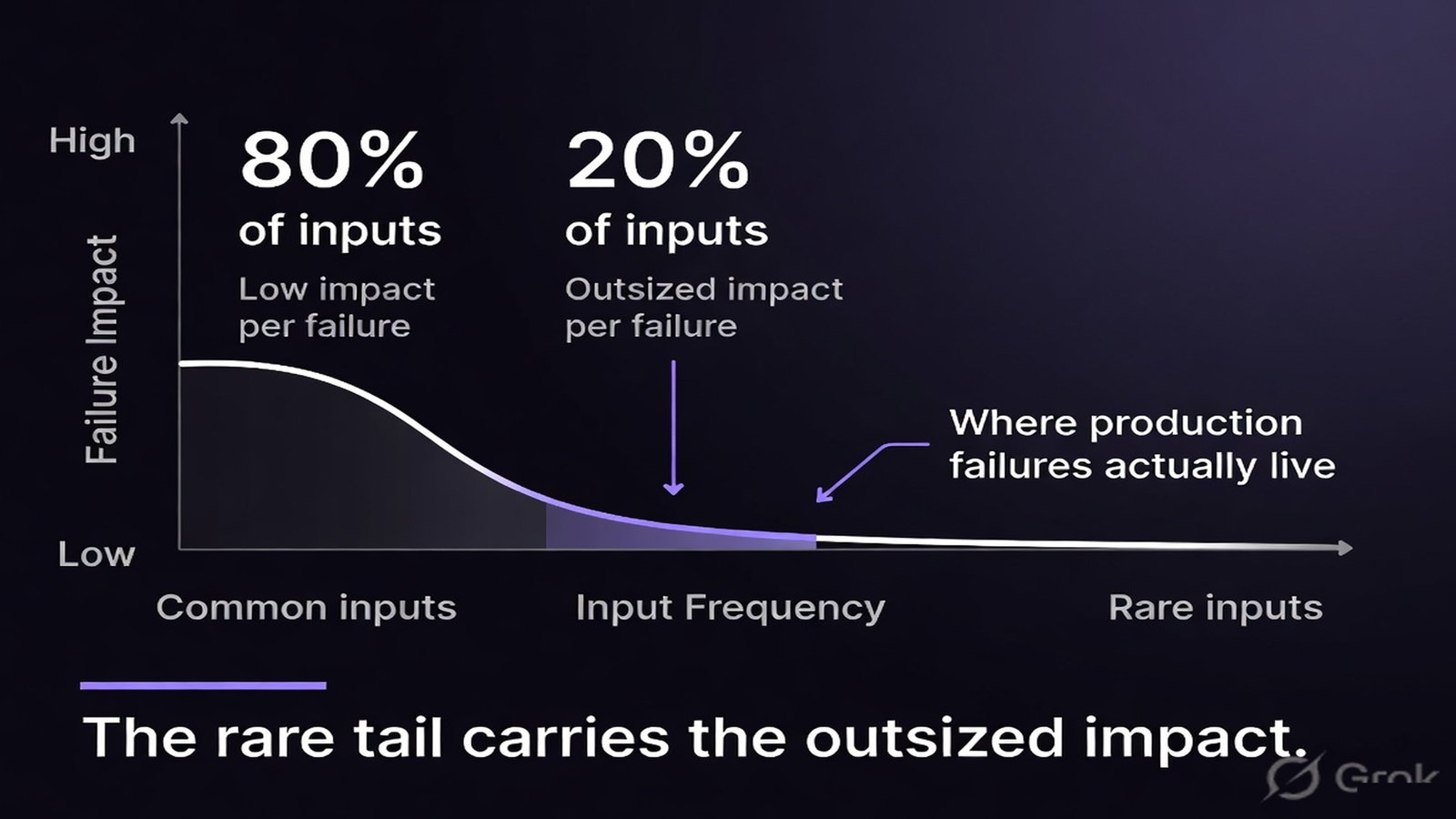
Why does the long tail cause outsized failures?
Testing covers what you can imagine and production is full of what you could not. Real inputs include the malformed, the unprecedented, the rare combination of conditions no one wrote a test for and these are exactly where an agent optimized only for the happy path behaves worst. The danger is not just that the agent gets the rare case wrong; it is that it gets it confidently wrong, because an unfamiliar input is precisely when a model is most likely to fabricate. The HaluEval results and the live Vectara and Galileo leaderboards show this is not a solved problem; current models still hallucinate at rates that matter and the long tail is where those rates spike.
Because you cannot enumerate the long tail in advance, the defense is structural rather than case-by-case. Detect If the agent is operating outside its tested range, by low confidence, unusual inputs or out-of-distribution signals and respond with a safe default and an escalation to a human rather than a confident guess. The goal is to convert the unseen case from a silent outsized failure into a contained, handled event. An agent designed only for the cases you tested treats the long tail as a surprise; one designed for failure treats it as expected and bounded.
How do you design for the long tail?
| Element | Happy-path only | Long-tail aware |
|---|---|---|
| Unseen input | Confident guess | Detected as out of range |
| Response | Proceed anyway | Safe default plus escalation |
| Failure | Outsized, silent | Contained, handled |
Detecting that an input is outside the agent's reliable range depends on knowing what that range is, which is what the Pattern Intelligence Layer makes explicit. VibeModel defines the patterns the agent handles reliably, so an input that does not match a known-good pattern triggers the safe default and escalation rather than a confident guess, turning the long tail from the source of your worst day into a set of cases the system was built to catch.
Frequently asked questions
Can you just test more cases?
More testing helps but cannot enumerate the long tail. The defense has to be structural: detect out-of-range inputs and fall back safely rather than relying on having foreseen every case.
Why are unseen inputs dangerous specifically?
Because models fabricate most readily when unfamiliar. HaluEval and live leaderboards show hallucination rates that spike exactly where your tests did not reach.
What is the safe response to an unknown case?
A safe default plus escalation to a human, so the rare input becomes a contained, handled event instead of a confident wrong action.