


Key facts.
- HTTP 200, confidently wrong content. The system looks healthy while producing incorrect results.source
- Most organizations discover these failures through secondary signals (customer complaints, declining conversions, compliance flags) rather than monitoring.source
- AI systems rarely fail with an outage. Gradual degradation, subtle shifts, no infrastructure alert is set up to catch it.source
- Frontier models still fabricate on short-answer factual benchmarks, so confident-wrong output is a standing risk, not an edge case.source
Why does a plausible wrong answer survive every check?
Because every check is testing the wrong thing. Schema validation confirms the output has the right shape. Status monitoring confirms the call returned. Latency monitoring confirms it was fast. A plausible wrong answer passes all three, because its shape is right, its call returned, and it was fast. The only thing wrong with it's the meaning, and nothing in the stack is measuring meaning. So the answer ships, the agent repeats the pattern, and the failure compounds quietly.
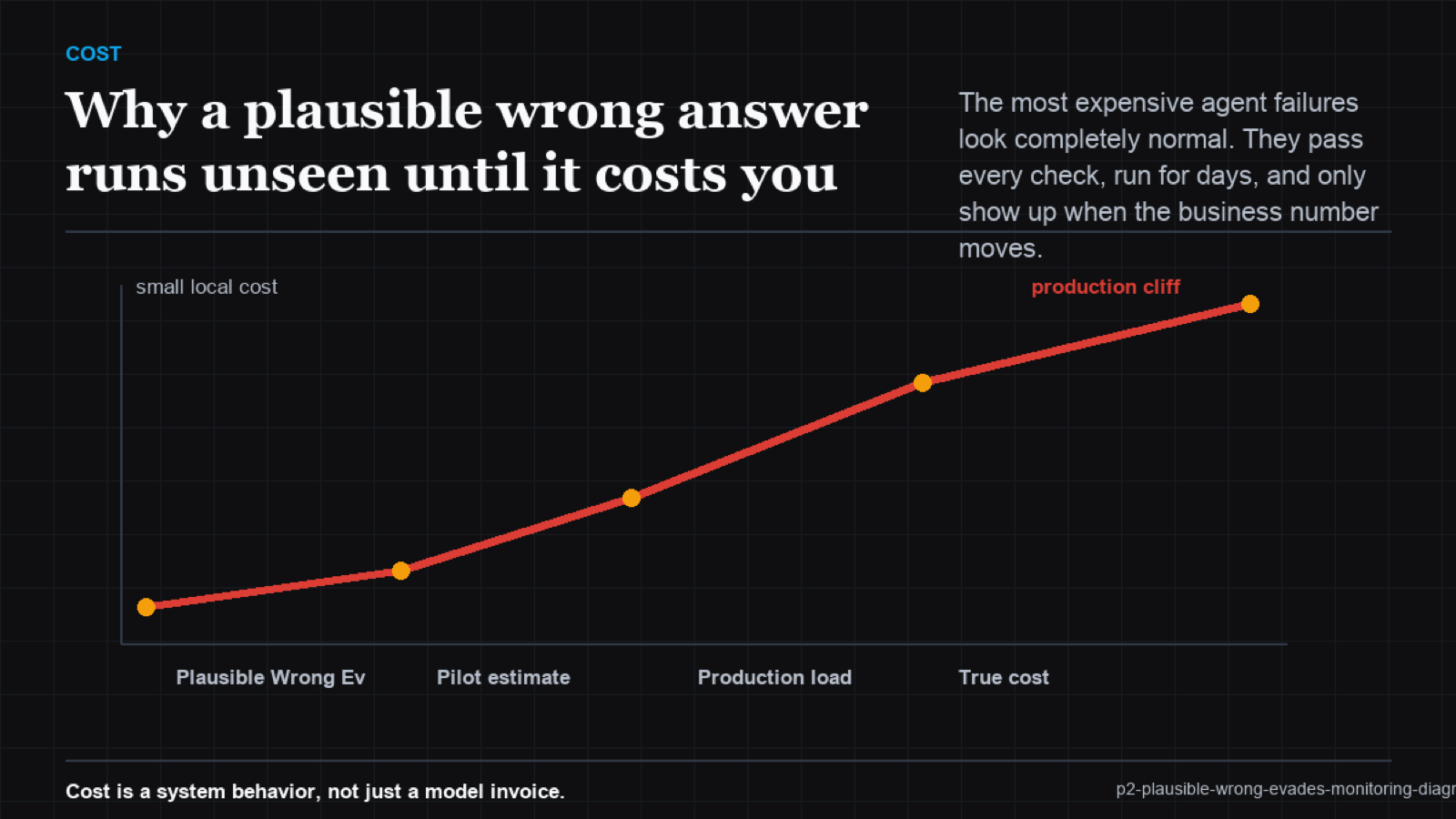
The lag between failure and discovery is the real cost. A crash is found in seconds. A plausible wrong answer is found when someone downstream notices the business consequence, which can be days later, after thousands of bad outputs. The failure was visible the whole time. Nobody was looking at the layer where it showed.
How do you shrink the gap?
Evaluate the output, not just the request. Add a check that asks whether the result satisfied the goal, whether the retrieved context supported it, and whether it stayed within policy. Sample outputs against a reference or a verifier so a drift in correctness shows up as a metric before it shows up as a KPI. The aim is to move discovery from the business layer, where it's late and expensive, back into your telemetry, where it's early and cheap.
| Check | What it confirms | Catches plausible-wrong? |
|---|---|---|
| Schema validation | Right shape | No |
| Status / latency | Returned and fast | No |
| Output evaluation | Goal satisfied, context supported | Yes |
| Drift sampling | Correctness over time | Yes, before the KPI moves |
A Pattern Intelligence Layer is what puts a meaning check in the path before the business feels the failure. Reliability at the pattern level means output correctness is evaluated around every run, so a plausible wrong answer is caught as a failure in your telemetry instead of surfacing later as a number nobody can explain. The crash was never the threat. The confident, normal-looking mistake was.
Frequently asked questions
Why don't my validations catch this?
They validate shape and health, not meaning. A plausible wrong answer has the right shape and a healthy 200, so it passes everything except a check on whether it was actually correct.
How early can I realistically catch it?
At output time, with an evaluation step, or shortly after, with drift sampling. Both beat waiting for a KPI to move days later.
Will a better model make this go away?
No. Frontier models still produce confident wrong answers on basic factual tasks. The failure mode is inherent, so the meaning check has to be there regardless of model.