


Key facts.
- Many agent failures are silent: a tool call succeeds with hallucinated parameters or incomplete retrieval, the output is well-formed and plausible, and no exception is thrown, so error-based monitoring never fires.source
- Most teams instrument only the infrastructure layer, while the majority of agent failures happen at the reasoning and semantic level, which that layer can't see.source
- The detection gap tracks observability, not system complexity: instrumented teams measure MTTD in minutes, while teams without it measure detection in days.source
- One reported case study cut mean time to detect from about 20 minutes to under 2 when reasoning-level monitoring was added; the same vendor reports roughly a 4.2-hour average MTTR without observability versus under an hour with it (single-vendor figures, treat as reported).source
Why do so many agent failures produce no error signal?
Because the agent did, mechanically, succeed. The tool returned a 200. The JSON validated. The plan finished. What went wrong is semantic: it retrieved the wrong document, reasoned from a bad premise, or updated the wrong customer record, and none of that's an error in the technical sense. Traditional monitoring is built to catch exceptions and bad status codes, so a failure that looks like a success sails straight past it. The agent isn't crashing. it's, in effect, lying with a straight face, and your dashboard is green.
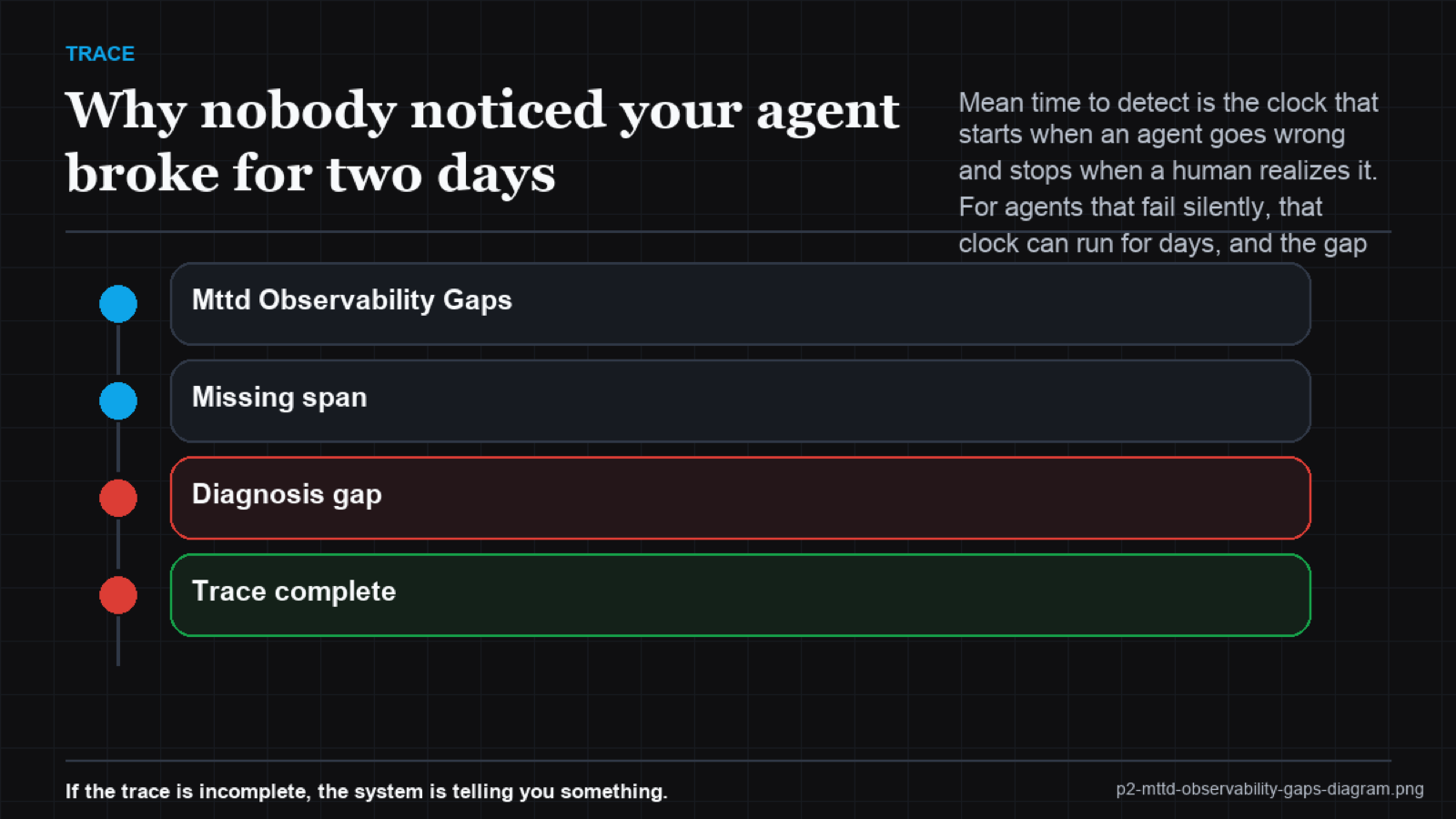
this is why instrumenting only the infrastructure layer leaves you blind. Latency, error rates, and resource use are the wrong sensors for a reasoning failure. The failure lives in the decision, the retrieval, and the tool argument, which means detection has to watch those, not just the plumbing around them. When it doesn't, the first detector is a human downstream, and that's how a broken agent runs for a day or two before anyone knows.
How do you actually pull MTTD down?
You move detection to the layer where the failure happens. Watch the reasoning and the tool outputs, not just the status codes: check whether retrieval returned anything usable, whether a tool's result is consistent with the request, whether the agent's confidence and behavior look normal for this input. Add semantic checks and verification at the decision points, so a plausible-but-wrong answer trips a signal instead of passing as success. The reported case studies that take MTTD from tens of minutes to single digits all do the same thing: they instrument the reasoning, not just the infrastructure. Treat the specific vendor numbers as directional and prove the improvement against your own before-and-after, but the direction isn't in doubt.
| Layer you watch | What it catches | What it misses |
|---|---|---|
| Infrastructure only | Crashes, 5xx, latency, resource use | Silent semantic failures (most of them) |
| Reasoning and tool outputs | Wrong retrieval, bad arguments, drift | Little, if the checks are well chosen |
| Customer complaint (default) | Everything, eventually | The hours or days before they complain |
Cutting MTTD is what a Pattern Intelligence Layer is built to do. At the pattern level, detection lives where decisions happen. A silent failure shows up as a deviation from normal behavior, not a downstream symptom surfaced by a customer complaint two days later. You stop discovering failures from angry customers and start catching them at the decision that caused them, which is the difference between a two-minute incident and a two-day one.
Frequently asked questions
Why is my dashboard green while the agent is failing?
Because the failure is semantic, not technical. The call succeeded and the output is well-formed; it's just wrong. Infra metrics can't see that.
What single change cuts MTTD the most?
Instrument the reasoning and tool outputs, not just the infrastructure. Detection has to live at the layer where the failure actually happens.
Are the minutes-to-days numbers trustworthy?
The minutes-versus-days direction is well supported and tied to observability investment. Specific vendor case-study figures are reported numbers; validate them against your own baseline.