


Key facts.
- MAKER (arXiv:2511.09030) categorized multi-step agent failures as loud (explicit error, execution halted) versus silent (execution completed, result incorrect) and found silent failures produce longer mean-time-to-detect, higher downstream error propagation, and higher total remediation cost than loud failures (MAKER, arXiv:2511.09030).
- OSWorld (arXiv:2404.07972) data shows that a significant proportion of "completed" agent tasks produce end states that fail validation when explicitly checked, meaning the silent failure rate in computer task agents is not marginal - it is the dominant failure mode by count.
- Silent failures in production agent deployments cluster around three mechanisms: semantic success with incorrect values (the right action on the wrong data), partial completion without detection (some but not all required changes were made), and state desynchronization (the agent's record of what happened differs from the actual system state).
- Detection time for silent agent failures in production typically runs 5-30x longer than detection time for loud failures (explicit errors, crashes) because silent failures produce no monitoring alert and are found only when a downstream system or human encounters the incorrect result.
- The economic case for investing in silent failure detection is stronger than for loud failure prevention: loud failures are already generating alerts and human attention; silent failures are generating costs that are not being attributed to the agent.
Why silent failures are more dangerous than crashes
A crashed agent is a known problem. The session is flagged, the error is logged, the on-call engineer is paged. The failure is contained. A silently failing agent is an invisible problem. The task is marked complete. The result is stored in the downstream system. Other processes consume the result. Downstream agents make decisions based on it. The incorrect result propagates through the organization until something breaks far from the source. By the time the failure surfaces, the evidence of what the agent did has often been overwritten by subsequent operations.
MAKER's finding that silent failures produce higher remediation cost than loud failures is almost trivially true once stated: you cannot start fixing something you do not know is broken. The mean time to detect a loud failure is minutes to hours. The mean time to detect a silent failure in a production agent without explicit verification is days to weeks. Every day of propagation adds remediation cost.
Making silent failures loud
Converting silent failures to loud failures requires adding explicit detection steps that generate observable signals when the result is wrong. Three mechanisms accomplish this at different depths. First, output schema validation: if the agent's output does not conform to the expected structure, flag it immediately. This catches format and completeness failures but not semantic failures. Second, business rule validation: check the output against known business rules and constraints. This catches out-of-range values, inconsistent states, and rule violations. Third, downstream state comparison: after the agent writes to a system, query the system to confirm the written state matches the intended state. This catches the deepest class of silent failures - those where the write appeared to succeed but did not take effect.
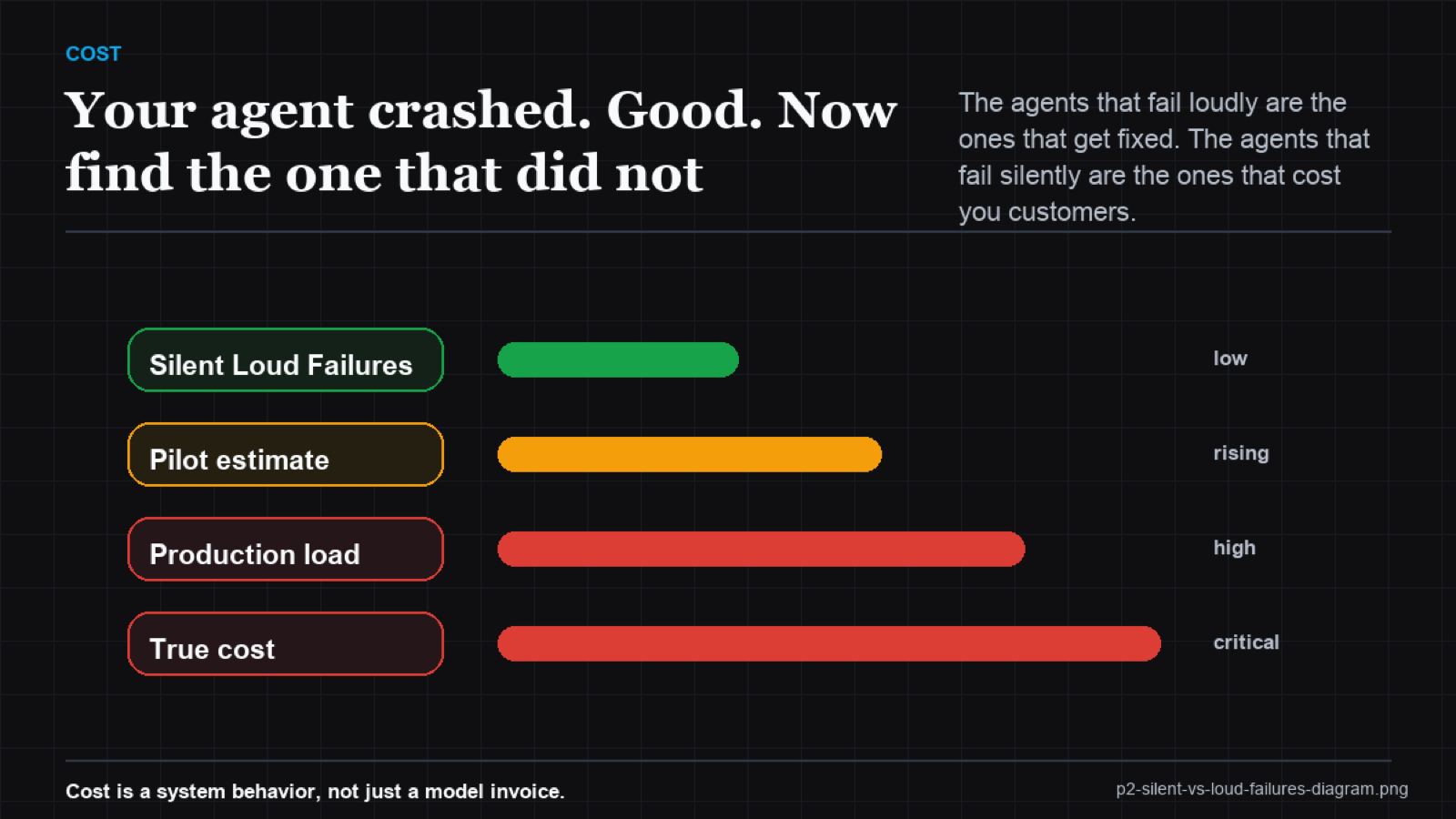
Silent vs loud failure characteristics
| Characteristic | Loud failure (crash/error) | Silent failure (wrong result) |
|---|---|---|
| Alert generated | Yes (immediate) | No (until downstream impact) |
| Mean time to detect | Minutes to hours | Days to weeks |
| Propagation before detection | Low (halted at failure point) | High (continues until external signal) |
| Attribution clarity | High (error log, stack trace) | Low (result overwritten, session ended) |
| Remediation cost relative to loud | Baseline (1x) | Substantially higher (5-20x) |
VibeModel's Pattern Intelligence Layer identifies the silent failure signatures in your specific agent deployment - the patterns in agent behavior that historically precede incorrect results without triggering any existing alert. By surfacing these patterns, it converts your silent failures from invisible-until-audit to flagged-at-completion. That is the reliability investment with the highest return for most production agent teams: not fixing the crashes (those are already getting fixed), but finding the silent errors before they propagate.
Frequently asked questions
How do we track silent failure rate when silent failures do not generate signals?
Audit sampling: randomly select 5-10% of completed agent sessions and manually verify the output against the intended outcome. The first 500 audited sessions establish your silent failure baseline rate. From there, you can infer which task types and context conditions correlate with higher silent failure rates, and target verification at those specifically.
Can we use LLM self-evaluation to detect silent failures without adding engineering infrastructure?
Partially. An LLM self-evaluation step (asking the agent to verify its own output against the original goal) catches some semantic failures with low engineering overhead. But it misses the class of silent failures that stem from incorrect data values, state desynchronization, and business rule violations - exactly the failures where downstream impact is highest. LLM self-evaluation is a starting point, not a complete detection system.
What is the most cost-effective first step for detecting silent failures in an existing production agent?
Add post-session output logging with enough structure to enable offline audit - even if you do not build automated checks immediately. Once you have a structured record of what the agent produced in each session, you can run analytical queries on that data to identify statistical anomalies that suggest silent failure clusters. The logging infrastructure pays back immediately as the raw material for everything else.