


Key facts.
- A single upstream mistake (a wrong retrieval, a malformed tool argument) propagates and corrupts every downstream step. Error propagation, more than the sheer number of failure modes, is what breaks reliability.source
- The MAKER study makes the cascade quantitative: because per-step errors compound, even an agent at 99% per-step accuracy is mathematically guaranteed to derail over a long task, so one early fault (poisoned memory, bad tool output, a hijacked plan) amplifies across the system before anyone detects it.source
- Root cause tooling classifies each failure in the chain as primary (the initiating cause), secondary (a direct consequence), or tertiary (the downstream symptom that usually triggers the alert), so you can separate the cause from what you noticed.source
- The MAST multi-agent failure taxonomy, built from more than 1,600 annotated traces across 7 frameworks, groups 14 failure modes into specification, inter-agent, and verification categories, and found many failing runs still returned a success status.source
How does one early mistake corrupt everything below it?
Walk a typical run. The retrieval layer returns a slightly wrong chunk because of embedding drift or a clumsy query rewrite. The planner has no reason to doubt it, so it builds a sensible plan on a bad premise. Tool execution then runs with arguments derived from that plan, operating on the wrong inputs. Verification, if it exists, checks the format or the final shape and waves it through, or it catches a problem and triggers retries that loop on the same poisoned state. By the time anything looks wrong, you're four layers downstream of the actual error, staring at a symptom that points nowhere near the cause.
Non-determinism makes it worse. A small early perturbation sends later steps down divergent paths, and agents sometimes partially recover in ways that hide the original fault entirely. The trace looks plausible at every step. Nothing threw an exception. The run returned a 200. The answer's just wrong, for a reason that happened long before the step you're looking at.
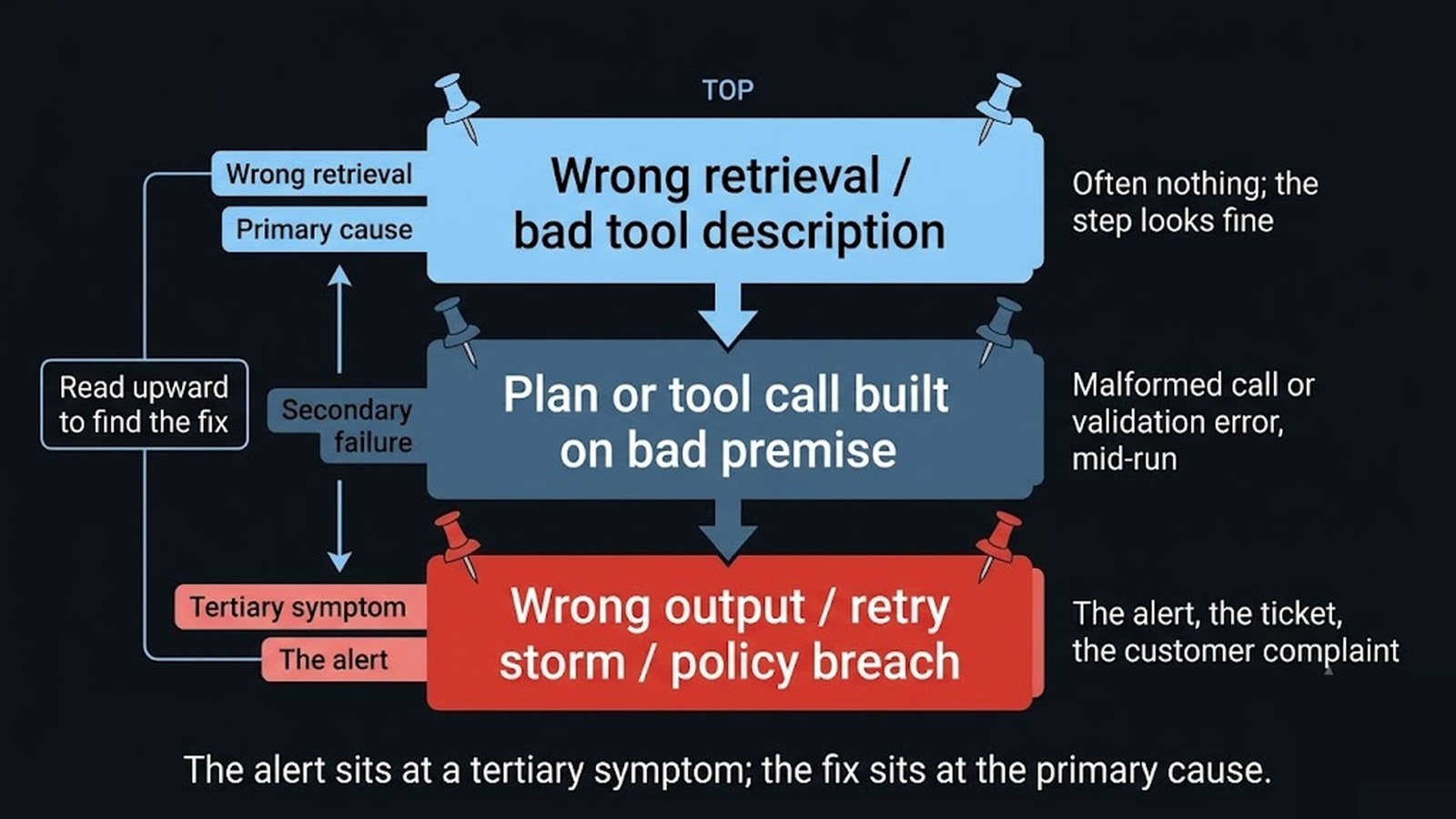
Separating cause from symptom
Classify the chain instead of chasing the last error. The primary failure is the earliest deviation (a wrong tool description that produced a missing parameter). The secondary failure is its direct consequence (the malformed call, the validation error). The tertiary failure is the downstream symptom (the wrong response, the retry storm, the user-facing error) and it's almost always what fired the alert. Reconstructing that chain requires a full trace across all four layers, which is why cascading failures and observability are the same problem viewed from two ends. Be skeptical of "instant, fully automated" root cause claims: the automation helps, but its quality depends entirely on the quality of your traces and a human in the loop to confirm.
| Layer | Failure | What you would see |
|---|---|---|
| Primary (root) | Wrong retrieval / bad tool description | Often nothing; the step looks fine |
| Secondary | Plan or tool call built on the bad premise | A malformed call or a validation error, mid-run |
| Tertiary (symptom) | Wrong output, retry storm, policy breach | The alert, the ticket, the customer complaint |
this is the case for a Pattern Intelligence Layer. At the pattern level, the cause-to-symptom chain is captured and classified identically on every run. Recurring primary failures become visible as patterns, not one-off mysteries. Fix the upstream cause once instead of re-debugging the same tertiary symptom again. The model can change underneath it, the cascade structure and the discipline of tracing back to the first domino is what actually keeps the system reliable.
Frequently asked questions
Would a stronger model stop the early mistake that cascades?
Retrieval returns a wrong doc, the planner builds on it, and the symptom lands far from its cause, which no upgrade ends, since MAST puts failure at 41 to 87%. (arXiv:2511.09030)
Why does the alert almost never point at the real cause?
Because alerts fire on symptoms, which are tertiary failures at the bottom of the chain. The primary cause happened several layers upstream and often produced no error of its own.
Is automated root cause analysis enough?
It helps. Treat "fully automated" claims as marketing. Accuracy depends on trace quality and a human confirming. Primary, secondary, tertiary classification, that's the useful artifact.
Where do I start when tracing a cascade?
Capture spans across all four layers (retrieval, planning, tool, verification) on one trace. You can't reconstruct a chain you only partially recorded.