


Key facts.
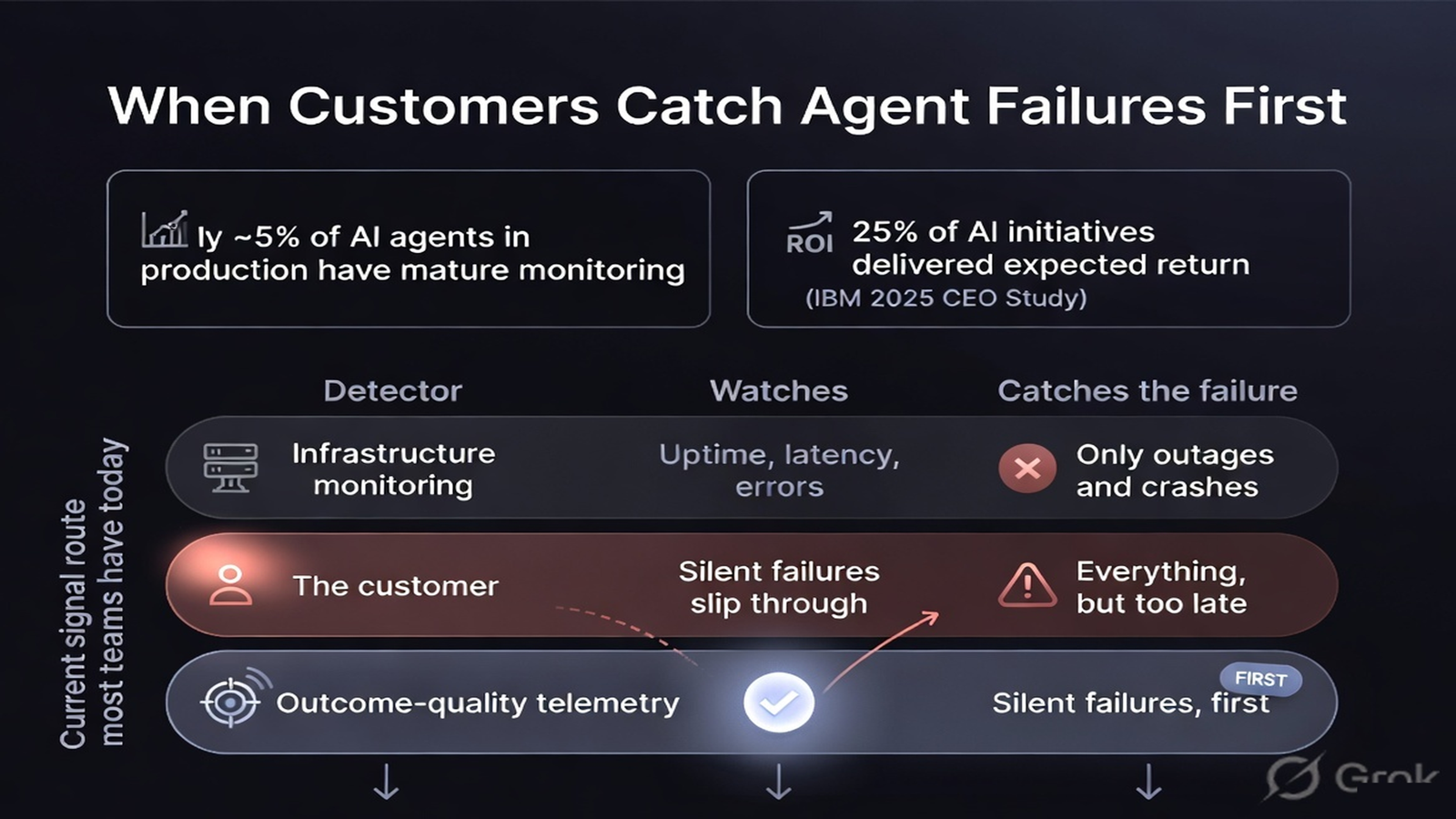
- Most organizations discover production AI failures through secondary signals (customer complaints, declining conversions, compliance flags), not monitoring systems. source
- AI systems rarely fail with an outage. They degrade gradually, with subtle shifts no infrastructure alert is designed to catch. source
- Reported: only about 5% of AI agents that reach production have mature monitoring, with most teams watching surface response quality rather than reasoning. source
- IBM's 2025 CEO Study found only 25% of AI initiatives delivered the expected return, often because teams validated on curated inputs and assumed the agent would generalize. source
Why does the customer see it first?
Because the customer is the only one measuring the outcome. Your monitoring measures whether the request returned and how fast. The customer measures whether the answer was right, the order shipped, the refund was correct. When an agent degrades or returns a confident mistake, the technical layer stays green and the outcome layer goes red, and only the customer is standing in the outcome layer. By the time the ticket arrives, the failure has been live long enough for someone to feel it.
Gradual degradation makes this worse. There is no single moment to alert on, just a slow drift in quality that crosses a threshold the customer notices before any fixed alert does. That is the worst kind of failure to inherit: discovered late, by the person you least wanted to discover it.
How do you make the dashboard win the race?
Measure outcomes, not just operations. Add checks for whether the output satisfied the goal, whether the retrieved context was relevant, and whether the agent's quality is drifting against a baseline. Correlate agent decision traces with the business KPI you actually care about, so a dip in that KPI lights up next to the traces that caused it. The goal is simple: move the first detection from the customer back into your own telemetry.
| Detector | Watches | Catches the failure |
|---|---|---|
| Infrastructure monitoring | Uptime, latency, errors | Only outages and crashes |
| The customer | Actual outcome | Everything, but too late |
| Outcome-quality telemetry | Goal satisfaction, drift | Silent failures, first |
Confident wrong outputs, not outages, mean the complaint beats the alert, and a stronger model does not buy you out, since OpenAI shows training rewards confident guessing. (source)
A Pattern Intelligence Layer is what puts outcome quality on your own dashboard. Reliability at the pattern level means goal satisfaction, context relevance, and behavioral drift are measured around every run and tied to the business KPIs, so the failure surfaces in your telemetry before it surfaces in a support queue. The customer stops being your monitoring system.
Frequently asked questions
Why doesn't my green dashboard reflect reality?
It measures technical health, which stays green during a semantic failure or gradual drift. The reality the customer sees is the outcome, which your dashboard is not measuring yet.
What is the first outcome metric to add?
Goal satisfaction: did the agent's output actually accomplish what was asked? It catches the confident-but-wrong failures that uptime never will.
How do I catch gradual degradation?
Baseline quality and alert on drift, then correlate with the business KPI. Drift detection turns a slow slide into a signal before a customer feels it.