

Key facts.
- Perry's study finds AI-assisted developers often skip established safeguards, the same way agent architectures skip proven distributed-systems reliability patterns.source
- Carlini's training-data extraction work shows what happens when isolation and rigor are treated as optional, lessons distributed systems already encode in their patterns.source
Why reinvent what already exists?
Before microservices teams shipped anything, they learned idempotency the hard way. Duplicate requests doing things twice. They learned backoff the hard way. Retries turning a slow dependency into a cascade. They learned circuit breakers the hard way. One bad component taking down the whole system. It took decades. The lessons got codified. Toolbox is sitting there. An agent is doing the same things those systems did: calling tools that can fail, coordinating between parts, keeping state. But agent builders don't open the toolbox. Perry measured this tendency with AI-assisted developers and it maps directly. The demo worked without the patterns. Production is where it matters.
Carlini showed what "optional isolation" costs. Not theoretical. Running cost. The same lesson shows up everywhere once you've seen it. Don't skip the reliability engineering. It was figured out the first time. You don't need to pay to relearn it.
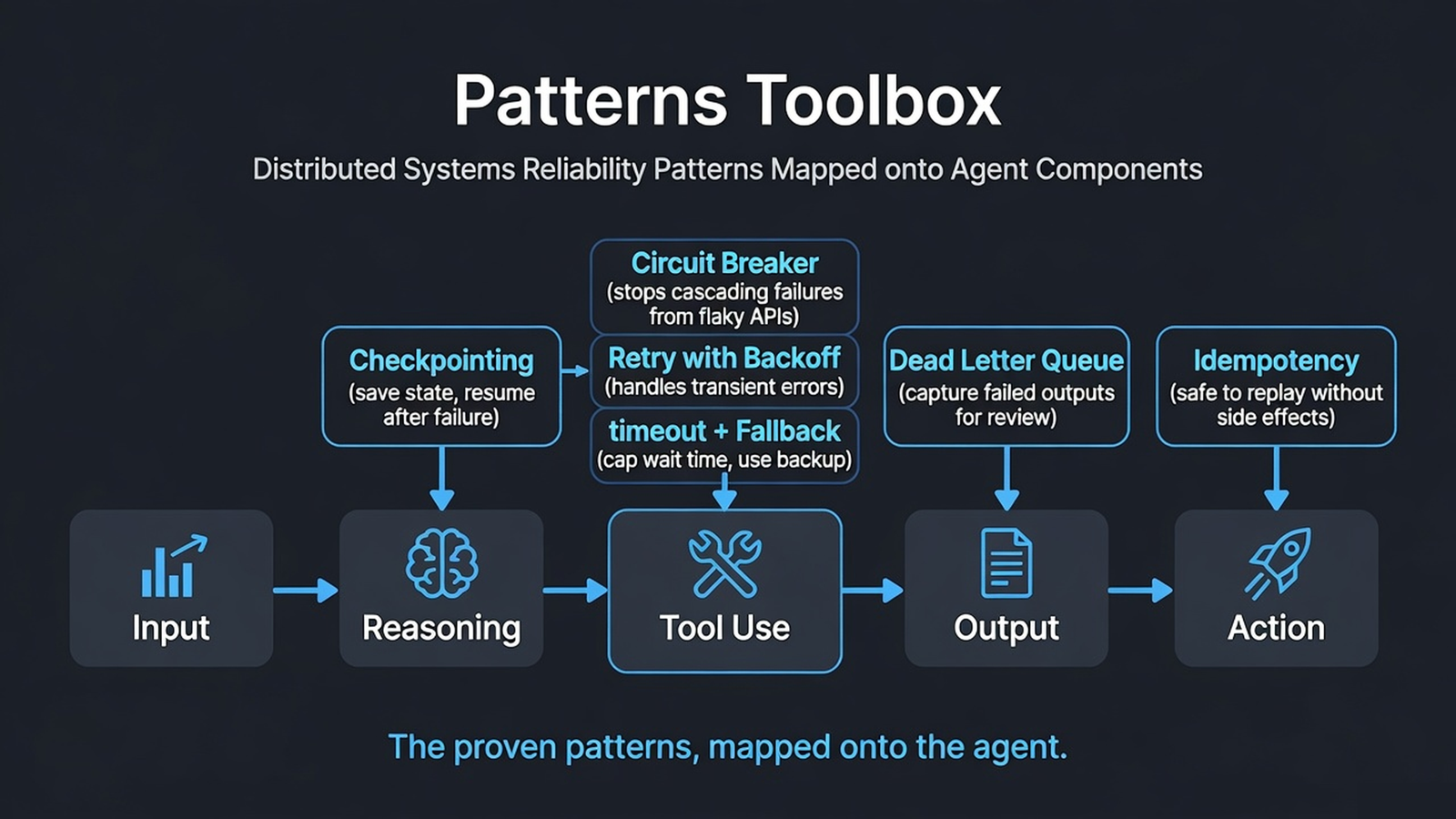
Which patterns map onto agents?
| Pattern | Ad hoc agent | Distributed-systems discipline |
|---|---|---|
| Retries | Blind repeat | Backoff plus idempotency |
| Failing dependency | Cascades | Circuit breaker |
| One component fails | Takes down the rest | Bulkhead isolates it |
| Partial failure | Total failure | Graceful degradation |
Backoff, circuit breakers and bulkheads were proven decades ago; a more capable agent skips them like devs skip safeguards, so it fails ad hoc. (arXiv:2211.03622)
Applying these patterns well means knowing which actions must be idempotent and which dependencies need a breaker. VibeModel, the Pattern Intelligence Layer, makes the agent's consequential actions and dependencies explicit. The distributed-systems toolbox can be applied where it matters rather than uniformly or not at all, and the agent inherits proven reliability instead of improvising it.
Frequently asked questions
Is an agent really a distributed system?
Functionally yes: it calls unreliable tools, coordinates components and persists state. The same failure modes apply, so the same patterns help.
Why do agent teams skip these patterns?
The same way AI-assisted developers skip safeguards, as Perry documents: the demo works without them, so the proven discipline gets deferred.
Which pattern matters most first?
Idempotency, because without it you cannot safely retry and safe retry underpins most other recovery.