

One failing tool, retried hard, can drag down everything that depends on it. Cascading failure is a documented mode: hammering a struggling dependency makes it worse until the whole system tips over (Google SRE Book, Addressing Cascading Failures). A naive agent loop, which answers every failure with another retry, is exactly the trigger.

Key facts.
- The classic resilience patterns apply directly: the Circuit Breaker trips after repeated failures to stop cascading calls, and the Bulkhead isolates resource pools so one failure cannot sink the system (Michael Nygard, Release It!).
- Cascading failure is a named, studied mode: an overloaded or failing dependency, retried hard, drags down everything depending on it unless degradation is designed in (Google SRE Book, Addressing Cascading Failures).
- Recovery patterns, retries, circuit breakers, fallbacks, bulkheads, are now treated as essential engineering for systems built on unreliable dependencies, which an agent's tools always are (Resilient Microservices: A Systematic Review of Recovery Patterns, arXiv:2512.16959, 2025).
- Drop the circuit breaker and one flaky tool cascades; no upgrade adds it, deterministic patterns do. (arXiv:2512.16959)
Why does a naive agent loop fail catastrophically?
Because it treats the model as a trusted oracle and every tool failure as a prompt to try harder. When a tool degrades, the loop retries, reasons, and retries again, which under load becomes a retry storm: resource exhaustion, duplicate side effects, and a cascade as one flaky dependency drags down everything calling it. Cascading failure is a well-documented mode in distributed systems precisely because hammering a struggling dependency makes it worse (Google SRE). The agent's probabilistic reasoning is the wrong place to handle this; it cannot reliably decide to stop. Resilience has to be a deterministic layer around the tool, not a hope that the model behaves.
What do the resilience patterns actually do?
They give a degrading system a defined behavior. A circuit breaker is a small state machine: after a threshold of failures or timeouts it opens, so calls fail fast instead of piling onto a struggling tool, then probes with a half-open state before closing again (Nygard). A bulkhead isolates each tool's resources, separate pools or instances, so one saturated tool cannot starve the others. A fallback gives the agent an alternative when the primary tool is open: a secondary tool, cached or stale data clearly flagged, or a reduced-capability path. And an escalation routes a persistent failure to a human, a supervisor agent, or an incident system with full context, instead of looping forever. Each is deterministic and observable.
# A circuit breaker makes a degrading tool fail fast, not cascade
breaker = CircuitBreaker(fail_threshold=5, reset_timeout=30)
if breaker.is_open("inventory_api"):
 return fallback_or_escalate() # don't hammer a tool that's down
try: result = call_tool(...)
except: breaker.record_failure("inventory_api"); raise # 5 fails -> open
How do you build resilience into tool calling?
Wrap every tool invocation in a circuit breaker so a failing tool trips open and stops the storm, and consider a runtime control that can disable a misbehaving tool without a redeploy. Apply bulkheads, separate pools or instances per tool or per criticality tier, so a slow tool cannot starve a critical one. Define fallbacks for each tool: an alternate, cached data with a staleness flag, or a graceful reduced path. Add explicit escalation on repeated failures or policy triggers, handing a human or supervisor the full context rather than looping. Instrument health signals, error rate, tail latency, and business-outcome success, and let them trip breakers and fire escalation automatically. The agent then survives a bad tool instead of being taken down by it.
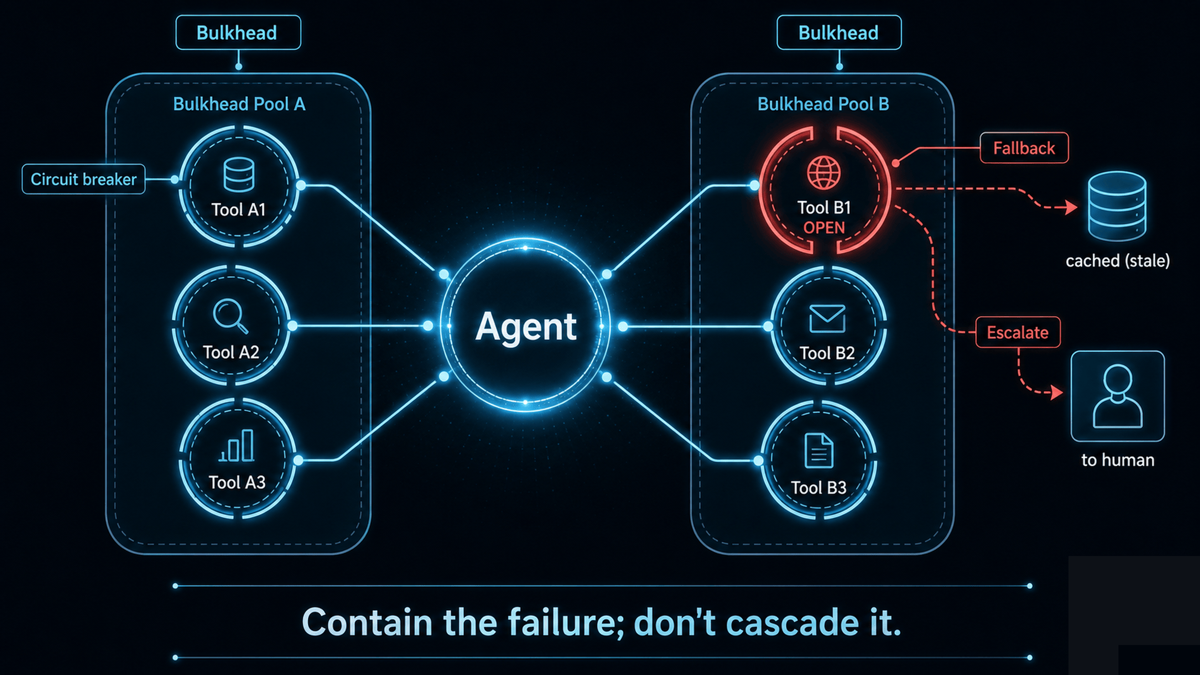
Naive loop versus resilient architecture
| Failure | Naive agent loop | Resilient architecture |
|---|---|---|
| Tool keeps failing | Retry storm, rising cost | Circuit breaker opens, fail fast |
| One tool saturates resources | Starves the whole agent | Bulkhead isolates the blast radius |
| Primary tool unavailable | Dead end or loop | Fallback: alternate or flagged cache |
| Persistent failure | Loops indefinitely | Escalate to human/supervisor with context |
| Degrading dependency | Cascade | Health SLIs trip breakers automatically |
The pattern is that the model cannot be trusted to stop, so resilience has to be a deterministic layer around every tool: breakers that fail fast, bulkheads that isolate, fallbacks that degrade, and escalation that hands off. Build those in and a flaky tool is a contained event instead of an outage. Treating each tool boundary as an unreliable dependency to be guarded, rather than an oracle to be trusted, is reliability at the pattern level, which is what VibeModel builds as the Pattern Intelligence Layer.
Frequently asked questions
Why not let the model decide when to stop retrying?
Because its control flow is probabilistic and it cannot reliably choose to stop, which is how retry storms start. A circuit breaker is a deterministic state machine that fails fast regardless of what the model reasons.
What does a fallback look like for an agent?
An alternate tool, cached or stale data returned with an explicit staleness flag, or a reduced-capability path, so the agent degrades usefully instead of dead-ending when a tool is open.
When should the agent escalate to a human?
When failures persist past the breaker, when a policy triggers, or when the action is high-impact. Hand over full context, the attempts, the errors, the state, so the human starts informed rather than blind.