


Key facts.
- MAKER (arXiv:2511.09030) evaluated agents on multi-step tool chains and documented error compounding, where failures in intermediate steps corrupt the state of all subsequent steps rather than terminating cleanly (MAKER, arXiv:2511.09030).
- Circuit breaker patterns from Fowler's microservices architecture documentation define three states (closed, open, half-open) for isolating failing dependencies - the same states apply to tool calls that begin showing elevated failure rates.
- PALADIN (arXiv:2509.25238) found that baseline tool recovery rates are low without structured failure handling, and that recovery rates improve substantially with explicit failure isolation and retry strategies.
- Bulkhead patterns, which isolate different types of tool calls into separate failure domains so that one tool's failure cannot exhaust resources for others, are standard in microservice architectures but rarely applied to agent tool layers.
- Graceful degradation, where an agent shifts to a reduced-capability mode when critical tools are unavailable rather than failing completely, requires explicit fallback path design that most agent teams skip.
Why agents need circuit breakers
A circuit breaker monitors calls to a dependency and trips to an "open" state when the failure rate crosses a threshold. While open, calls fail immediately with a fast fallback rather than waiting for a timeout. After a configured period, it shifts to "half-open" and tries a single call to see if the dependency has recovered. This prevents the pattern where a failing external service causes an agent to repeatedly wait for timeouts, consuming budget and context window on calls that will not succeed.
Applied to tool calls, a circuit breaker on a CRM integration means: if the CRM API fails 5 times in 60 seconds, stop making CRM calls for the next 5 minutes and route to a degraded mode (notify the human operator, queue the updates for later, or decline new tasks that require CRM access). This is not a model decision. It is a wrapper-layer decision made before the model is even aware the tool is degraded.
The resilience pattern stack
The full resilience pattern stack for a production agent tool layer combines four patterns. Circuit breakers isolate failing tools from the rest of the session. Bulkheads prevent one tool's resource consumption from affecting another. Timeouts prevent indefinite waits on unresponsive tools. Fallbacks provide degraded but functional behavior when the primary tool is unavailable. Each pattern can be implemented in the tool wrapper layer independently of the model, and each addresses a distinct failure mode that the model alone cannot handle.
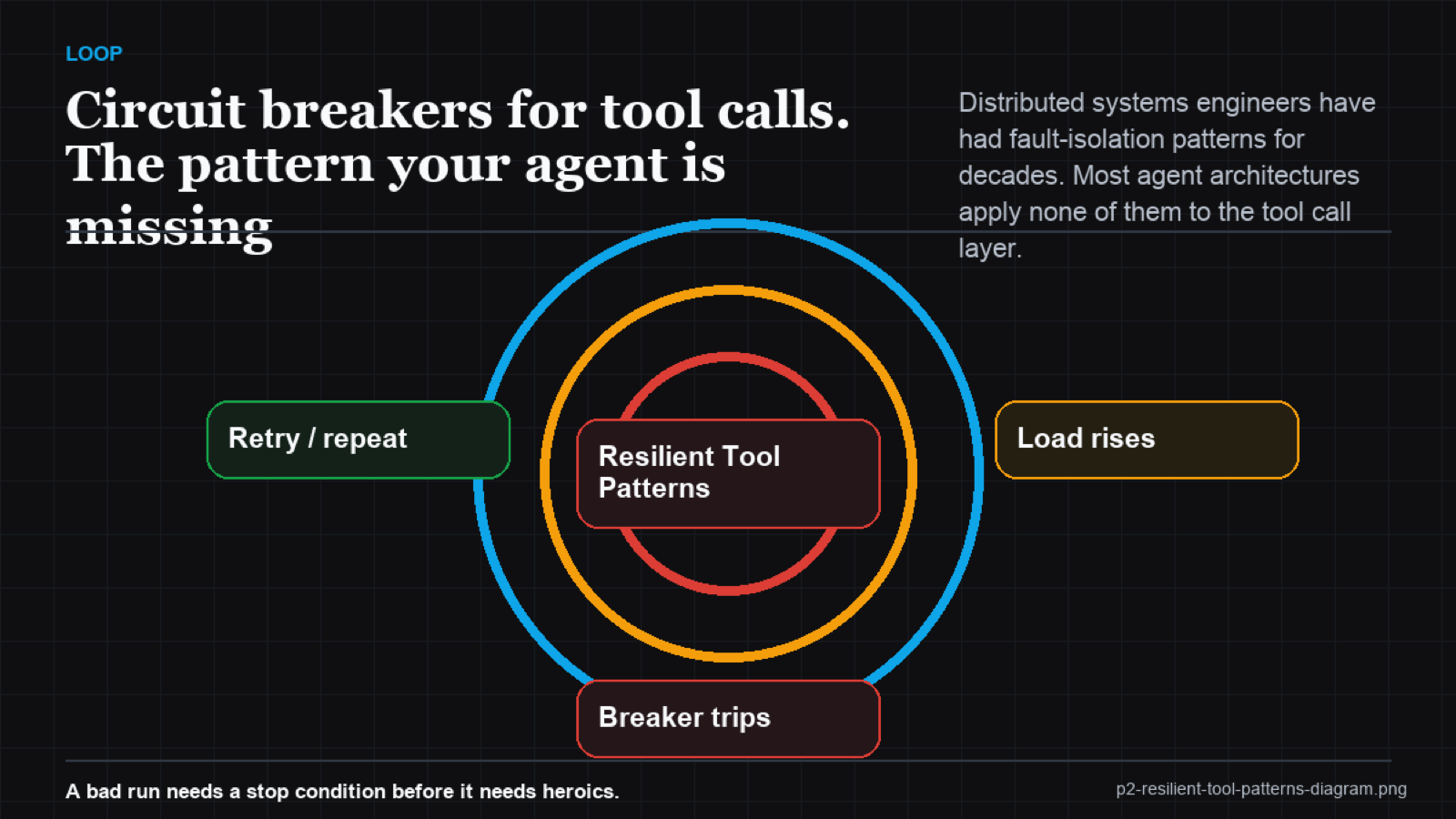
Resilience patterns for agent tool layers
| Pattern | Failure mode it prevents | Implementation location | Agent framework support |
|---|---|---|---|
| Circuit breaker | Repeated calls to failing tool | Tool wrapper | Rarely native, build it |
| Bulkhead | One tool failure cascades to others | Tool pool isolation | Almost never native |
| Timeout | Indefinite wait on unresponsive tool | Tool wrapper | Sometimes native |
| Fallback | Complete failure when tool unavailable | Orchestrator logic | Requires explicit design |
MAKER showed a step-3 error cascading through steps 4 to 8; a stronger model cascades the same way without circuit breakers. (arXiv:2511.09030)
VibeModel's Pattern Intelligence Layer learns the tool call failure patterns that precede cascading session failures in your specific deployment. By identifying which tool combinations produce error compounding when one of them degrades, it surfaces the circuit breaker and bulkhead configurations that prevent the cascade. The pattern layer does not replace the engineering work of implementing these patterns. It tells you which patterns to implement first, based on where your error compounding actually occurs.
Frequently asked questions
What failure rate threshold should I use for a circuit breaker?
Start with 50% failure rate over a 60-second window for most tool integrations. For tools on the critical path (payments, authentication), use a tighter threshold like 25% over 30 seconds. Tune from production data once you have a baseline failure rate for each tool.
Do circuit breakers work for agent sessions that are already in progress?
Yes, and this is where they are most valuable. A session that is halfway through a multi-step workflow and encounters a tool failure benefits immediately from circuit breaker isolation - it routes to degraded mode rather than continuing to attempt calls that will fail and corrupting the remaining workflow steps.
Is there an open-source library for agent-specific circuit breakers?
Most circuit breaker libraries (resilience4j for Java, Polly for .NET, pybreaker for Python) work at the HTTP client level and can be applied to tool call wrappers directly. Agent-specific circuit breaker libraries are emerging but the general-purpose ones are well-tested and suitable for tool wrapper wrapping.