


Key facts.
- "Expensively Quadratic" documents agent context and cost growing quadratically with steps, so an unbounded run becomes an unbounded bill without hard limits. source
- ToolEmu finds agents take risky and irreversible actions in high-stakes scenarios, the case a circuit breaker on consequential actions exists to stop. source
Why does an agent need explicit limits?
Agent cost grows quadratically with steps, so an unbounded loop is an unbounded bill; a better model just loops cheaper, not bounded. (arXiv:2309.15817)
A traditional service fails in bounded ways: it errors, times out, returns. An agent can fail in unbounded ones. It can loop, retrying a step that will never succeed; it can wander, taking action after action toward a goal it misread; it can escalate, each step committing to a wrong path. Without explicit limits there is nothing to stop any of these and two costs run away at once. The Expensively Quadratic effect means a long run gets disproportionately expensive as history accumulates, so a stuck agent is also a financial event. And ToolEmu shows the actions themselves can be irreversible, so an unbounded agent is not just wasting money, it may be doing damage you cannot undo.
The fix is standard reliability engineering applied to a new kind of system. Set a step budget and a wall-clock timeout so a run cannot continue forever. Set a spend cap so cost cannot run away. Put a circuit breaker in front of consequential or irreversible actions, so they require a check or a human rather than firing automatically. And design a graceful degradation path, so when a limit trips the agent falls back to a safe state instead of crashing mid-action. These are not exotic; they are the seatbelts that should be standard, installed before the crash rather than after.
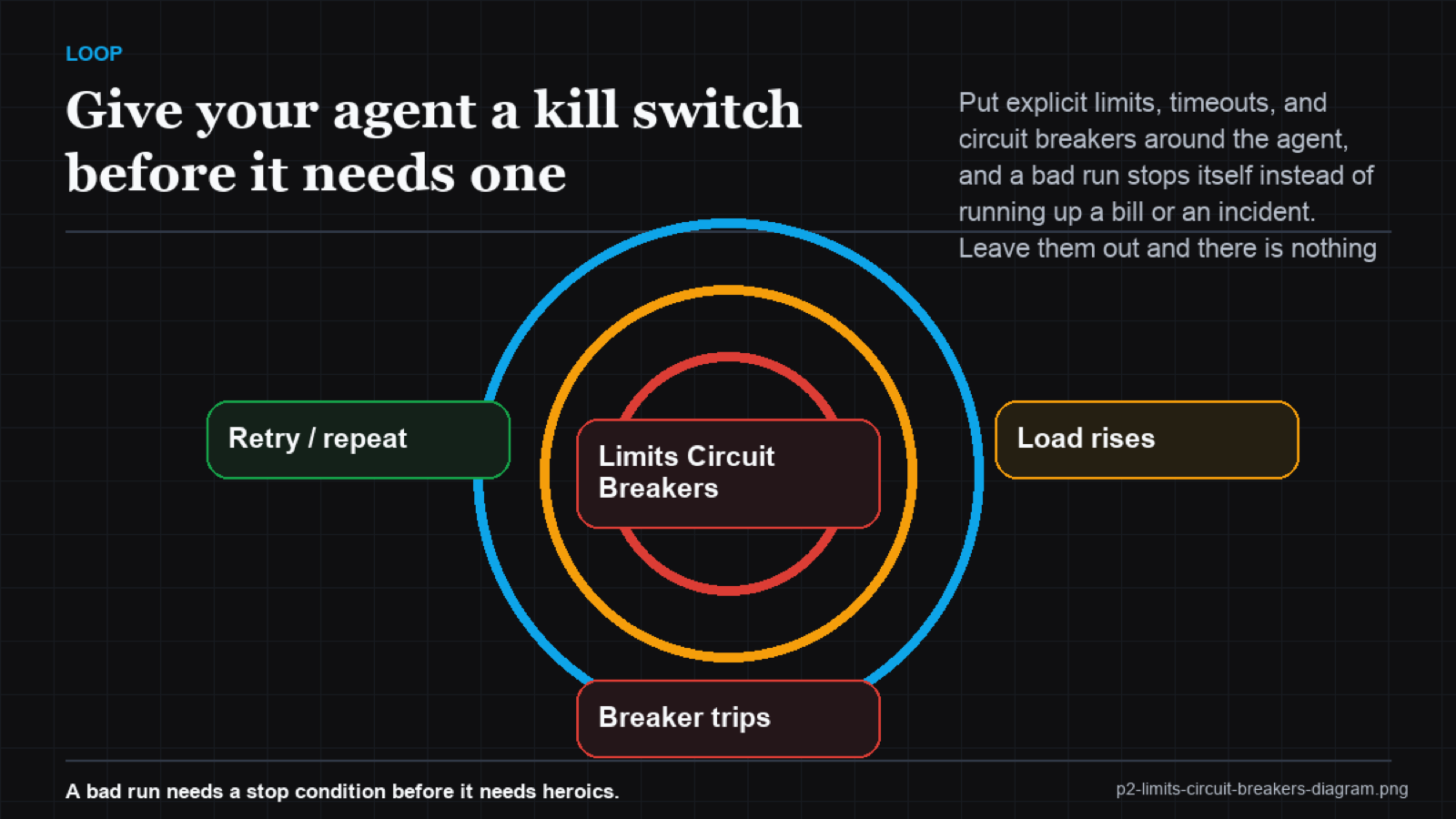
What limits belong around a production agent?
| Control | Without it | With it |
|---|---|---|
| Step/time budget | Loops forever | Halts at the limit |
| Spend cap | Runaway bill | Cost bounded |
| Action circuit breaker | Irreversible action fires | Gated or escalated |
| Degradation path | Crashes mid-action | Falls back safely |
Knowing which actions need a circuit breaker means knowing which carry consequence, a pattern-level judgment the Pattern Intelligence Layer makes explicit. VibeModel distinguishes the routine patterns that can run freely from the consequential ones that need a gate, so the limits land where they matter and a bad run stops itself before it becomes a bill or an incident rather than after.
Frequently asked questions
Aren't limits just for cost?
No. They also stop irreversible actions. ToolEmu shows agents take risky, irreversible steps, so a circuit breaker on consequential actions is a safety control, not only a budget one.
Why does an agent run away in cost?
Context and cost grow quadratically with steps, so a stuck or looping agent gets disproportionately expensive fast. A spend cap and step budget bound it.
Where should the circuit breaker sit?
In front of consequential or irreversible actions, so they require a check or a human rather than firing automatically.