


Key facts.
- Self-preference bias shows agents systematically favor their own outputs, a behavioral failure the agent will not flag and technical metrics cannot see. source
- Position bias in LLM-as-judge is another systematic, non-obvious behavioral failure that uptime and latency monitoring miss entirely. source
- Self-preference bias never flags itself; a more capable agent makes the biased call while every uptime cost dashboard stays green. (arXiv:2410.21819)
Why is technical health not enough?
Traditional monitoring answers "is the system up and fast": CPU, memory, latency, error rate. For an agent, all of those can be perfect while the thing is failing at its actual job. The agent is responding quickly, not crashing, returning valid-looking output and quietly making biased or wrong decisions. The self-preference and position-bias findings are concrete examples: these are systematic behavioral tendencies, an agent over-rating its own work or over-weighting whichever option came first, that produce wrong outcomes with zero technical symptoms. No latency spike, no error log, just a steady stream of decisions that are subtly off, which a health dashboard reports as a healthy service.
Behavioral monitoring asks a different question: "is the agent doing the right thing." That means tracking the distribution of its decisions and outputs for anomalies, watching for drift in the kinds of answers it gives, flagging when its confidence and its accuracy diverge and sampling outputs for quality rather than just counting that they were produced. It also means instrumenting the reasoning, not just the result, so a decision that came out plausible for the wrong reason can be caught. The failures that hurt an agent in production are usually behavioral and behavioral failures are invisible to monitoring built for uptime. You have to watch what the agent does, not just whether it is running.
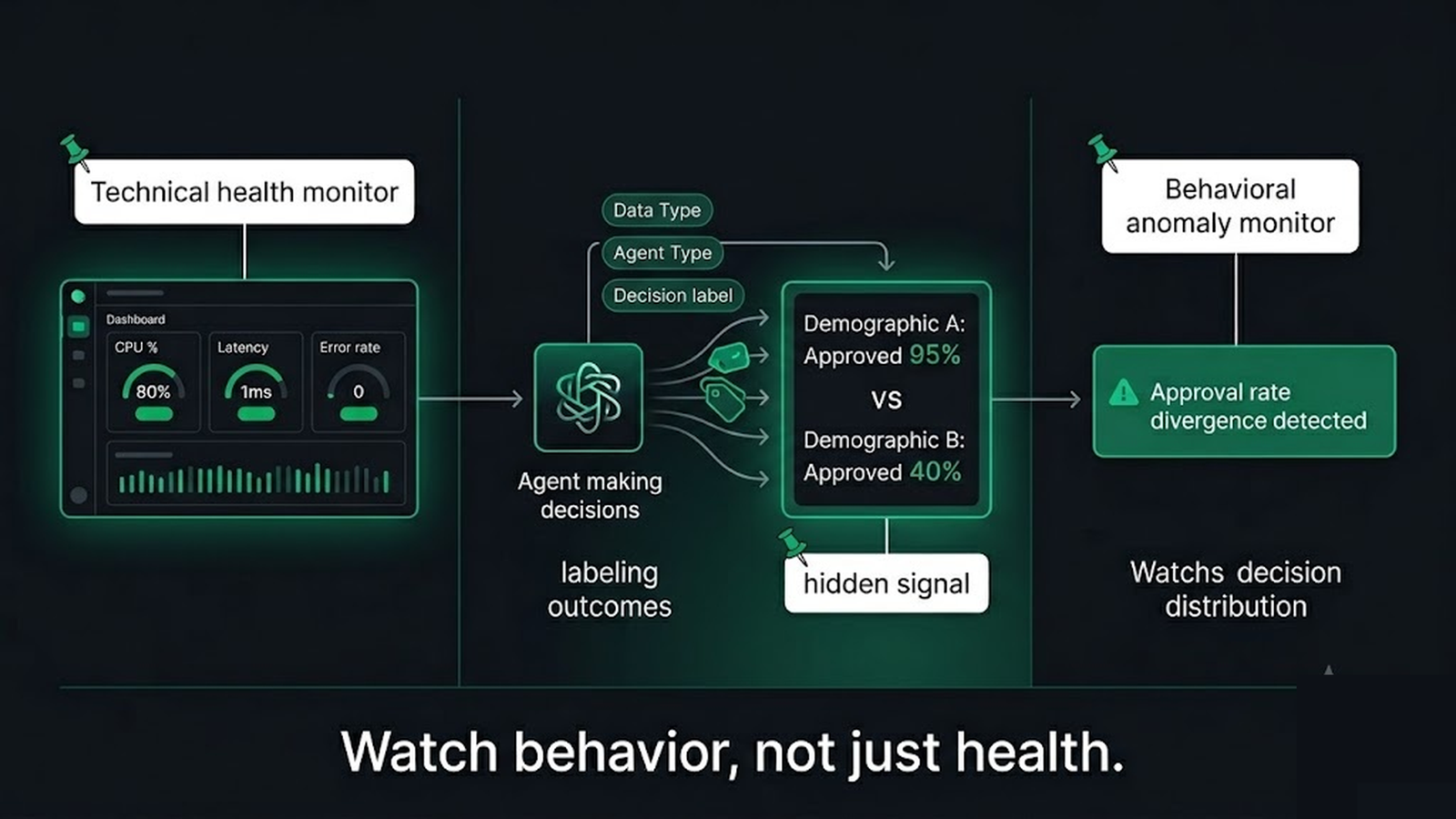
What does behavioral monitoring add?
| Layer | Technical health | Behavioral monitoring |
|---|---|---|
| Watches | Uptime, latency, errors | Decisions and outputs |
| Catches | Crashes | Bias, drift, wrong answers |
| A biased decision | Shows green | Flagged as anomaly |
| Signal | Is it running | Is it doing the right thing |
Spotting a behavioral anomaly requires a baseline of correct behavior to compare against, which is what the Pattern Intelligence Layer provides. VibeModel makes the agent's expected handling of each situation explicit, so monitoring can flag when its actual behavior deviates from the pattern, catching the biased or wrong decision that every uptime metric would have reported as a healthy, green service.
Frequently asked questions
Why can't technical metrics catch this?
Because behavioral failures have no technical symptom. A biased decision is fast, valid-looking and crash-free, so CPU and latency dashboards show green while the agent is wrong.
What should behavioral monitoring track?
The distribution of decisions and outputs, drift in answers, confidence-versus-accuracy divergence and sampled output quality, plus the reasoning behind decisions.
Are these failures common?
Yes. Systematic biases like self-preference and position bias are documented and invisible to health monitoring, so they run unseen without behavioral checks.