

Key facts.
- WildToolBench tested 57 LLMs on 256 real tool-interaction scenarios and found session-level accuracy below 15% for every model evaluated, yet every session produces a confident response (arXiv 2604.06185, ICLR 2026).
- The TRAIL observability framework distinguishes semantic correctness from technical success as a separate monitoring dimension that standard APM tools don't capture (TRAIL, arXiv 2505.08638).
- Research on the generator-verifier gap shows verification is computationally cheap relative to generation, models that generate correct answers only 36% of the time verify them at 96%, meaning semantic checking is affordable if you build it in (RLSR, arXiv 2505.08827).
What does a semantic error look like in production?
It looks like success. The agent queried the right API, got a 200 OK, parsed the response, and returned an answer. The answer referenced the wrong customer record, applied a discount to the wrong tier, or summarized last quarter's report instead of this quarter's. None of that appears in your error logs. The span closed clean.
this is the class of failure that technical monitoring was never designed to catch, because it predates the era when a system could be confidently wrong at inference time. Classic observability assumes that if the code ran without exceptions, the output is acceptable. Agents break that assumption on every call.
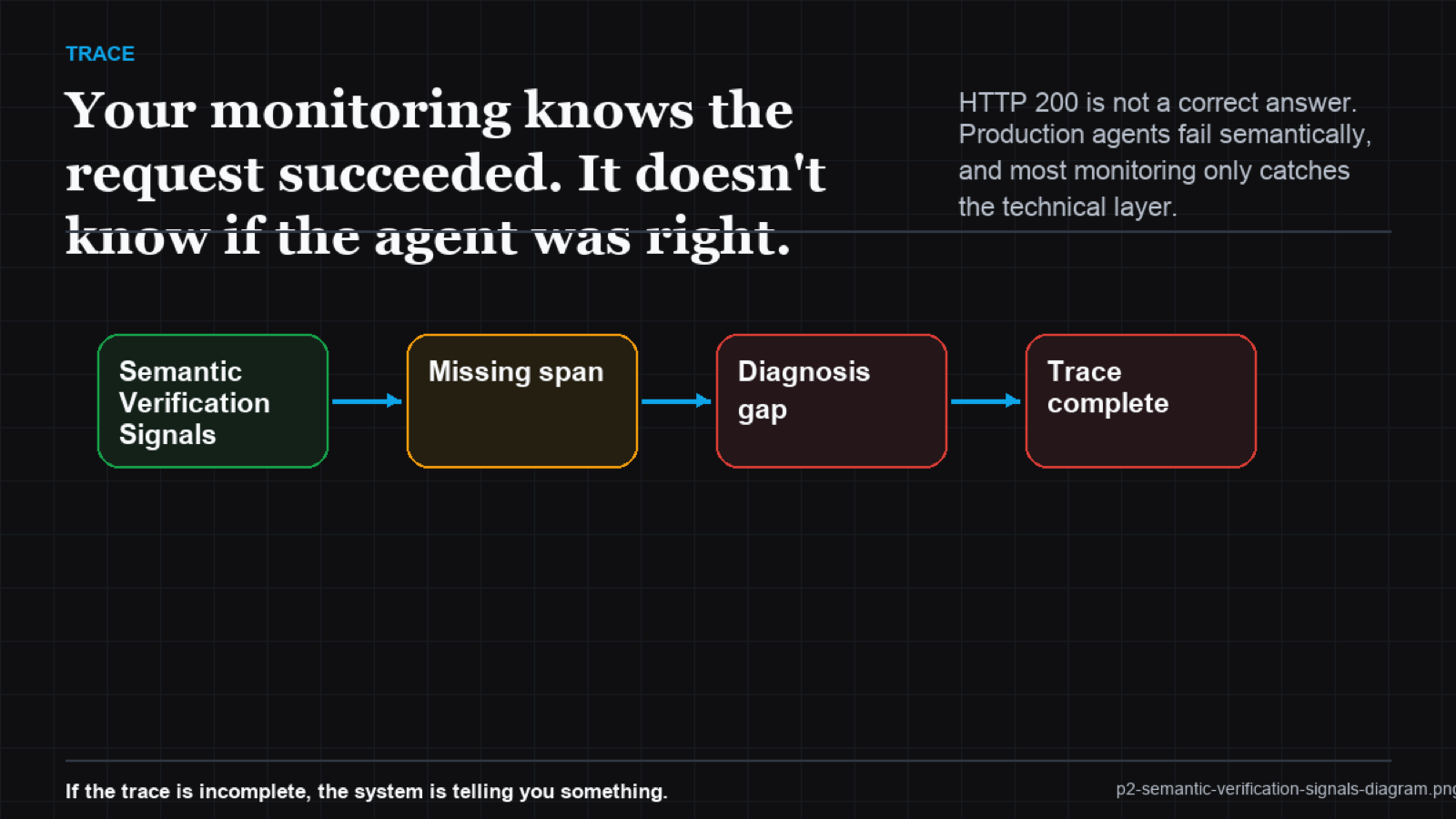
Technical signals vs. semantic signals
| Technical signal (what you have) | Semantic signal (what you need) |
|---|---|
| HTTP 200 / no exception | Did the agent answer the right question? |
| Latency within SLA | Did the tool result match the stated goal? |
| Tool called successfully | Was the tool's output interpreted correctly? |
| Retry count zero | Did the final state reflect the intended action? |
this is where the Pattern Intelligence Layer sits. VibeModel monitors semantic signals as a production category distinct from infrastructure health, the same way a circuit breaker catches latency, a semantic verifier catches wrong answers before they reach the customer. You don't choose between speed and correctness; you instrument for both.
Frequently asked questions
Can't I just use LLM-as-judge to catch semantic errors?
You can use it as one signal. But LLM judges carry their own biases, they prefer their own style, prefer longer answers, and can be fooled by plausible-sounding wrong answers. Layer multiple signals: schema checks, downstream state verification, and sampling-based review. One judge isn't enough.
Is this expensive to add?
The generator-verifier gap research shows verification is much cheaper than generation. You don't need to re-run the full task; a targeted correctness check on the output costs a fraction of the original inference. The cost of not doing it's measured in customer escalations.