


Key facts.
- BCG's 10-20-70 framing puts about 70% of AI value in people and process, which is exactly where workflow owners hold the knowledge a model lacks. source
- Writer's 2025 report found 41% of younger employees admit undermining their employer's AI strategy, a number that drops when those employees help shape the tool instead of receiving it. source
- tau2-bench shows frontier models passing roughly 34 to 49% of difficult multi-turn tool tasks, so owner-set boundaries on autonomy are not bureaucracy, they are risk control. source
Why does a veto change the outcome?
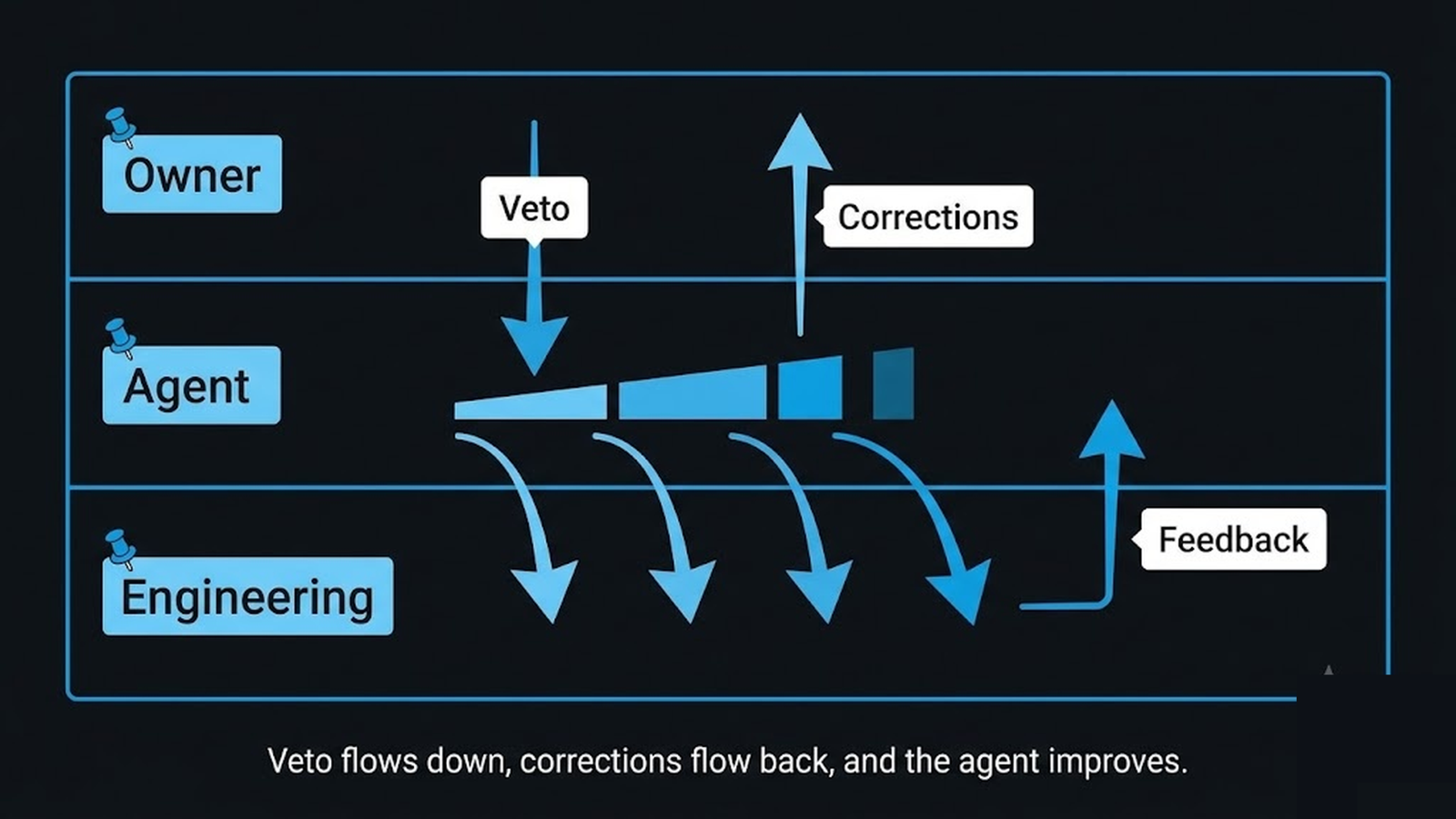
Authority changes how people engage. A workflow owner with no power over the agent watches it warily and routes around it. The same owner with a veto over what the agent does unsupervised starts treating its boundaries as theirs to set, which means they think hard about the edge cases, the irreversible actions and the places the agent should ask first. That thinking is the most valuable input the project gets and it only comes when the person has skin in the decision.
The feedback channel matters just as much. If an owner reports a recurring mistake and nothing changes, they stop reporting and the agent stops improving. If their correction visibly tightens the agent's behavior next week, they become the person teaching it the cases only they know. That loop is how an agent gets better at the long tail no benchmark covers.
What does real involvement require?
| Element | Token involvement | Real authority |
|---|---|---|
| When | Shown the finished agent | In the room during scoping |
| Power | Can give feedback, ignored | Veto over unsupervised scope |
| Feedback | Goes into a backlog | Changes behavior visibly |
| Effect | Quiet resistance | An invested defender |
Give the owner a veto and output stops outrunning review; a stronger model will not carry it, so rework is real. (arXiv:2506.07982)
This is reliability and adoption meeting in one design choice. The owner's boundaries are where the agent's reliability gets defined in human terms and the corrections are how it improves on the patterns that matter to the business. VibeModel is the Pattern Intelligence Layer because it makes those patterns the unit of reliability, so an owner's rule about what the agent must always do and never do, becomes something the system enforces consistently rather than a hope written in a prompt.
Frequently asked questions
Does a veto slow everything down?
It scopes autonomy, it does not block work. The owner decides what runs unsupervised versus what asks first, which is faster than cleaning up an action that should have asked.
What if owners veto too much?
They loosen the leash as trust builds, usually fast, once they see the agent handle the cases they were worried about. Starting tight earns the room to widen.
Why not just collect feedback after launch?
Because feedback with no power and no visible effect dies. Authority plus a loop that changes behavior is what keeps owners engaged.