

Even trained experts defer to a confident AI: in a randomized trial, physicians who had completed AI-literacy training still followed erroneous model suggestions, their diagnostic accuracy falling from 84.9% to 73.3%.The reflex to trust fluent output survives training, so it will reach your reviewers too (NEJM AI, 2026).

Key facts.
- A randomized trial found that physicians who'd completed AI-literacy training still followed erroneous model suggestions, diagnostic accuracy dropped from 84.9% to 73.3%, a 14-point fall (Automation Bias in LLM-Assisted Diagnostic Reasoning, NEJM AI, 2026).
- The confidence that drives over-trust is unearned: modern neural networks are systematically miscalibrated and overconfident, attaching high probability to wrong answers (On Calibration of Modern Neural Networks, arXiv:1706.04599, 2017).
- Organizations choose simpler controls under delivery pressure: most production teams cap autonomy and rely on human review rather than building automated verification (Measuring Agents in Production, arXiv:2512.04123, 2025).
Why it's behavioral, not technical
Fluent output triggers automation bias even in experts; a better model only sounds more authoritative, never safer. (arXiv:1706.04599)
The tools for verification are cheap and available. What stops teams is human and organizational. The core driver is automation bias, the tendency to over-rely on an automated system and lower your own guard. It survives training. A randomized trial with physicians who'd completed a dedicated AI-literacy program: they still followed erroneous model suggestions, and their diagnostic accuracy dropped from 84.9% to 73.3% (NEJM AI). Fluent output amplifies it. Sounds authoritative, so it must be right. The confidence is unearned, modern models are systematically miscalibrated, just as assured when wrong (On Calibration of Modern Neural Networks). People stop checking exactly when the output looks most convincing. That's when a fluent error is most dangerous.
The organizational pressures that reinforce it
Incentives and assumptions all pointing away from verification. Speed-to-demo wins: a working demo gets rewarded now. A verification layer adds friction now for a benefit that only appears later, at scale or after an incident. So reliability gets cut. There's also the assumed-intelligence belief: frontier models are capable enough that a second check feels like overhead, and the fluent output confirms it. Under delivery pressure, teams pick the simplest control that bounds risk, cap autonomy, keep a human in the loop, rather than building automated verification. That's the pattern production surveys find (Measuring Agents in Production). None of this means verification doesn't work. It just keeps losing to whatever ships faster.
How to counter the reflex
Treat verification as a behavioral and process problem. Make it required and tracked: verification coverage as a metric alongside velocity, so reliability competes with speed rather than losing by default. Design for doubt. Surface uncertainty. Default high-impact actions to read-only or dry-run. Require explicit confirmation on consequential steps. The fluent output shouldn't be able to sail through on tone alone. In post-incident reviews, name the missing verification layer, don't file it under model error, or the lesson never lands. And don't rely on literacy training alone. The NEJM AI trial showed it isn't enough. You need process gates that force a check at the moment of over-trust. The fix isn't a smarter model. It's an organization that keeps verifying after the output looks good.
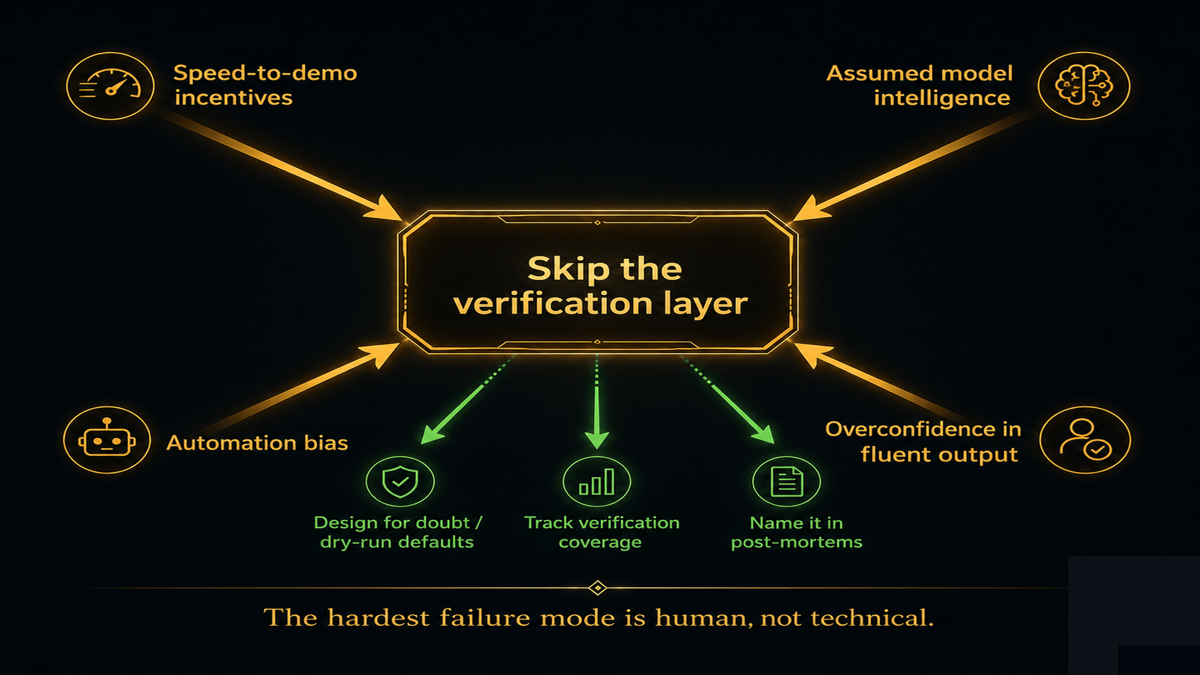
The driver and the counter-measure
| Driver | How it skips verification | Counter-measure |
|---|---|---|
| Automation bias | Over-trust, vigilance drops | Design for doubt, force a check |
| Fluent overconfidence | Sounds right, so it must be | Surface uncertainty, dry-run defaults |
| Speed-to-demo | Reliability deprioritized | Track coverage as a metric |
| Assumed model intelligence | Check feels redundant | Calibrate with incident evidence |
| Incident blamed on model | Lesson not learned | Name missing verification in reviews |
The techniques for verification are cheap. What stops teams is human over-trust and incentives that reward speed over reliability. Name those drivers, design for doubt, track coverage, and call out the missing layer in reviews, and the reflex to stop checking once the output looks good gives way to a process that keeps verifying. Baking that discipline into the system rather than hoping people resist a confident agent is reliability at the pattern level. That's what VibeModel builds as the Pattern Intelligence Layer.
Frequently asked questions
Won't training people to be skeptical fix this?
Only partly. A randomized trial found that physicians with dedicated AI-literacy training still showed automation bias and followed erroneous suggestions. Training helps, but you also need process gates and design-for-doubt that force a check at the moment of over-trust.
Why does fluent output make it worse?
Because confident, polished output reads as authoritative, which lowers the reviewer's guard, and the model's confidence is poorly calibrated, so it's just as assured when wrong. People stop checking exactly when a fluent error is most dangerous.
How do you get reliability to win the prioritization fight?
Track verification coverage alongside velocity, make it a visible metric, not an afterthought. Default risky actions to dry-run. In post-incident reviews, name the missing verification layer, don't blame the model. That's how the organization learns the right lesson.