


Key facts.
- CSA 2024: 61% of organizations skipping verification cited speed, but verification actually added only 8-12% to development time in teams that built it.
- Optimism bias in AI deployment: teams consistently rate their model's production reliability 25-40% higher than measured post-deployment performance, per CSA data.
- Anchoring on demo performance is the most common reasoning path to skipping verification - if it worked in the demo, the team's prior belief in reliability is anchored too high.
- Organizational incentives make it worse. Launch velocity gets measured and rewarded. Post-launch incident rates rarely trace back to the team that built the agent.
Three cognitive biases at work
Optimism bias makes teams believe their agent will outperform in production what the evidence actually warrants. A developer who has worked with the agent for weeks, tuned the prompts, and watched it succeed on test data has accumulated strong positive prior beliefs. Those beliefs are accurate for the conditions they observed. they're systematically too optimistic for the conditions they haven't yet encountered - which is most of production.
Anchoring bias causes teams to set their reliability estimates based on the most salient data point they've: the demo. The demo worked. The agent solved the problem. That anchor persists even when the team is told that demo conditions differ significantly from production conditions. The anchor is emotional and experiential, not analytical.
Attribution gaps in organizational incentives allow the bias to persist. If the team that ships an agent isn't the team that investigates production incidents three months later, the feedback loop that would correct the bias never closes. Speed gets the reward; the cost of skipping verification is paid by a different team, in a different quarter, and attributed to "model quality" rather than "missing verification layer."
Why "we'll add verification later" never happens
this is the most expensive sentence in enterprise AI development. Once an agent is in production, the team disperses to other projects. The urgency that would have driven verification design during the build phase doesn't exist after launch - until the first major incident. By the time the incident creates urgency to add verification, the codebase has evolved, the original developers may have moved on, and retrofitting a verification layer into a running production system is 3-5x more expensive than building it during initial development.
The pattern also interacts with confirmation bias post-launch. Once the agent is running and most tasks appear to complete, the team treats low-visibility incidents, silent failures, minor errors, edge-case misfires, as acceptable noise, not signals that verification would catch. "It mostly works" becomes the anchor. Verification never gets added until a major incident forces it.
Breaking the cycle organizationally
Change the metric that's visible during development. Track verification coverage in sprint planning alongside feature completion and it becomes a deliverable, not an afterthought. Teams optimize for what's measured. Measure verification coverage from day one.
Close the attribution loop. Make the team that built the agent responsible for production incident investigation for at least 90 days post-launch. When the cost of missing verification hits the team that made the decision, the decision calculus changes permanently. This isn't punitive - it's feedback loop design.
Reframe the cost estimate. When a developer says "adding verification will take too long," replace the implicit comparison (verification overhead vs zero overhead) with the correct comparison (verification overhead vs expected remediation cost for the incident that verification would have prevented). The math usually ends the debate.
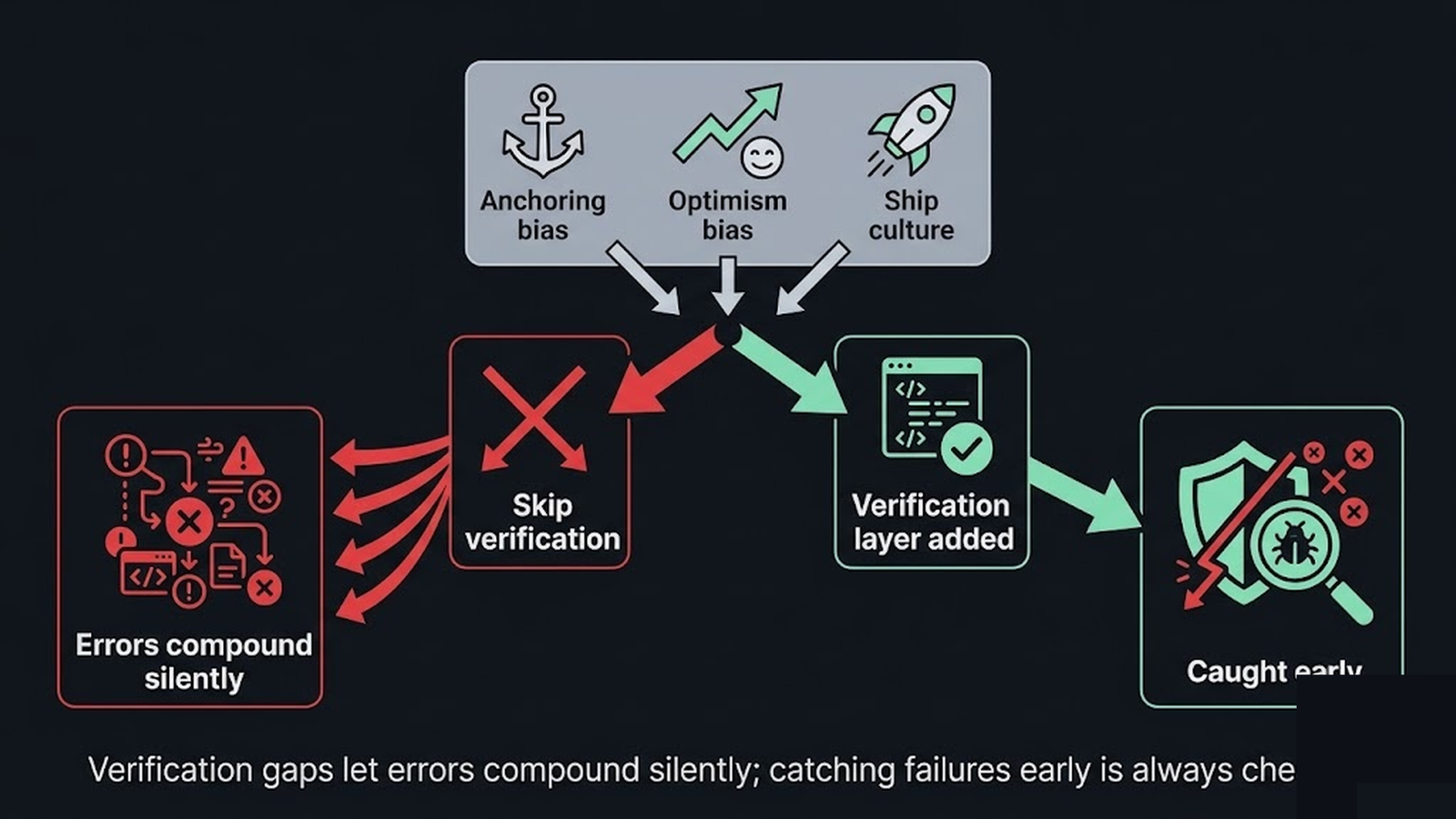
Bias-to-outcome mapping
| Bias | How it manifests | Organizational fix |
|---|---|---|
| Optimism bias | "It passed QA, it will work in prod" | Mandatory fault injection pre-launch |
| Anchoring bias | "The demo worked perfectly" | Pre-mortem exercise before launch |
| Attribution gap | "Not our incident to investigate" | 90-day post-launch ownership for builders |
| "Later" planning | "We'll add verification in v2" | Verification as launch gate, not v2 feature |
The Pattern Intelligence Layer removes the cognitive bias from the equation entirely by making verification a required attribute of every pattern specification - not a separate decision the team makes during development. The question becomes "what does this pattern's verification contract look like?", not "should we add verification?" That decision is already made by the pattern spec.