


Key facts.
- CSA 2024 AI Safety Survey: fewer than 15% of enterprise deployments have dedicated secondary verification agents.
- CSA 2024: deployments with secondary verification report 67% fewer incidents reaching external stakeholders.
- Average implementation cost for a focused verification agent: 15-25% of the primary agent's development cost, with lower maintenance overhead because the verification agent has a narrower and more stable task.
- The primary reason for non-adoption: teams believe the primary agent's confidence scores are sufficient for verification, which the LLMs-Cannot-Self-Correct literature (arXiv:2310.01798) explicitly disproves.
What a verification agent actually does
A verification agent is not a general-purpose AI. It is a purpose-built, narrow agent with a single job: evaluate the primary agent's output against a defined set of criteria and return a structured pass/fail with reasons. Narrow scope means it can be thoroughly tested, has a stable evaluation surface, and rarely needs model updates when the primary agent's task evolves.
The verification agent receives the primary agent's output alongside the task specification and any relevant ground truth (schema, business rules, system-of-record values). It does not have access to the tools the primary agent used - it only sees the output. It evaluates that output deterministically against encoded criteria, probabilistically using a model for cases that require semantic judgment, and via lookup against external oracles for factual claims.
The key design principle is independence. The verification agent must not share context, model weights, or execution state with the primary agent. Independence is what makes the check meaningful. A verification agent that sees the same input context as the primary agent will reproduce the same reasoning biases.
Why teams skip it despite the ROI
Confidence score anchoring is the primary failure mode. Developers see a high confidence score on the primary agent's output and conclude verification is unnecessary. Confidence scores measure the model's certainty about its own answer - they do not measure whether the answer is correct. High confidence on a wrong answer is the failure mode that secondary verification is designed to catch.
Latency concern is a real but surmountable objection. A well-implemented verification agent adds 200-500ms on average. For synchronous workflows where the user is waiting for a real-time response, this is a meaningful budget. For asynchronous workflows - the majority of enterprise agentic tasks - it is irrelevant. Teams apply synchronous latency standards to asynchronous tasks and conclude incorrectly that verification is too slow.
Scope ambiguity prevents investment. Teams ask "what should the verification agent check?" and, lacking a precise answer, defer the design. This is a goal specification problem, not a verification problem. The solution is to specify the acceptance criteria for the primary agent's output before building either agent, then build the verification agent to evaluate against those criteria.
# Verification agent interface class VerificationAgent: def __init__(self, criteria: VerificationCriteria, oracles: List[Oracle]): self.criteria = criteria self.oracles = oracles # external lookups - independent of primary agentdef evaluate(self, primary_output: AgentOutput, task_spec: TaskSpec) -> VerificationResult: schema_check = self.criteria.schema.validate(primary_output) rule_check = self.criteria.business_rules.evaluate(primary_output) oracle_checks = [o.verify(primary_output) for o in self.oracles]
if all([schema_check.ok, rule_check.ok, all(c.ok for c in oracle_checks)]): return VerificationResult.PASS return VerificationResult.fail(schema_check, rule_check, oracle_checks)
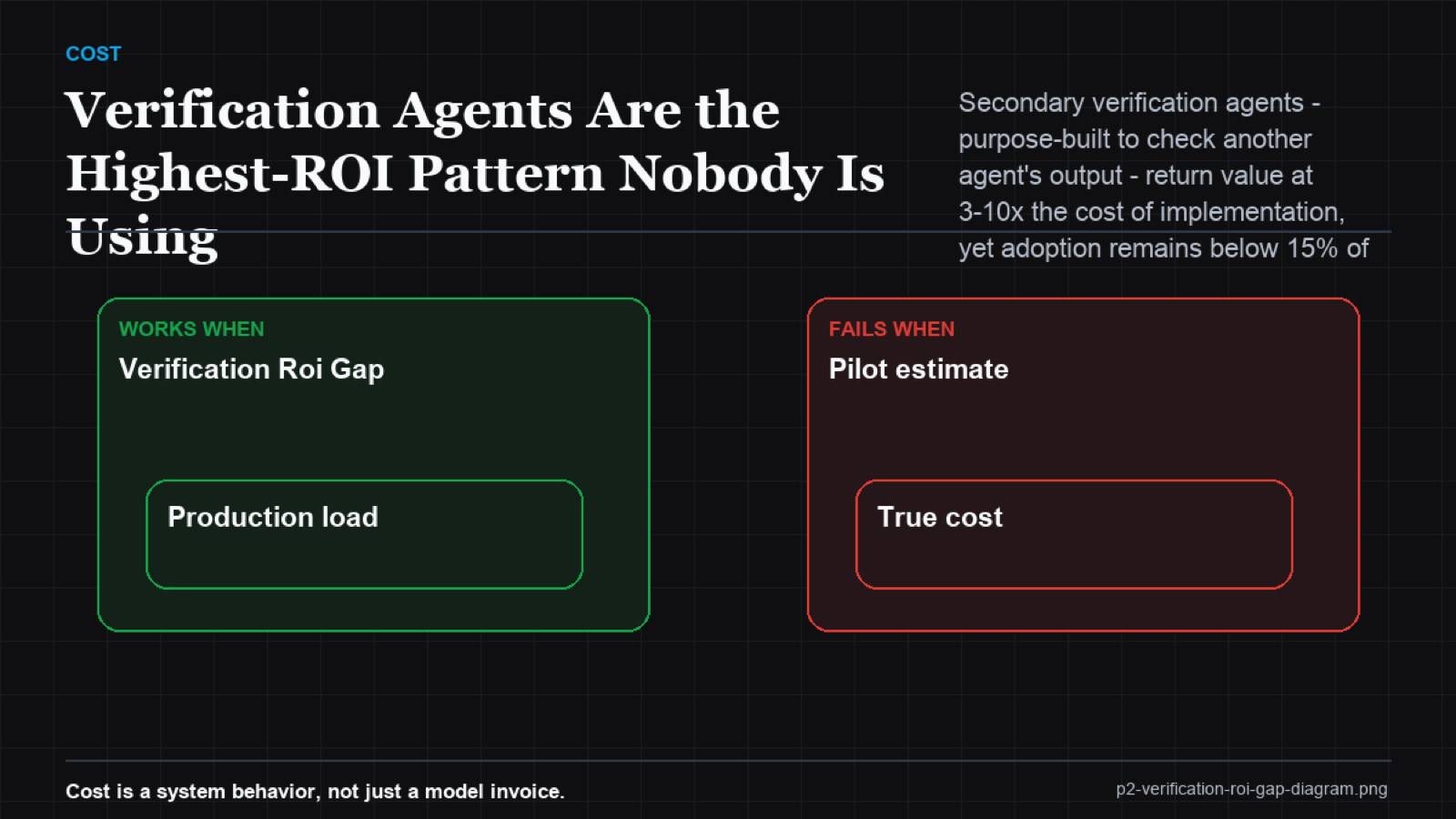
ROI drivers by deployment type
| Deployment type | Error amplification risk | Verification ROI driver | Expected incident reduction |
|---|---|---|---|
| Finance/billing automation | High (payment errors compound) | Dispute prevention | 60-70% |
| Customer comms automation | Medium (external visibility) | Reputation/trust | 50-65% |
| Internal workflow automation | Low-medium | Rework reduction | 40-55% |
| Data pipeline automation | High (downstream data integrity) | Data quality | 55-70% |
The Pattern Intelligence Layer treats secondary verification as a first-class pattern component, not an optional add-on. Every high-risk pattern ships with a verification agent specification - the acceptance criteria, the oracle connections, and the escalation path when verification fails. The 15% adoption rate in the field reflects teams building agents without patterns; teams building with the Pattern Intelligence Layer get verification by default.
Frequently asked questions
Is a stronger model a substitute for a dedicated verification agent?
Verification cuts incidents 67% in CSA data; a stronger model does not close that gap. (arXiv:2310.01798)