

Key facts.
- RLSR (arXiv:2505.08827) found that verification architecture independence significantly affects critique quality: architectures where the critic and generator share context or model weights show substantially lower error-detection rates than fully isolated critic architectures (RLSR, arXiv:2505.08827).
- The same model prompted to verify its own output shows a self-preference bias (arXiv:2410.21819): it tends to rate its own outputs as correct even when they contain detectable errors, because the verification prompt activates similar reasoning patterns to the original generation prompt.
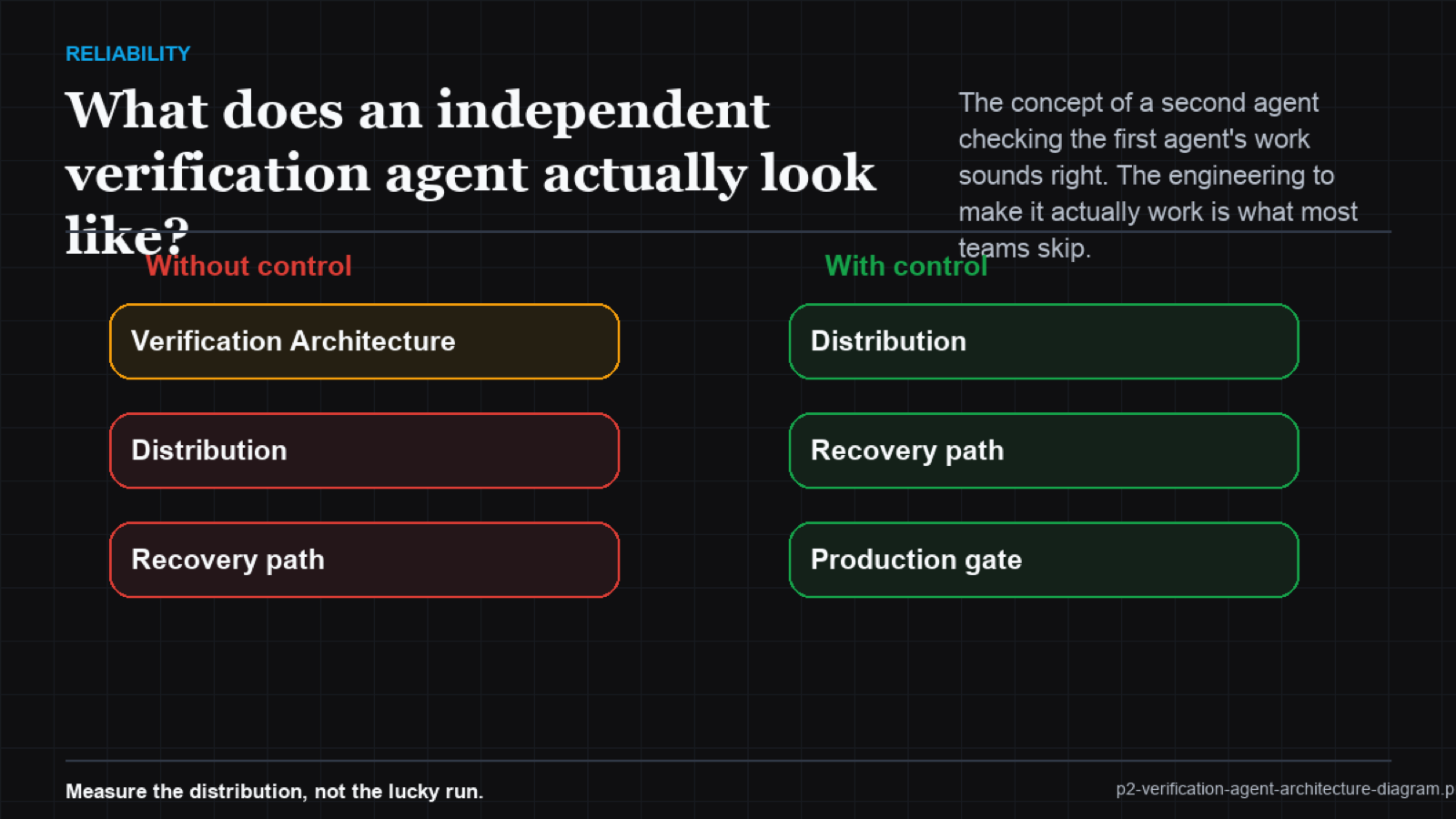
- Architectural independence for verification agents requires three separations: model isolation (different model or checkpoint from the generator), context isolation (verifier does not see the generator's reasoning trace, only the output and original specification), and inference isolation (separate API calls with clean context windows).
- Deterministic verification components - rule checkers, schema validators, business rule engines - provide higher verification reliability for well-specified constraints than LLM-based critics, because their failure mode is constrained (false negatives on novel violations) versus LLM critics, which also show false positives.
- Production verification architectures that achieve the highest reliability combine deterministic checks (schema, business rules) with probabilistic LLM critique for semantic correctness, rather than relying on either approach alone.
Why a second prompt is not an independent verifier
RLSR shows verification drops when critic and generator share a model; a better model graded by itself still misses what it missed. (arXiv:2505.08827)
The minimum viable version of verification is prompting the same model, in the same session, to check its own work. This catches the most obvious errors - typos, incomplete steps, logical contradictions - because the model can detect these when asked to look for them directly. What it does not catch is the class of systematic errors that were present in the original generation and are present in the verification for the same reason: the model's priors about what the task output should look like, its tendency toward self-preference, and the fact that the same reasoning patterns that produced the error are active during verification.
RLSR's finding is that architectural isolation changes the error detection profile. A critic that sees only the output and the original specification - not the generator's reasoning trace - catches errors that the generator's own verification misses, because it approaches the output without the anchor of the original reasoning path. This is the same principle that makes code review effective: the reviewer brings a fresh perspective that the author cannot replicate by self-reviewing.
The independent verification agent architecture
A properly independent verification agent has three properties. First, it receives only the output to be verified and the original specification - not the generator's prompts, reasoning steps, or intermediate outputs. This enforces epistemic independence. Second, it uses a separate inference call with a clean context window, ideally with a different system prompt or model, to avoid anchor effects from the generator's context. Third, its verification output is structured and actionable: specific claims about what passes, what fails, and why - not a summary judgment that requires the human to dig further.
The deterministic layer runs in parallel: schema validation, business rule checks, and constraint verification that the LLM critic does not need to cover. The combined verdict requires both the deterministic checks and the LLM critic to pass before the output is released to the user. This architecture finds the errors that neither component catches alone: the deterministic layer catches structural violations, the LLM critic catches semantic errors, and together they catch compound failures.
Verification architecture independence levels
| Independence level | Approach | Error detection rate | Engineering cost |
|---|---|---|---|
| None (no verification) | Single agent, no check | Baseline | None |
| Low (self-verification) | Same session, same model | Marginal improvement | Low (extra prompt) |
| Medium (context isolation) | New context, same model | Moderate improvement | Medium (extra API call) |
| High (full independence) | Different model + deterministic checks | Substantial improvement | Higher (separate infrastructure) |
VibeModel's Pattern Intelligence Layer provides the outcome data that tells you which verification architecture level is warranted for each of your agent's task types. For tasks where the same-session verification is catching 95% of errors, the additional engineering cost of full independence is not justified. For tasks where self-verification has a 40% miss rate on consequential errors, the full independent architecture is the correct investment. The pattern data makes that decision data-driven rather than architectural theory.
Frequently asked questions
Should the verification agent be a different LLM provider from the generator?
Not necessarily, but a different model checkpoint or fine-tune improves independence. The key is context isolation, not provider diversity. A differently-configured instance of the same model with a clean context window provides more independence than the same model instance in the same session, even if provider diversity adds marginal additional benefit.
What does "structured and actionable" output from a verification agent look like?
A JSON object with: a pass/fail verdict per specific criterion ("does the output address the original goal?", "are all required fields present?", "are all cited sources verifiable?"), a confidence score per criterion, and a specific failure description for any failing criterion that includes what was found versus what was required. Not a prose paragraph that buries the finding.
At what scale does it become cost-effective to run two LLM calls per task for verification?
The break-even depends on the cost of undetected errors for your task type. For tasks where an undetected error costs $1 in human remediation, two LLM calls at $0.01 each pay for themselves if they prevent 1 in 50 errors. For tasks where undetected errors have regulatory consequences, the break-even is much lower.